

By Sareer Ahmad
There was a time when a person could drive into a petrol station, fill his motorcycle or car, pay the bill and leave without thinking too much about it. Today, before filling the tank, people look at the price displayed on the pump, then look at their wallets, and sometimes simply say, “Put in enough to get me home.” That small moment tells us more about Pakistan’s fuel crisis than many official press conferences ever could. For millions of Pakistanis, petrol is not something they consume for pleasure. It is what takes them to work in the morning and brings them home at night. It takes children to school, patients to hospitals and small traders to markets. For a delivery rider, a motorcycle is his workplace. For a daily-wage worker, fuel can determine whether travelling to a job is financially worthwhile. So when the price of petrol rises, it is not merely a change on a government notification. It enters the household budget. It enters the kitchen. It enters the school-fee calculation. It enters the decision about whether a family can afford another trip to the doctor. And this is why the government’s current fuel policy deserves more than slogans about relief. It deserves an honest conversation.
Pakistan’s petroleum-pricing system has become increasingly difficult for an ordinary citizen to understand. International oil prices are one component. The exchange rate is another. There are freight and other costs, customs duties, the petroleum levy and now climate-related charges. The government has also moved toward much more frequent price revisions during the current period of international oil-market volatility. To be technically precise, it would be wrong to say that petrol has gone up by three or four rupees every single day. Prices have moved in both directions. On September 17, for example, petrol was actually reduced by Rs0.43 per litre while High-Speed Diesel increased by Rs3.47 per litre. Petrol stood at Rs390.79 per litre and HSD at Rs424.92. But ordinary people are not sitting at petrol pumps with calculators trying to distinguish between a daily increase and a daily revision. They know one thing: fuel has become painfully expensive.
And there is another part of this story that cannot be ignored. Petroleum is not only a product that Pakistanis buy. It is also a major source of government revenue. According to the federal government’s 2026-27 budget documents, the petroleum levy is expected to generate approximately Rs1.676 trillion during the financial year. The budget also includes Rs50 billion under the Climate Support Levy. These are not small figures. They run into hundreds of billions and trillions of rupees, and they demonstrate why petroleum taxation cannot be treated as a minor detail in the national fuel-price debate.
The significance becomes clearer when we look at the price paid at the petrol pump. On September 18, petrol was selling at Rs390.79 per litre after the latest revision. Earlier reporting on the government’s price structure showed that petrol carried substantial government-imposed taxes and duties. On September 16, for example, Dawn reported that the government was collecting Rs114 per litre in taxes and duties on petrol and Rs100 per litre on diesel. In other words, a substantial part of what an ordinary citizen pays at the pump consists not simply of the underlying petroleum product but of taxes, duties and other government-related charges. This is why the government owes citizens a transparent explanation of the entire fuel-price chain.
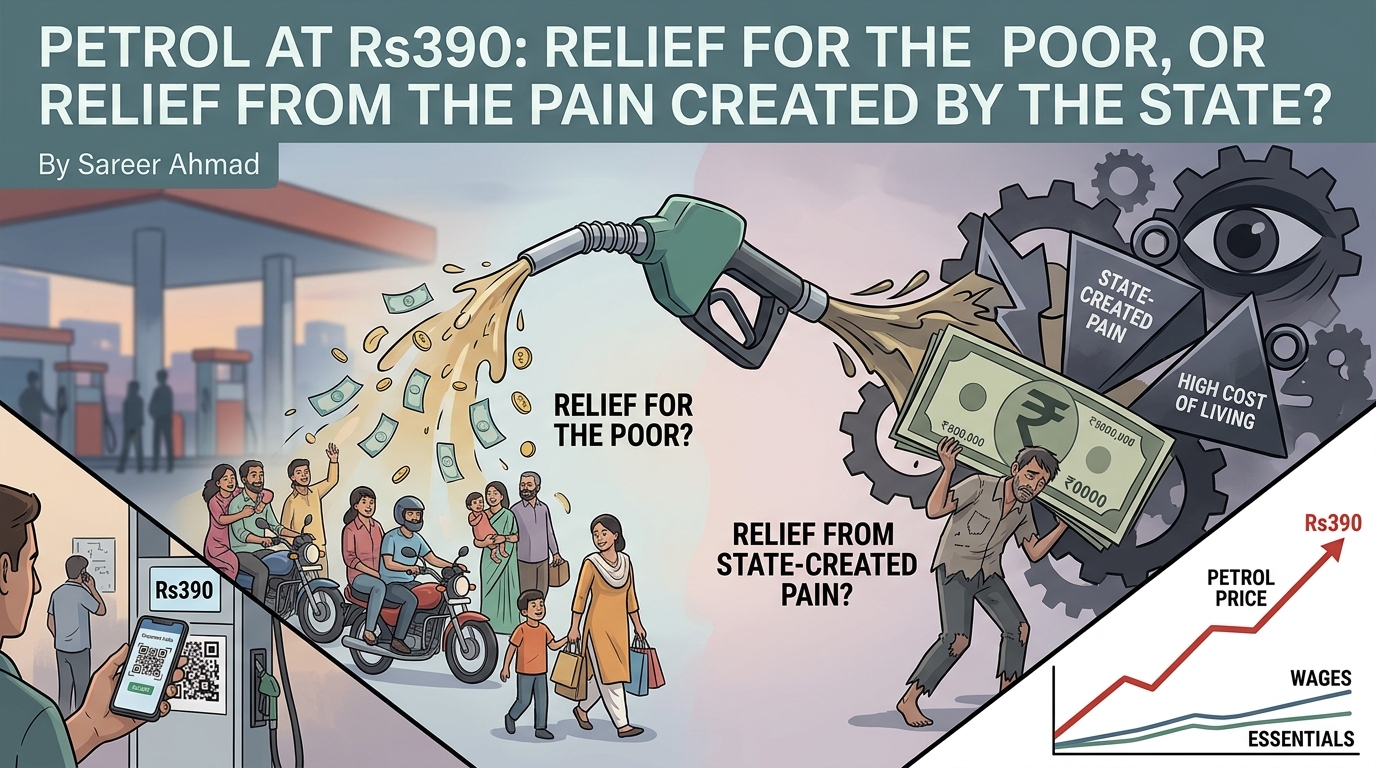
And then comes the relief. The federal government has launched the Prime Minister’s Fuel Relief Scheme, presenting it as a targeted response to the extraordinary increase in petroleum prices. Under the scheme, eligible users of motorcycles and other qualifying two- and three-wheelers receive relief of Rs100 per litre on up to 20 litres of petrol per month. Owners of cars up to 800cc receive the same Rs100-per-litre relief on up to 30 litres per month. The government has allocated Rs75 billion for the programme. There is no doubt that this relief can matter to a struggling household. A motorcycle user receiving the full entitlement can receive up to Rs2,000 in relief, while an eligible 800cc car owner can receive up to Rs3,000. For a household that is struggling to make ends meet, Rs2,000 or Rs3,000 is not an insignificant amount. It can buy groceries, pay part of a school bill, buy medicine or help with an electricity bill. The government is therefore justified in saying that the programme can provide some immediate relief to vulnerable households.
But there is another side of the story that deserves equal attention. The government expects to collect Rs1.676 trillion through the petroleum levy in the 2026-27 budget, while the fuel-relief programme has been allocated Rs75 billion. These two numbers should not be presented as if the Rs75 billion is literally being taken from the petroleum levy and returned to consumers; government revenues and expenditures do not work through such a simple one-to-one transaction. But the enormous difference in scale raises a legitimate question about the overall philosophy of the policy. When the state collects vast amounts of revenue from the petroleum sector and then gives a limited group of consumers a limited subsidy on a limited quantity of fuel, should that subsidy be presented simply as an extraordinary favour to the public? A government is entitled to collect taxes, and a government also has a responsibility to protect vulnerable citizens. Both things can be true at the same time. But citizens deserve to understand the complete picture. If the petroleum levy is necessary to finance the national budget, the government should explain that openly. If reducing the levy would create an unacceptable fiscal burden, the government should show the numbers. And if the government believes that targeted relief is more effective than reducing petroleum taxes for everyone, it should explain why. Citizens deserve the calculation, not merely the advertisement.
There is an important difference between making fuel cheaper and giving selected consumers a discount on a limited amount of expensive fuel. If the petroleum levy is reduced, the underlying price comes down for everyone. If a targeted subsidy is given, the underlying price can remain high while selected consumers receive compensation for part of their expenditure. There can be sound economic reasons for choosing targeted subsidies. In a country facing fiscal pressure, a government may decide that it cannot afford to subsidise every litre consumed by every person. Targeting assistance toward vulnerable consumers can reduce the fiscal cost. The government has made precisely this argument in defending its relief programme. But if targeted assistance is the preferred policy, the public deserves to see the evidence behind it. How many people will actually receive the subsidy? How much will the average beneficiary save? How many litres does the average motorcycle rider consume every month? How many beneficiaries will exhaust their quota before the end of the month? And what happens to them after that? These are simple questions. They should have simple answers.
For a daily commuter, 20 litres can disappear surprisingly quickly. Imagine a young man who rides his motorcycle to work every day. Perhaps he lives on one side of the city and works on the other. Perhaps he makes deliveries after office hours to earn some additional money. Perhaps his motorcycle is the only asset that allows him to earn a living. For him, petrol is not an optional expense. It is the cost of earning his salary. If he uses more than his subsidised quota, every additional litre is purchased at the prevailing price. The same applies to a family with an 800cc car. The government may provide relief on 30 litres, but families do not stop travelling after 30 litres. Children still need to go to school. Parents still need to go to work. Patients still need to visit hospitals. Grocery shops still need to be visited. Life does not operate according to a 30-litre government quota. The subsidy therefore does not fundamentally reduce the cost of transportation. It reduces the cost of a limited quantity of fuel for selected users.
There is also the bureaucracy surrounding the relief. The government has introduced a digital Fuel Pass system through which eligible citizens register their vehicles and receive fuel tokens. The registration process uses the 9771 SMS service, and the government says the system is intended to make the distribution transparent and prevent misuse. Digitisation can certainly help. But we should also remember the person at the other end of the system. Not everyone has the same level of digital literacy. Not everyone understands government procedures. Not everyone has a smartphone, reliable internet access or the time to navigate a complicated registration process. A worker who spends his entire day earning enough money to feed his family should not have to become an expert in government subsidy procedures simply to obtain a limited discount on petrol. The government says the process has been simplified and that registration SMS messages have been made free. That is welcome. But the larger question remains: why must the relief system be so complicated in the first place?
The answer becomes even more important when we look at diesel. Much of the public discussion is focused on petrol because motorcycles and small private vehicles are so common. But diesel is the fuel that keeps a large part of the productive economy moving. Trucks use diesel. Buses use diesel. Agricultural machinery uses diesel. Construction equipment uses diesel. Goods travelling from one city to another depend on diesel. When diesel becomes more expensive, the impact does not remain with the truck driver. It eventually reaches the consumer. The price of vegetables can be affected. The price of food transported from farms to cities can be affected. The cost of construction can be affected. The cost of moving goods can be affected. A person buying vegetables in a local market may never see the diesel price printed on the receipt, but a part of that transportation cost can already be inside the price he pays. That is why the fuel debate cannot be reduced to the question of whether a motorcycle owner receives Rs100 relief. The economy is much larger than the petrol pump.
The government, of course, has one powerful argument on its side: Pakistan does not control international oil prices. That is true. Pakistan imports petroleum, and international prices are affected by geopolitical tensions, conflicts, supply disruptions and global market conditions. The recent escalation of tensions in the Gulf has added another layer of uncertainty to energy markets. The government has responded with austerity and fuel-conservation measures as part of its response to the international shock. It would therefore be unfair to blame every increase in the price of petrol or diesel on the government. But there is a very important distinction: Pakistan cannot control the international price of oil. Islamabad can, however, explain and make policy choices about the domestic charges added to that imported fuel.
That is where transparency becomes essential. The public should be shown the complete price of a litre of petrol. How much is the international petroleum cost? How much is freight? How much is the exchange-rate impact? How much is petroleum levy? How much is the Climate Support Levy? How much is customs duty? How much goes to oil companies and dealers? And finally, how much does the consumer pay? There should be no mystery. If the government has good reasons for every charge, it should explain them. In fact, complete transparency would help the government itself. Because when citizens do not understand the price, they naturally assume the worst. And when they see the government collecting substantial petroleum revenue and then launching a highly publicised relief scheme, they understandably ask whether the relief is actually reducing the burden or simply giving back a small portion of what they have already paid.
This is where the politics of publicity enters the debate. There is nothing wrong with informing citizens about a welfare programme. People need to know that the scheme exists. They need to know whether they qualify. They need to know how to register and how to claim the benefit. But public information should not become a substitute for public accountability. If the government tells people about Rs100-per-litre relief, it should also tell them about the taxes and levies built into the price. If it tells them about the Rs75 billion relief package, it should also explain the broader petroleum revenue picture. If it tells them that it is helping the poor, it should also explain what portion of the fuel-price burden comes from international markets and what portion comes from domestic government charges. People can understand difficult economic realities. What people dislike is being given only half the story.
The ordinary Pakistani is not asking the government to perform a miracle. He knows the country is facing an economic crisis. He knows international oil prices can rise. He knows Pakistan has limited foreign exchange. He knows the government needs revenue. What he wants is an honest explanation. And perhaps more importantly, he wants some predictability. Because repeated fuel-price shocks change people’s behaviour. A father thinks twice before taking his children somewhere. A worker calculates the cost of commuting before accepting a job. A small shopkeeper thinks twice before making a delivery. A young person earning through a motorcycle starts calculating every kilometre. A family begins planning its month around petrol instead of food. This is the human cost that is often missing from official statements.
In government offices, a Rs3 increase is a number. At a petrol pump, it can be the difference between having enough money for dinner and having to cut something from the shopping list. That is why fuel policy needs to be discussed not only in terms of revenue and fiscal management but also in terms of human dignity. A citizen who pays taxes is not asking for charity when the government provides social protection. He is receiving a public service. The motorcycle rider who pays petroleum taxes is a citizen. The salaried employee who pays income tax and then buys taxed fuel is a citizen. The shopkeeper who pays taxes indirectly through his purchases is a citizen. The farmer whose diesel costs rise is a citizen. They are not standing before the state with an empty hand. They are contributing to the state every day.
So perhaps the language of “relief” needs to change. The government should not present assistance to vulnerable citizens as an act of personal generosity. It should present it as what it really is: public policy designed to protect citizens during an economic shock. That would be more dignified. It would also be more honest.
Pakistan needs a fuel policy that an ordinary citizen can understand without needing an economist sitting beside him. The government should publish a simple monthly—or, if prices are changing daily, weekly—breakdown of the fuel price. Every major component should be visible. Citizens should be able to look at the price of a litre and understand where their money is going. They should also be able to see how much petroleum revenue the government is collecting and how much is being spent on targeted relief. And the government should publish the results of the relief programme: how many people registered, how many actually received the subsidy, how much was distributed, and what the average household actually saved. That would be meaningful accountability.
The current international oil shock is undoubtedly influenced by international events. The government is not responsible for every increase in the global price of oil. Nor is every part of the petrol price determined by Islamabad. But that does not remove the government’s responsibility to explain the domestic components of the price honestly and clearly. The same principle applies to the relief programme. The Rs75 billion allocation may provide genuine assistance to vulnerable households. For some families, it may make a real difference. That should be acknowledged. But relief should not become a substitute for a transparent fuel policy.
The government should not merely tell people that it is giving them Rs100 relief. It should also tell them why they are paying nearly Rs391 per litre in the first place. It should explain what portion of that price comes from international petroleum costs and what portion comes from domestic taxation and charges. It should explain why the petroleum levy is necessary. It should explain why targeted relief is preferable to a reduction in the levy. And above all, it should publish the complete arithmetic.
Because the ordinary Pakistani does not need another slogan. He needs an answer. He needs to know how much of every rupee he pays at the petrol pump is the genuine cost of fuel, how much goes to the government, and how much comes back to him in the form of relief. That is the real issue. The question is not whether the poor deserve relief. They do. The question is whether the state’s fuel policy is designed in a way that genuinely reduces the burden on ordinary citizens, or whether citizens are being asked to celebrate a limited subsidy while continuing to carry a much larger burden through petroleum taxes and levies.
That is a question the government should answer with numbers, not advertisements. Because the people of Pakistan do not need a favour. They need fairness. They need transparency. And they deserve to know exactly what they are paying for every litre of fuel they put into their tanks.
— Sareer Ahmad