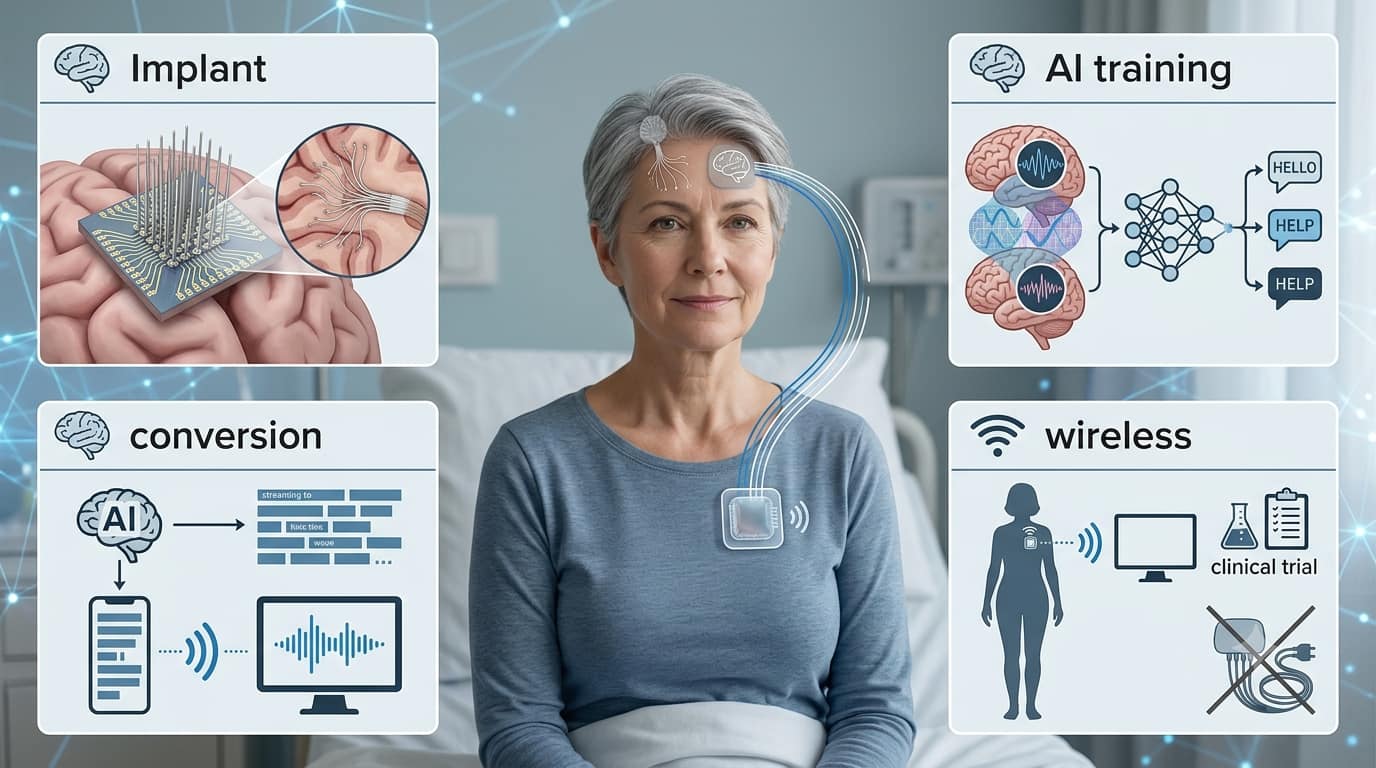
<p><span dir="auto">Paralysis or neurological disease makes it extremely difficult for many people to speak, even though their minds retain the ability to express themselves. For such people, scientists are working on brain-computer interfaces (BCIs). In this approach, neural signals from the brain are recorded, interpreted using artificial intelligence and machine learning, and then converted into words or sounds. In 2026, the first wireless and fully implantable BCI was implanted in a human in the United States and is being tested on patients with speech impairments.</span></p>
<h2><strong><span dir="auto">First, A Special Implant Is Placed In The Brain</span></strong></h2>
<p><span dir="auto">The first part of this technology is a brain implant. This involves implanting very tiny electrodes. For example, Paradromics’ Connexus BCI contains 421 microelectrodes that record various neural activities in the brain. These are specifically implanted near areas that generate signals related to speech and body movements. When the patient attempts to speak, or in some cases, even thinks about speaking, the signals generated in the brain reach these electrodes.</span></p>
<p><span dir="auto">ALSO READ | </span><a href="https://news.abplive.com/lifestyle/why-do-some-people-talk-in-their-sleep-know-the-causes-and-triggers-1867421" target="_blank" rel="noopener"><strong>Why Do Some People Talk In Their Sleep? Know The Causes And Triggers</strong></a></p>
<div class="mid-taboola">
<h2 id="taboola-mid-article-personalisation-3190087" class="trc_related_container tbl-trecs-container trc_spotlight_widget"><strong>Brain Signals Are Understood By Computers </strong></h2>
</div>
<p><span dir="auto">Simply receiving signals from the brain isn’t enough, as these signals aren’t directly understood by computers like words. To achieve this, machine learning models are trained to understand the relationship between a patient’s brain signals and the words they’re trying to say. In both past and recent BCI experiments, patients were asked to silently attempt to speak while their brain signals were recorded. The AI then learned to associate different neural patterns with words and sounds.</span></p>
<p><span dir="auto">ALSO READ | </span><a href="https://news.abplive.com/health/doc-talk-cough-mimicking-tb-or-pneumonia-know-when-a-fungal-infection-could-be-the-clue-1867415" target="_blank" rel="noopener"><strong>Doc Talk | Cough Mimicking TB Or Pneumonia? Know When A Fungal Infection Could Be The Clue</strong></a></p>
<h2><strong><span dir="auto">Signals Are Converted Into Text Or Voice</span></strong></h2>
<p><span dir="auto">Once the system has received sufficient training, the patient attempts to speak, and the implant records their brain signals. The computer then decodes these signals, converting them into words and generating text or synthetic voices as needed. A study launched in 2025 produced streaming speech by decoding a woman’s brain signals at 80-millisecond intervals. Another experiment created a voice for a person with ALS that closely resembled their previous speaking voice.</span></p>
<h2><strong><span dir="auto"> What Will Change With Going Wireless?</span></strong></h2>
<p><span dir="auto">The advantage of wireless BCIs is that they can reduce the reliance on wires running through the body to transmit signals from electrodes implanted in the brain to an external computer. In 2026, the University of Michigan Health performed the first human implant of Paradromics’ Connexus BCI. In this device, brain signals are transmitted first to a small transceiver in the chest and then to an external receiver. This technology is currently in clinical trials, aiming to test whether it can safely help people with speech impairments communicate long-term. This means it is not a standard treatment yet, but a rapidly developing medical technology.</span></p>
<p><em><strong><span dir="auto">[Disclaimer: The information provided in the article is intended for general informational purposes only. It is not a substitute for professional medical advice, diagnosis, or treatment. Always seek the advice of your physician or other qualified healthcare provider with any questions you may have regarding a medical condition.]</span></strong></em></p>
The post Brain Implant Can Turn Thoughts Into Speech? Know How Wireless BCI Technology Works appeared first on Doc Talk | Protein Craze In India: Why More Protein Doesn't Always Mean A Healthier Diet.