

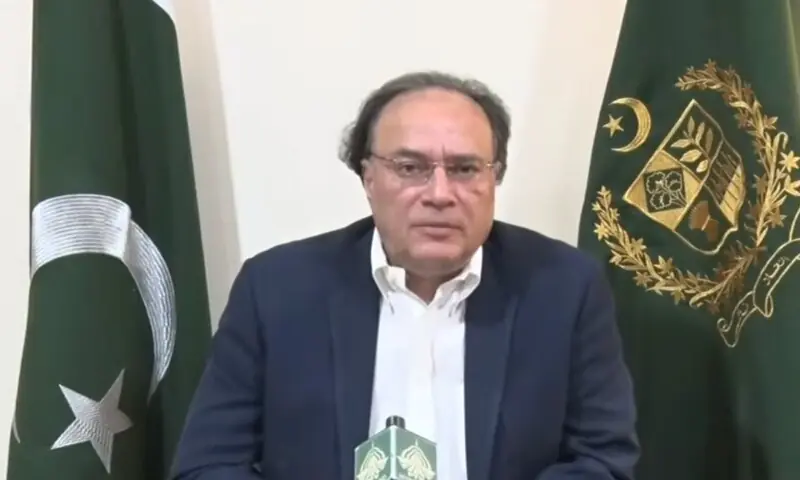
Finance Minister Muhammad Aurangzeb warned on Sunday that protests and sit-ins would result in a daily loss of around Rs120 billion, citing research findings.
His warning came ahead of separate marches to Islamabad by PTI and Jamaat-i-Islami (JI), the latter having already departed Karachi. The government has vowed to stop any march on the federal capital “in every possible way”.
The PTI has announced a nationwide protest on September 27 to demand the release of party founder Imran Khan and mobilise people for the supremacy of the Constitution, while the JI aims to press the government to end the fuel levy.
In his televised recorded message on Sunday, Aurangzeb said the protests and sit-ins, when seen against the backdrop of the economic hardships resulting from the Middle East conflict, would be a “self-inflicted pain”.
The finance czar said that supply chain disruptions and increased freight and insurance costs were arising from Middle East tensions. He also recalled the recent Kohat bombing, noting a fresh wave of terrorism in the country.
Within this context, he said, “In the past few days, along with the economic wing of our planning commission, we have held consultations on the results of protests and sit-ins on the economic progress we have sustained through difficult decisions.”
Taking previous instances and the present situation into account, he said the planning commission had estimated that the proposed protests will cause “a loss of Rs120bn daily, and this is based on very good research”.
He noted that the services sector — including financial services, communication, retail, transportation, wholesale and hospitality — was estimated to take the biggest hit, with a loss of Rs86bn.
In the industrial sector, the loss was estimated to be Rs25bn, the finance minister said, adding, “This includes construction, finished goods, raw material and supply chain”.
Meanwhile, the agriculture sector will suffer a loss of Rs9bn, he said.
Aurangzeb estimated an additional Rs17bn revenue loss if the proposed protests were to go ahead.
He also noted the “burden of a high cost on the national treasury” within the context of logistics, transport, fuel, and security deployment used in response to the previous protests and sit-ins.
Aurganzeb noted that an emphasis was often placed on promoting export-led growth, noting that the target for the current fiscal year stood at $35.9bn “and there is a six per cent increase expected”.
“We have been on trajectory for the first two months,” he said.
Within this context, the finance minister recalled a strike in December 2025 and said, “It took us 1.5 months to recover” from the resulting economic losses.
He recalled a similar instance in August, noting that “such disruptions could severely harm our growth trajectory, and this is on top of the situation in the Middle East in Hormuz and Bab al-Mandeb”.
Aurangzeb also spoke of the economic impact on Information Technology (IT) exports resulting from civil disobedience.
“In July and August, our IT exports have been $811 million, with $13m daily,” he said. Aurangezeb expressed concern that internet connectivity issues from acts of civil disobedience previously “impacted IT exports by 80pc”.
“So, as you can see, aside from goods and services, this will be a big setback if we go towards these long marches and sit-ins,” he said.
The finance minister urged that it be taken into account that the resulting “economic burden” would ultimately be borne by the common man, labourers, small traders, and daily wagers.
“I am requesting you that this is very hard-earned macro stability and now [it is] moving towards growth; many difficult decisions were made, and our economy, after a long time, is on track.”
Aurangzeb urged that outstanding issues be resolved with dialogue, stressing that it was his responsibility as finance minister to present “ to everyone the facts, figures and possible downside” of the “self-inflicted pain”.
Meanwhile, in a press conference later in the day, Information Minister Attaullah Tarar, when asked about PTI’s planned protest and the possible disruption caused by it, said the matter had both administrative and legal aspects.
Tarar referred to the Islamabad High Court’s (IHC) recent ruling on the protest and said the court had “clearly ruled” against road closures and traffic disruption. He added that now it was the administration’s responsibility to ensure that.
“No violent group will be allowed to reach Islamabad.”
“On this, the administration, police, interior minister and entire government are absolutely clear,” Tarar said. “They will not even be allowed to reach (Islamabad), so the roads will of course remain open.”
Security arrangements in capital reviewed; Pims on ‘high alert’
Ahead of the potential long marches, Islamabad police chief Sohail Chaudhry and Chief Commissioner Mohammad Usman reviewed security arrangements at major entry and exit points and other key locations, APP reported.
Hundreds of containers have been placed at the city’s entry points as the administration braces for back-to-back protests.
During the visit, the chief commissioner said maintaining law and order was a top priority and stressed that citizens, traders, businesses, professionals and government employees should be able to carry out their lawful activities without unnecessary disruption.
Furthermore, police officers in the Security Division were given a “special briefing” on dealing with emergencies, Islamabad police said on X.
Deputy Superintendent of Police (DSP) Mukhtiar Bugti directed the personnel to remain vigilant and prepared at all times for security arrangements and dealing with unpleasant situations.
DSP Bugti also briefed personnel deployed in the “high-security zone”, the police said, adding that “all possible resources” were being utilised to maintain law and order.
Separately, the Pakistan Institute of Medical Sciences (Pims) and Federal Government Polyclinic Hospital were placed on “high alert”, according to separate notifications, copies of which are available with Dawn.
The Pims circular directed its officers and staff to “remain vigilant, readily available and fully prepared to respond in case of emergency call”. Superintendent transport was urged to ensure ambulance availability round the clock during the “high alert” period until September 30.
The hospital directed that emergency, ICU, operation theatre, trauma, nursing, diagnostic, blood bank, pharmacy and other critical services would remain “fully operational with adequate backup arrangements”.
“All concerned are directed to make all necessary arrangement readily in case of mass casualty situation/surge,” the circular said.
“Emergency and ambulance access routes shall remain clear at all times,” it added.
PTI, JI protests
The finance minister’s appeal for dialogue comes amid proposed protests announced by political parties — PTI and JI — in the coming days.
A petition in the IHC was filed earlier this month against the PTI protest, on the grounds that the activity could disrupt routine life, traffic and business activities in the federal capital. In its ruling, the IHC held that no political party or its leadership had the “lawful right to occupy public roads, highways, interchanges, toll plazas and buildings in Islamabad”.
No political party or political leader had the right to obstruct the free movement of citizens, the Sept 14 court order read.
On Friday, following the IHC judgement, Interior Minister Mohsin Naqvi warned that the government would stop anyone from marching towards the federal capital “in every possible way”.
The administrations of the twin cities of Rawalpindi and Islamabad had already begun preparations last week to counter the PTI’s announced march to the capital, including a request for the detention of activists, arranging containers, seeking additional personnel and procuring anti-riot gear.
Meanwhile, JI launched its protest march towards Islamabad today.
JI chief Hafiz Naeemur Rehman, speaking at a rally earlier today, warned that if the government failed to abolish the petroleum levy, the JI’s protest could turn into one to oust the government.
The government levies Rs114 per litre in taxes and duties on petrol and Rs100 per litre on diesel. JI has been staging regular sit-ins in Lahore, Peshawar, Karachi and dozens of other locations across the country since August 16 to protest the levy.
The post 'Self-inflicted pain': Finance minister says protests, sit-ins to cause daily loss of around Rs120bn appeared first on Dawn – Home.