

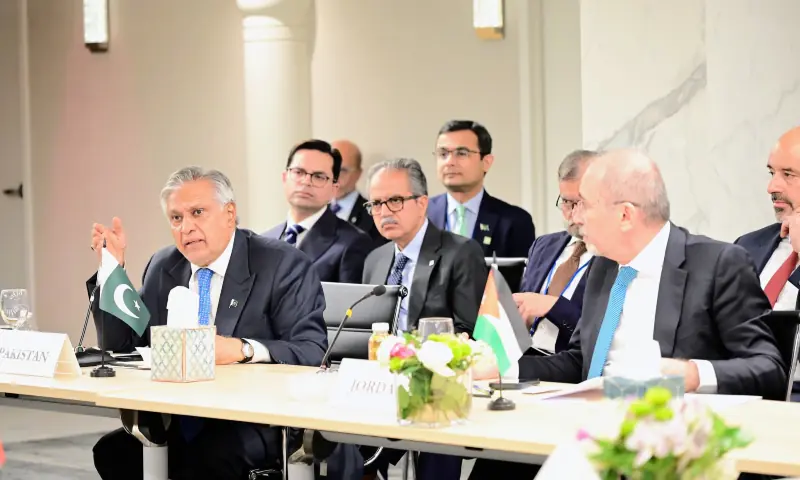
Pakistan joined other Muslim countries on Tuesday in calling for Israel to “immediately fulfill its outstanding commitments” under the first phase of a plan aimed at ending the conflict in Gaza.
The demand was made in a joint statement attributed to the foreign ministers of Pakistan, Egypt, Turkiye, Indonesia, Jordan, Qatar, Saudi Arabia and the United Arab Emirates after they met on the sidelines of the 81st session of the United Nations General Assembly in New York.
The statement said that as part of its commitments under the Gaza plan, Israel should ensure the immediate, safe and unhindered delivery of humanitarian assistance and early recovery supplies, as well as facilitate the rehabilitation of critical infrastructure.
The ministers stressed the “imperative of preserving the ceasefire and ending all violations”.
They emphasised that the road map for completing the implementation of the of the Gaza plan was an “integral part” of the plan and provided the framework for implementation to advance its second phase.
This included “decommissioning alongside full Israeli withdrawal, the deployment of the International Stabilisation Force (ISF), the assumption by the National Committee for the Administration of Gaza (NCAG) of its responsibilities throughout the Gaza Strip, and the launch of early recovery and reconstruction across Gaza”, the statement read.
The ministers called on all parties to fulfill their respective commitments “in good faith and without delay” under the plan.
They further reiterated their “categorical rejection of any measures aimed at the expulsion or the forced displacement of the Palestinian people from their homeland or attempts to alter the territorial or demographic character of the Occupied Palestinian Territory”.
“They deplore in this context the illegal measures aimed at consolidating Israeli control and annexation, including the accelerating settlement expansion, land confiscation, demolition of Palestinian homes, settler violence and terrorism, and forced displacement, and called for their immediate reversal,” the statement said.
The ministers additionally expressed grave concern over measures that undermined the historical and legal status quo of Muslim and Christian holy sites in Jerusalem.
Moreover, they welcomed the recent measures taken by the United Kingdom in response to “illegal Israeli settlement activity, as well as broader national and European efforts, including measures to halt trade with illegal Israeli settlements”.
The ministers called for further effective measures to end the expansion of settlements and ensure accountability for settler violence.
They also emphasised that Gaza remained an integral part of the Palestinian territory.
The ministers reaffirmed that the implementation of the Gaza plan must contribute to the reunification of the West Bank, including East Jerusalem, and the Gaza Strip, and to a “credible and irreversible pathway towards the exercise of the Palestinian people’s right to self-determination and the realisation of a sovereign, viable, and independent Palestinian State with East Jerusalem as its capital” through the implementation of the two-state solution.
They commended the leadership of US President Donald Trump and highlighted the role of the US in ensuring the implementation of the Comprehensive Plan. They called for “sustained and active” US engagement to ensure that all parties fulfilled their commitments, and to overcome obstacles to the implementation of the road map.
“Tangible progress on the ground will strengthen the credibility of the Board of Peace and the authority of the plan and create deeply needed momentum,” the joint statement said.
The eight ministers reaffirmed their readiness to continue working collectively with the US, the Board of Peace, the Palestinian Authority and all relevant parties to advance the full implementation of the Comprehensive Plan and its road map, alleviate the suffering of the Palestinian people, fulfill their right to self-determination and independent statehood, and “achieve just, lasting and comprehensive peace in the region”.
Much of Gaza remains in ruins from two years of relentless Israeli bombing that began on Oct 7, 2023.
After a ceasefire deal was struck in October 2025, Trump set out a 20-point peace plan for Gaza that provided for a the supply of humanitarian aid, civilian administration by Palestinian technocrats, Hamas laying down its arms and Israeli forces withdrawing.
But the plan has stalled and the group of technocrats — known as the National Committee for the Administration of Gaza — has remained outside Gaza.
Meanwhile, Israel rejected in August a plan — the latest stage in a US-led ceasefire announced in October — that said Hamas would surrender weapons to a nascent Palestinian governing body.
The plan was endorsed by Hamas in July.
After more than a week of gradually escalating criticism of the plan, Israeli Prime Minister Benjamin Netanyahu explicitly opposed it as he faced pushback from his right-wing base ahead of elections.
The Israeli military “will not carry out any withdrawal until Hamas is genuinely disarmed and will continue to thwart threats against our forces and our citizens”, Netanyahu said at a cabinet meeting.
OIC meeting
Deputy Prime Minister and Foreign Minister Ishaq Dar also attended a meeting of the Organisation of Islamic Cooperation (OIC) on Monday where he called for urgent global attention to Israeli settler violence and annexation policies in the occupied West Bank, as well as violations of the Gaza ceasefire, describing such acts as “flagrant violations of international law”.
Speaking at the meeting of the OIC Committee of Six on Palestine in New York, Dar said the Palestinian cause remained “central to the OIC and the collective conscience of the Muslim Ummah”.
“The Committee of Six has an important responsibility to mobilise political and diplomatic support for the Palestinian people and to ensure that the international community does not lose sight of their legitimate and inalienable rights,” he noted.
He said the situation in the occupied Palestinian territory, both in Gaza and the West Bank, continued to demand “urgent and immediate attention”, with the humanitarian situation remaining dire and the security environment “extremely fragile”.
“Our recent diplomatic efforts have created an opportunity to advance a critical process. Serious challenges still remain,” Dar said, adding that the Gaza ceasefire was being violated “on an almost daily basis”.
He appreciated the efforts of mediating countries, including the United States, Egypt, Qatar and Turkiye, towards implementing the comprehensive plan to end the Gaza conflict, as endorsed by UN Security Council Resolution 2803.
Dar said Israeli settlement activity, settler violence, annexation policies and other violations in the West Bank, including East Jerusalem, continued to threaten the “territorial integrity and contiguity” of the occupied Palestinian territory and undermine the viability of a future Palestinian state.
Pakistan, he said, continued to “strongly condemn” Israeli violations at Al-Aqsa Mosque and Al-Haram Al-Sharif, including incursions by extremist settlers.
“These acts are flagrant violations of international law, relevant UN resolutions, and the historical and legal status quo governing the Holy Sites,” he said.
Dar said the ongoing situation required “renewed, coordinated diplomatic action” by the OIC and its member states, adding that the committee should continue to work on six points.
The first was to safeguard the historical and legal status quo at Al-Aqsa Mosque, Al-Haram Al-Sharif and other Islamic and Christian holy sites in Jerusalem.
Second, reject Israel’s illegal settlement expansion, annexation, settler violence and forced displacement in the occupied Palestinian territory, including East Jerusalem.
Third, support the full and faithful implementation of the Gaza peace plan and UN Security Council Resolution 2803.
Fourth, ensure that reconstruction and governance arrangements in Gaza remain Palestinian-led, with a central role for the Palestinian Authority.
Fifth, support accountability for violations of international law and international humanitarian law; further strengthen coordination among OIC member states in other international forums to protect the Palestinian people and uphold international law.
Finally, maintain sustained international efforts towards a credible, irreversible and time-bound political process leading to the establishment of an independent, sovereign and contiguous State of Palestine based on the pre-1967 borders, with Al-Quds Al-Sharif as its capital, while also supporting Palestine’s full membership of the United Nations.
“As members of the OIC Committee of Six, we have a particular responsibility to translate our collective solidarity into sustained and coordinated diplomatic efforts,” Dar stressed.
“Pakistan’s solidarity with the Palestinian people remains steadfast and unwavering. We will continue to work with brotherly and partner countries to advance the Palestinian cause and contribute to a just and lasting resolution of the question of Palestine, in line with international legitimacy,” he affirmed.
The Foreign Office (FO) later shared a statement outlining DPM Dar’s remarks at the meeting.
The remarks come amid renewed Israeli settlement expansion and rising settler violence in the occupied West Bank.
Israel has recently added 2,167 housing units to its E1 settlement plan, bringing the total planned units to 3,401, a move that Palestinians and several countries have criticised as threatening the territorial contiguity of a future Palestinian state.
The UN has also reported a sharp rise in settler attacks. More than 1,600 incidents resulting in Palestinian casualties or property damage were recorded across 275 communities between January and September 14, while more than 2,600 Palestinians had been displaced in the context of settler violence and related access restrictions.
R-4 meeting
Dar also participated in the ministerial meeting of the Regional-4 (R-4) group in New York on Tuesday. He was joined by the foreign ministers of Turkiye, Saudi Arabia, and Egypt.
The R-4 group has been focused on regional security and emerged in March amid efforts for mediation between the US and Iran.
As the group met in New York, DPM Dar reaffirmed “Pakistan’s strong commitment to the R-4 framework and expressed the need for continued engagement for enhancing regional peace and prosperity”, the Foreign Office (FO) said in a statement.
It added that the participants exchanged views on the latest situation in the region and expressed full support for efforts aimed at a peaceful resolution of the situation.
“The ministers reiterated their support for the legitimate rights of the Palestinian people, including their inalienable right to self-determination and to establish an independent, sovereign, viable, and contiguous State of Palestine on the basis of 4 June 1967 lines, with East Jerusalem as its capital, in accordance with relevant United Nations Security Council resolutions,” it read.
A statement issued by the Permanent Mission of Pakistan to the UN said that the ministers’ consultative meeting on Sept 21 on the sidelines of the session also discussed recent regional and international developments.
The group reaffirmed the importance of continued consultation and coordination between their countries to support peace, security, stability and prosperity in the region at large. They expressed deep concern over continued tension and hostilities in the region.
“The ministers underscored that dialogue and diplomacy remain the only path towards sustainable resolution, and in this context they underscored the need for upholding the Islamabad Memorandum of Understanding for lasting peace and stability,” the statement said.
They also condemned all attacks against Saudi Arabia including those by Yemen’s Houthis, reaffirming their support for the Kingdom’s sovereignty, security and territorial integrity as well as its right to defend itself.
They also stressed the importance of safeguarding the safety and freedom of maritime navigation, the statement said.
The ministers reaffirmed their support for “the legitimate Yemeni government and the Presidential Leadership Council in their efforts to achieve security, stability and development in Yemen through a political process and an inclusive Yemeni-Yemeni dialogue involving different parties”. They agreed to maintain close coordination and continue their consultations with an eye on strengthening collective security and promoting long-term regional stability.
Dar meets with Libyan FM
Separately, in a meeting with Libya’s acting foreign minister, Al-Taher Al-Baour, Dar discussed ways to further strengthen bilateral ties, particularly in trade, education and business-to-business exchanges, FO said in a statement.
During the meeting, which took place on the sidelines of the 81st session of the UN General Assembly, the two sides exchanged views on “regional and international developments, including the evolving situation in the Middle East”, FO said.
The Libyan foreign minister appreciated Pakistan’s “constructive diplomatic efforts” for regional peace and stability, according to the FO.
DPM Dar underscored that “dialogue and diplomacy remained the only viable means of addressing regional challenges” and stressed the need for all parties to return to the Islamabad Memorandum of Understanding (MoU) to advance regional stability, the statement added.
Dar meets with Japanese FM
Dar also held a meeting with Japanese Foreign Minister Toshimitsu Motegi, during which the two discussed ways to further deepen bilateral cooperation, particularly in trade and investment, education, health, the automobile sector and digital IT cooperation, the FO said in a statement.
They also exchanged views on “regional and international developments, including the situation in the Middle East”.
Motegi appreciated Pakistan’s diplomatic and mediation efforts in support of regional peace and stability, the FO added.
Both sides expressed hope that all parties would return to dialogue and pursue implementation of the Islamabad MoU. They also discussed the implications of the situation for energy supplies, supply chains and the global economy, according to the FO.
The two ministers reaffirmed their commitment to sustaining the momentum of bilateral engagement and further expanding cooperation in areas of mutual interest, the statement added.
The post Pakistan, 7 other Muslim nations call upon Israel to fulfil its commitment under Gaza plan appeared first on Dawn – Home.