On July 27, 2026, a family had gathered to celebrate a birthday when their three-storey home in Lahore’s Harbanspura locality folded in on itself, one storey after another, killing 11 and injuring six. In an instant, the celebrations turned into panic and horror.
Less than a month earlier, on June 30, a residential building that also served as a tuition centre in Lahore’s Kahna town, had collapsed, killing 14 children. The youngest of them was five years old.
The fact that both incidents occurred in Lahore, within weeks of each other at the height of the monsoon rains, brings two basic questions into sharp focus: can the homes of low-income families withstand shocks and is Punjab’s housing policy, which is centred largely on new construction, doing enough for the fragile, rickety homes that vulnerable households call ghar [home]?
It is a cruel irony that the rains that bring relief from the summer heat can also threaten the very shelter meant to protect families. Heavy rainfall can weaken walls, bring down roofs and, in the worst cases, leave families searching through rubble for those they love.
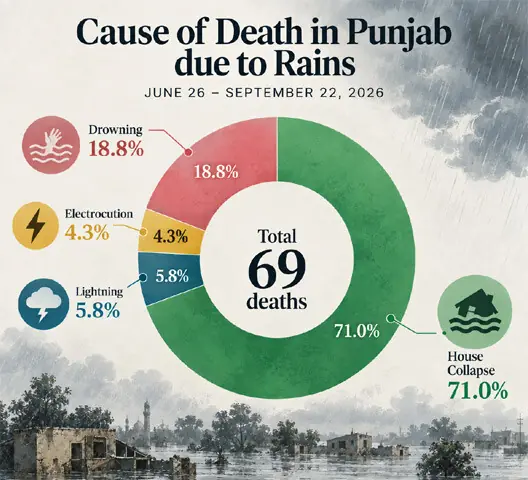
This season, across Punjab, successive spells of rain between June 26 and September 22 have claimed 69 lives and injured another 392, according to the National Disaster Management Authority (NDMA). Among those killed were 29 men, 12 women and 28 children. It is reported that 71 percent of these deaths — 49 people — have occurred due to houses collapsing. Some 104 houses have been destroyed and 122 partially damaged across Punjab.
During the 2025 floods, Punjab recorded the highest housing losses in the country, with 55,134 houses completely destroyed and another 157,963 partially damaged.
Against this backdrop, the Punjab government’s Apni Chhat Apna Ghar (literally: Own Roof, Own Home; ACAG) programme, its construction-loan design and ambitious claims are drawing scrutiny from housing experts and developers over whether the policy will ultimately translate into adequate, safer and accessible homes for those who need them most.
The collapse of homes during Punjab’s monsoon season has exposed how vulnerable low-income families are and raised questions about the province’s affordable housing policies. As the Punjab government expands housing construction programmes and loans, experts and developers question whether building homes is enough if issues such as structural safety, infrastructure and accessibility are not addressed
TACKLING THE HOUSING PROBLEM
Soon after the Kahna tragedy, Punjab Chief Minister Maryam Nawaz launched the ‘Apni Chhat, Mahfooz Chhat’ [Own Roof, Secure Roof] programme in July. The director-general of the Punjab Housing and Town Planning Agency (PHATA), Sikandar Zeeshan, tells Eos that the programme offers interest-free loans of up to Rs500,000 for constructing additional rooms, repayable over nine years in monthly instalments of approximately Rs4,700; Rs500,000 for roof repairs, on the same repayment terms, while Rs1,000,000 is offered for constructing an additional floor, with monthly instalments of approximately Rs9,500.
The initiative is an extension of the Punjab government’s flagship ACAG programme, launched in August 2024, under which low-income households owning plots of up to five marlas in urban areas and 10 marlas [one marla is 272.25 square feet] in rural areas can obtain interest-free loans of up to Rs1.5 million to construct homes.
It requires applicants to provide a valid computerised national identity card (CNIC), own or occupy an eligible plot or house, have no criminal record and provide two non-family guarantors. Applicants also undergo a social appraisal before a loan is approved.
Zeeshan claims that the ACAG programme has revolutionised the whole ecosystem of house-building in Punjab, stating, “In merely two years, 200,000 families have benefitted and, by 2028, 300,000 will benefit from the programme. It may not solve the housing problem completely, but we are confident that no previous low-income housing programme has delivered as much as Apni Chhat Apna Ghar.”
In May 2026, Maryam Nawaz had echoed similar claims, by announcing that more than 100,000 houses had been completed under the ACAG programme, with another 600 to 700 houses being constructed each day.
But experts and developers are questioning the scale, design and the evidence base of the ACAG programme. They ask: was there a comprehensive, province-wide assessment of how many households needed housing assistance and what form that assistance should take? Will the assistance improve housing conditions and reach those most in need?
Jawad Aslam, founder and CEO of the Ansaar Management Company, a social-enterprise developer focused on affordable housing, says, “I find it difficult to believe that 100,000 affordable houses have actually been delivered. While some projects have certainly been completed, I have yet to see evidence of housing being delivered on anything close to the scale claimed publicly.”
On the ground, the picture is more complicated. While the people for whom the programme is intended are aware of the schemes, many still remain apprehensive about applying for the loans. Samina, a domestic helper, says, “For a person earning 40,000 rupees a month, repaying nearly 14,000 rupees a month in instalments is impossible.” Faisal, who works as a sports coach at an elite club, says, “These loans are approved for only those with jaan pehchaan [connections].” Clearly, scepticism remains widespread and, whether well-founded or not, may be a barrier to the very people the schemes are designed to reach.
Their doubts are rooted in a longer history of housing schemes that have failed to deliver on their promises.
Take for instance, the Ashiana Housing Scheme, launched in 2010 under the Pakistan Muslim League-Nawaz (PML-N) government of then-Chief Minister Shehbaz Sharif. It aimed to provide subsidised housing for low-income families, but it became embroiled in allegations of corruption and irregularities.
Then came the Naya Pakistan Housing Programme, launched by the Pakistan Tehreek-i-Insaf (PTI) government in 2019, which relied on public-private partnerships and housing finance to deliver on its promise of five million homes nationwide, including an estimated 2-2.5 million in Punjab. That initiative also failed to deliver on its promise. Nowhere near those numbers were ever achieved.
During this year’s monsoon season, along the residential streets of Ahlu Road in Lahore’s Kahna locality, almost every vacant plot became a receptacle for garbage, rainwater and sewage. In the middle of this mess stand rows of newly built concrete and steel houses, some of which have been built with ACAG loans.

HOW REAL IS PUNJAB’S HOUSING SHORTAGE?
In its Punjab Affordable Housing Programme appraisal, the World Bank estimated Punjab’s urban housing gap at 2.3 million units in 2017, with the largest in Lahore (302,000), Multan (215,000) and Faisalabad (208,000). It projected that the shortage could rise to 11.3 million units by 2047.
But measuring the shortage of housing is only one way of looking at the problem. The Pakistan Institute of Development Economics’ (PIDE) analysis of data from the 2019-20 Pakistan Social and Living Standards Measurement (PSLM) survey suggests that Punjab’s more fundamental housing problem is inadequacy, including the quality and structural condition of homes and access to basic services, than simply a deficit of housing units.
PIDE estimated that 12 percent of households in the province — about 2.28 million households— were living in overcrowded conditions, with the incidence slightly higher in rural Punjab than in urban areas. In that sense, the ACAG programme addresses both sides of the problem: helping families build or acquire houses and, through its housing-improvement component, making existing structures safer and more resilient.
According to the Household Integrated Economic Survey (HIES) 2024-25, around 84 percent of households in Punjab own their homes, a figure that remains broadly stable across urban and rural areas. The proportion of one-room dwellings declined from 27 to 21 percent between 2019 and 2025, while houses with two to four rooms increased from 66 to 72 percent during the same time period.
The HIES data reveals that more households are living under reinforced concrete roofs, with the share of reinforced cement concrete (RCC)/reinforced brick concrete (RBC) roofs rising from 35 to 41 percent between 2019 and 2025, while wood and bamboo roofs declined from 13 to eight percent. Burnt brick or block walls now account for 94 percent of housing. Access to sanitation has also improved markedly, with flush toilet coverage increasing from 87 to 94 percent, driven largely by changes in rural areas, and the proportion of households without toilets falling from 12 to five percent.
Unfortunately, the HIES measures only what a house is made of and what facilities it has. It does not assess whether the structure is safe, sound or capable of withstanding hazards, such as heavy rains or earthquakes. In doing so, it misses an opportunity to identify the scale of demand for strengthening and repairing vulnerable homes.
The housing loan product offered by the Kashf Foundation, a non-profit organisation focused on financial inclusion and women’s economic empowerment, underscores the challenge. Anaum Ather, manager research and business development at Kashf Foundation, says the loans are “designed primarily for the renovation and incremental improvement of existing homes, not for financing the construction of entirely new houses.”
More than 80 percent of the foundation’s clients live in homes that they or their families own, making them suitable for incremental investments rather than relocation. The loans are commonly used to add an extra room, repair or replace a roof, strengthen an existing structure, improve a kitchen or bathroom or undertake other home improvements.
Following the devastating 2022 floods, the Kashf Foundation began reassessing its housing loan product. The organisation found that when displaced families returned to their communities, many found their homes destroyed or severely damaged. They had lost their livelihoods and the financial means to rebuild. Ather says, “Our community consultations identified climate-resilient housing as a major priority.”
Before developing its own approach, the Kashf Foundation reviewed existing government programmes and initiatives implemented by development organisations. According to Ather, “We discovered that there was very little rigorous evidence available on the long-term impact of climate-resilient housing programmes.
“Given that many such initiatives were relatively recent, there were few robust studies assessing whether they had actually reduced households’ vulnerability to climate-related risks. This limited evidence base made it difficult for us to simply replicate an existing model or determine which approaches were most effective.”

WHEN HOUSING PROMISES FALL SHORT
A key yet relatively little-known pillar of Punjab’s affordable housing policy is the requirement that private residential developers set aside 20 percent of their schemes for affordable housing. The requirement originates from the Punjab Housing and Town-Planning Agency (Affordable Private Housing Schemes) Rules, 2020, framed under the Punjab Housing and Town-Planning Agency Ordinance, 2002, and has since been updated through the Punjab Housing and Town-Planning Agency (Affordable Private Housing Schemes) Regulations, 2024.
The regulations require developers reserve 20 percent of the residential area or, alternatively, construct affordable housing units on land equivalent to 20 percent of the scheme, for low-income households. Rather than relying solely on government-built housing, the policy seeks to harness private sector investment by making affordable housing a mandatory component of new residential developments, while offering regulatory incentives and streamlined approvals for compliant schemes.
Jawad Aslam explains that premium developments, such as Bahria Town or Lake City, are designed to maximise saleable area and generate high profit margins over a relatively long development cycle. “Affordable housing, by contrast, is a high-volume, low-margin business,” he points out.
According to Aslam, a premium housing project may take up to five to six years to complete, while generating substantial profits. Meanwhile, affordable housing projects remain financially viable only if they can be completed much more quickly, ideally within 18 months. “Instead of earning a large profit from a single development, affordable housing developers depend on completing three or four projects during the same period, to generate comparable returns,” he adds. “Profitability comes from throughput. Time is money.”
Between 2019-22, under the Naya Pakistan Housing Programme, developers urged the government to establish a fast-track approval mechanism for housing projects, to make the public-private model for affordable housing successful. No objection certificates (NOCs) and other statutory approvals were to be completed within six months, allowing developers to begin construction without prolonged regulatory delays.
However, as Aslam puts it, “Under the model, the state was also expected to help create demand, by identifying and directing qualified beneficiaries towards participating private sector projects. Though the necessary regulatory mechanisms were put in place, the demand-side component has proved more difficult to implement.”
This was because, according to him, the Urban Unit (which provides policy advice, research and technical services for urban planning and management) was first assigned to establish a demand aggregation system — a database of eligible low-income households that would be pre-qualified for housing finance through institutions such as the House Building Finance Corporation (HBFC). This never came through. “If that system had functioned as intended,” Aslam says, “developers could have immediately connected with qualified buyers.”
He adds that, under the scheme, housing loans financed through housing finance institutions are repaid over nine to 10 years. “Because developers must wait for loan proceeds to flow back through these long-term repayments, their capital remains tied up for too long,” he says. “This reduces the speed at which they can recover their investment and reinvest in new projects, making the scheme less commercially attractive to private investors.”
For Aslam, everything begins with demand aggregation. The government needs a credible database of eligible low-income households and an effective mechanism to connect them with housing finance. “Once demand is organised and financing is in place, developers can determine the most appropriate housing typologies… high-rise apartments, mid-rise developments or low-rise housing.”
ADEQUATE, AFFORDABLE AND ACCESSIBLE?
During this year’s monsoon season, along the residential streets of Ahlu Road in Lahore’s Kahna, almost every vacant plot became a receptacle for garbage, rainwater and sewage. In the sunken stretches of road, stagnant water mixes with sewage, leaving behind dark, foul-smelling sludge. In the middle of this mess stand rows of newly built concrete and steel houses, their imposing gates rising from plots of barely two to four marlas. Among them are also houses built with ACAG loans.
Nasreen, a resident of the locality, who works as a domestic helper in Lahore’s Model Town, built her four marla house with Rs1.5 million interest-free loans through a non-profit that provides financial services to low-income households under the Punjab government’s housing programme, implemented through PHATA. Though she speaks of her apna ghar [own home] with unmistakable pride, she says, “Every plot is a swamp, a gutter, which gives off a stench and breeds mosquitoes. But, at least this makaan [house] is mine. I don’t have to put up with a landlord or worry about being asked to leave.”
Asifa, another resident of the same locality, built her house on a 2.5 marla plot. Her house, like Nasreen’s, has an open area at the entrance that serves both as a laundry space as well as motorcycle parking. Bedrooms and a bathroom open on to it. A staircase leads to the upper floors, where additional bedrooms are located. Another flight leads to the roof.
Asifa and Nasreen’s houses are alike in another, more telling, way. The interior of both houses are unfinished. The walls are left in their raw grey state. In Nasreen’s house, the rooms and bathrooms have no doors; curtains strung from makeshift strings serve as the only barrier between the private spaces and the rest of the house. “The 15 lakh rupees were just enough to build the lanter [concrete roof slab], buy steel, bricks and cement,” says Nasreen. “The money ran out before we could afford to put in the doors.”
Together, Nasreen and her son, who works as a food-delivery rider, earn Rs70,000 a month to support a household of seven. With a monthly instalment of Rs14,336 on the house-building loan, there is little left for finishing the house. “Let’s see when we can afford to install the doors,” she says.
Asifa, a retired schoolteacher, now depends on her two children, a son and a daughter. Her son works at a factory and earns Rs40,000 a month. “He spends Rs7,000 just getting to and from work,” she says. Her daughter, who worked at a microfinance bank, had to resign after being posted to a branch too far from home, making the commute unaffordable. “We could only afford to buy a plot not near my children’s workplaces,” she says.
Dr Nasir Javed, former CEO of the Urban Unit and an urban-development specialist, says, “By tying access to plot ownership, the ACAG pushes low-income households to the urban fringe, where a cheaper house can come at a higher cost in the form of longer commutes, inadequate infrastructure and the expansion of already sprawling cities.”
Pakistan’s commitment to the Sustainable Development Goals (SDGs) is broader than simply putting roofs over people’s heads. The SDG 11.1 calls for access to “adequate, safe and affordable housing and basic services” for all by 2030, with particular attention to vulnerable groups, while SDG 11.2 calls for “safe, affordable, accessible and sustainable transport systems for all.” Pakistan’s national SDG framework provides the overarching commitment.
But housing is primarily a provincial responsibility, making Punjab’s policies and investments critical to translating that commitment into practice. Punjab has, therefore, established an SDG Support Unit within its Planning and Development Board, in collaboration with the United Nations Development Programme (UNDP), and developed a provincial SDG Framework that seeks to align government policies, development plans and investments with the 2030 Agenda for Sustainable Development.
Against those commitments, Asifa and Nasreen’s houses lack “basic services” such as sanitation, while their structures remain unfinished or potentially unsafe and the distance from work makes daily life more expensive. Whether these houses translate into lasting improvements in people’s lives is a question that only time, and a credible impact assessment, will answer.

ENABLING SAFE HOUSING
In Aslam’s view, the government’s role is not to build houses. “Its primary responsibility should be to create an enabling environment in which affordable housing can be delivered efficiently and safely,” he says. “That means establishing clear policies, streamlining approvals, improving infrastructure, ensuring access to finance and encouraging planned development before informal settlements emerge.”
The $200 million Punjab Affordable Housing Programme (PAHP), approved by the World Bank in March 2022 and implemented by the Punjab government, was designed to address this shortcoming. It is a long-term sector reform programme, designed to increase the supply of affordable housing through institutional reforms and public-private partnerships. It does not finance individual borrowers.
Instead, it seeks to create an enabling environment for affordable housing by strengthening policies, improving regulations, developing a housing market information system, identifying land, establishing beneficiary and programme management systems and encouraging private-sector investment in low-cost housing. The programme was originally scheduled to close on June 30, 2027. However, the World Bank recently proposed a 21-month extension till March 2029. The programme was set to support the supply of approximately 77,000 housing units over five years, of which 37,000 were to be affordable houses.
While preparing for this ambitious programme, the World Bank carried out a detailed analysis of Punjab’s housing market, covering affordability, supply and the constraints facing developers and lenders. According to a World Bank spokesperson, “The analysis found substantial unmet demand among lower-income households and very little formal supply priced within their reach.”
PAHP was designed to close that gap by reducing barriers for private developers to supply more affordable units and by financing core housing — starter homes that households expand over time — for the poorer segment the private sector does not target. The World Bank spokesperson adds, “The proposed restructuring broadens the route to affordable housing, adding support for lower-income households to build or improve homes on land they already own.”
However, the spokesperson cautions that, “Housing delivery has progressed more slowly than anticipated, due to macroeconomic challenges, institutional transitions, delays in public land transfers and limited private sector participation. The programme is now being restructured to reflect current market conditions and align with the government of Punjab’s ACAG programme.”
Recent World Bank documents have described the implementation of this programme as “moderately unsatisfactory”, with the international organisation raising its overall risk rating of this programme from “moderate” to “substantial”. As of May 2026, no affordable housing units had been delivered under this programme, according to the World Bank.
A HOUSING POLICY BUILT ON A SHAKY FOUNDATION
Dr Javed says that, with an average household size of about 6.4 persons, based on the Pakistan Bureau of Statistics Census 2023, population growth in Punjab alone creates an estimated requirement of 500,000-550,000 additional housing units each year in the province. This is excluding the existing housing backlog and replacement of dilapidated houses. So, while the government’s ACAG programme is, according to Dr Javed, “a significant contribution”, it cannot carry the weight of Punjab’s housing problem on its own.
“It needs to sit within a broader housing policy, one that addresses the cost of a house and the market around it,” he says. He believes the large demand-side subsidies may push up the price of land, construction materials and labour when supply fails to keep pace, and “zero-interest public loans may, in turn, crowd out private housing finance rather than draw banks into the market.”
According to him, a more durable policy would begin with the land itself through higher-density development and faster, more transparent approvals. “It would include affordable rental housing and the upgrading of informal settlements, rather than assuming that every low-income family can or should become a homeowner,” he argues. He adds that credit guarantees and partial interest rate subsidies could bring commercial banks into the market.
More critically, he says, “the state needs to know where the most dangerous houses are, through an inventory of unsafe housing and direct grants towards households least able to repair them. Stronger beneficiary verification, occupancy rules and independent audits would help keep subsidised homes with the people for whom they were intended, while better property taxation, tighter regulation of developers and measures against speculative vacancies could address some of the market distortions that keep housing out of reach in the first place.”
Despite criticisms of and shortcomings in the programme, Sikandar Zeeshan, director general of PHATA, says, “the ACAG target population is predominantly the one living below the poverty line. We have hundreds and thousands of heart-warming stories, where families were living in highly compromised situations and ACAG provided them an opportunity to transform their lives.”
A home must be more than a roof over one’s head. It must be a place to return to after a long day’s work, where one can spend quality time with family, stay warm and build memories. But what if the chhat [roof] meant to provide security becomes a source of fear each time the skies darken? Can it still be called a ghar?
The Apni Chhat, Apna Ghar initiative is still in its infancy and it remains to be seen how widely it will reach, what impact it will have and if it can be sustained beyond the immediate response to the recent building collapses in Kahna and Harbanspura.
The writer is a freelance journalist based in Lahore.
She can be reached at alefiath@gmail.com
Published in Dawn, EOS, September 27th, 2026
The post THE WEAKNESS OF THE ROOF OVER THE HEAD appeared first on Dawn – Home.