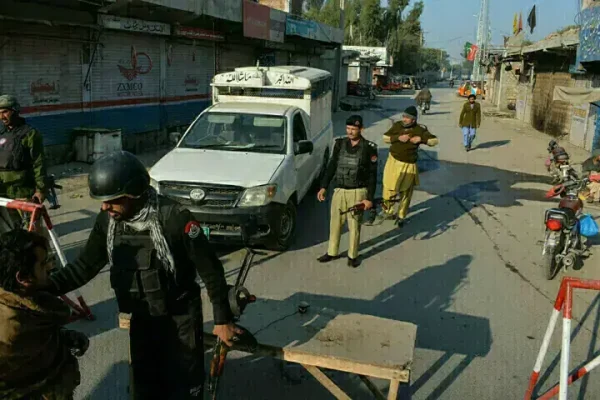
On the morning of April 7, Karachi’s Baghdadi police were alerted to a body on a footpath near a school in Lyari. Brown shirt, checked trousers, about 25 years old, no ID. Of note was a small tin sealed in golden foil that was found on his person. It said: “Queen Medam Pinky 🖤Don 🖤Naam hi kafi hai. Enjoy.”
The Baghdadi police put the body down as Unidentified Drug Addict in the roznamcha and dispatched it to a morgue. On May 9, they registered a murder case and nominated the name on the tin: Pinky. A forensic toxicology report confirmed their suspicion a few days later that it had traces of the A-class Schedule I narcotic cocaine.
On May 12, Pinky was declared arrested.
In the official telling, Pinky was taken into custody from a flat in Karachi’s Garden on May 12 by the Sindh Police and a federal intelligence agency. Her arrest, it emerged, according to one version of events, was based on a tip-off. Pinky’s ex-husband had snitched on her to a sub-inspector in Karachi to tell him where she was hiding. The policeman, who cannot be named due to his current deputation, was ecstatic—he had been on Pinky’s case since 2019 and had once even come close. She had been dodging arrest for eight years and was thus well known to the Lahore and Karachi police, Counter-Terrorism Department and Anti-Narcotics Force as a most-wanted criminal in 28 cases involving narcotics, illegal arms and violent crimes.
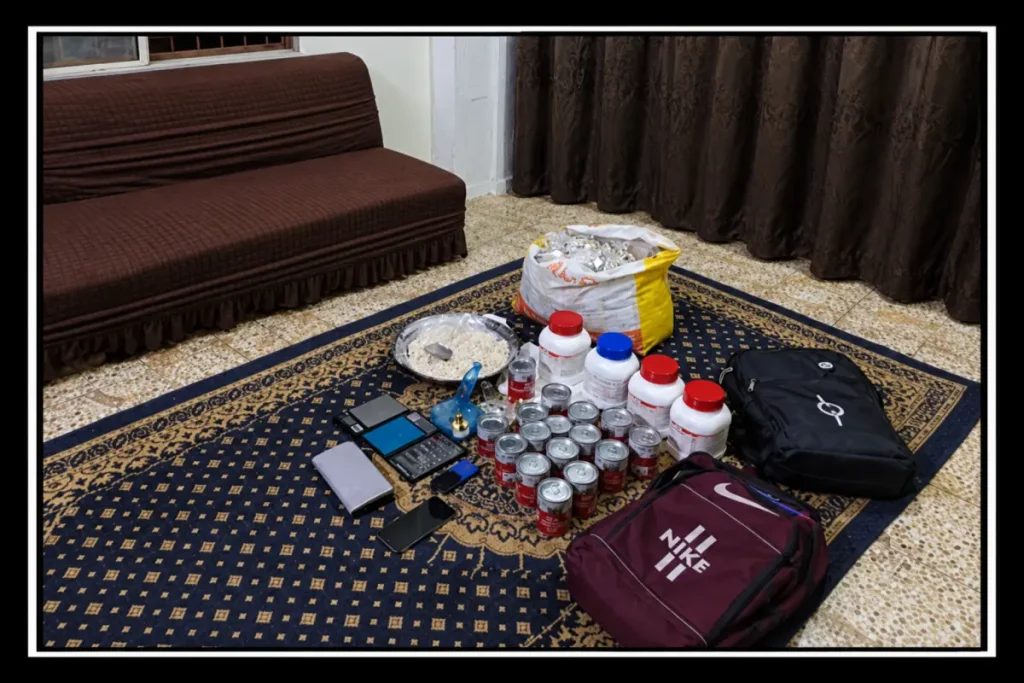
The joint operation team said it found in her flat boxes of packaging material, sealed tins like the one found on the Unidentified Drug Addict, other drugs, and a 9mm pistol with ten rounds. But most importantly, it had about 1.5kg of cocaine, which is worth as much as Rs30 million—a single seizure that equaled what the police intercepted from the entire City district in the first eight months of the year.

When Medam Pinky was presented at the Judicial Complex inside Central Prison Karachi on May 17, she challenged this version of the arrest loud and clear. As she was dragged into a police van—restrained by a clutch of women police officers who struggled to cover her face with a white chador—she shouted. “These people picked me up from Lahore and brought me here 22 days ago!”
The reporters latched onto this but she theatrically parried their questions: “Hum to doobay hain sanam, in sab ko lai doobay gain.”
I may be drowning, my love, but I will take all of them down with me too.
At one point in the ensuing media circus, a PDF list of 326 Karachi-based telephone numbers, supposedly from her smartphone, was reported as leaked. This news sent shivers down the city’s most expensive spines. The personal information doxxing was devastating for businessmen, journalists, bankers, and industrialists, whose CNICs and home and work addresses were spilled all over the internet. Frantic calls were made and eventually word had to be put out that the list was fake.
By this time, Pinky had captured the nation’s imagination. Television news channels were tickled pink that they could safely use the title “Queenpin” to salt the storytelling. TikTok—unencumbered by journalistic decorum—hashtagged her as #CocaineQueen. Indeed, the entire country had something to say about her brazen appearances. Look at the way she saunters in. Imagine coming to court in pajamas and a T-shirt! What’s with the vintage sunglasses? Shouldn’t she be in handcuffs?
Bulk supply
The officer who had received the tip-off accompanied the intelligence agency to the centre of Pinky’s web, Lahore. This is where over half of her contacts, 785 out of 1,286, resided. The Punjab capital, along with Islamabad and Rawalpindi, is a hot market for cocaine. A former investigation officer at the Anti-Narcotics Force explained that most of it is snuck in by air, usually as capsules swallowed by mules, a majority of whom travel from Africa. Others arrive from Europe carrying smaller quantities concealed among ordinary belongings such as infant formula.
Large consignments arrive by sea. Commercial vessels are used as unwitting vehicles. The packages of narcotics are concealed either inside a container in its cargo or within the structure of the container itself, hidden in the walls or below the floor. Reefer containers are used for their refrigeration units.
Pinky’s supplier was a Nigerian, identified as Chike Ochuba Chinwuba, according to her case file available with Dawn. The cocaine first came to Sialkot and then made its way to Lahore.
Once it arrived, it had to be bulked up. Pinky could turn 1.5kg from abroad into 5kg by adding impurities. She told the police that “Google Uncle” taught her how to mix with ketamine, methamphetamine, ephedrine, and lidocaine as they mimic cocaine’s sensory effects, or alter the perceived potency.
“Pure cocaine is rare here,” said the former ANF official. That is why most of what you get in Karachi is synthetically created in homes and labs. “And [the mixing] has resulted in deaths.”
Smooth operator
Selling the cocaine was fairly straightforward after Pinky’s brother Nasir helped her mix and package it.
All orders were placed directly with medam who would only entertain customers with a reference. Communication took place entirely over WhatsApp messages and voice notes. Pinky would share the bank account of an “accountant” and after a screenshot confirmed the payment, she shared the customer’s location with the rider and dispatched the delivery.
if (!window._rawHtmlListenerAttached) {
window._rawHtmlListenerAttached = true;
window.addEventListener(‘message’, function(event) {
if (event.data && event.data.type === ‘raw-html-resize’ && event.data.id) {
var iframe = document.getElementById(event.data.id);
if (iframe) {
var height = Math.min(Math.max(event.data.height, 50), 9200);
iframe.style.height = height + ‘px’;
}
}
});
}
Deliveries to Karachi were organised through people she hired, mostly women, who travelled there by bus, with the cocaine concealed in small packages in their clothes and luggage. Bus staff helped couriers conceal the drugs under the seats or inside luggage compartments. Altogether, one kilogramme was dispatched a week.
Pinky’s other brother Shaukat would be waiting in Karachi to receive the packages, which he would measure off, put into the tins, brand and distribute among three handlers, who delivered them by riders. Everyone reported to Shaukat.
None of the payments was made directly to Pinky as she had two finance handlers, Sohail and Zeeshan, whose bank accounts were used. Muhammad Sameer managed ATM and other online transactions through four different banks. In one account, transactions over a year and a half amounted to Rs29.46 million. Across the four accounts—under the names of Sohail, Zeeshan and Sameer—she had Rs32.7 million.
Customer satisfaction
Cocaine is an elite drug because of who can afford to keep using it. It’s the people with the house with a garage and an eight-million-rupee car parked in the driveway. That is the point, said Ustad*, a user-turned-police informer. Age isn’t a consideration. Customers range from 14 to 65 years.
At a party, the customer reviews are glowing.
“Her stuff is good, not gonna lie,” said Inaya*. The first time she had tried the white stuff, she felt like she was “on top of the world”.
Another client, Hadi*, a 32-year-old introvert, experienced a personality transplant—the shyness that had plagued him his whole life simply switched off. “He was flirting left, right, and centre. He was unstoppable, man,” said his best friend, as they described the experience snorting cocaine.
They had come to know Pinky on a desperate night. “I was wasted…but had to walk back home,” said Hadi, who lived two streets from the house where they had been partying. “A friend suggested cocaine. A line.”
At 4am, the tin, bearing Pinky’s tagline, was delivered to their doorstep.
The effect doesn’t last, though. Fifteen minutes, stretch it to 20, and the floor drops out from under the high as fast as it had arrived. You chase that first quarter of an hour for the rest of the night and pay for it in thousand-rupee increments, said Hadi*.
“There goes your money,” added Inaya*.
Package deal
Pinky’s delivery network may have been pulling in the clients, but it was also putting her on the police radar. The sub-inspector who would go on to arrest her seven years later, first came across her name in 2019, while he was posted to DHA, Karachi and told to look into the area’s drug problem.
All he had back then was the nickname and a number. So they pulled the call detail record and ran the most frequent numbers through TrueCaller. Then they picked one number that barely showed up. “Sab se gareeb admi,” the SI told Dawn. That would have been the poorest customer. They called him and said a complaint had been filed. In exchange for immunity, he agreed to score 2g of cocaine for the cops.
After two days of dillydallying, the delivery was finally made. A man and woman showed up on a motorcycle, both of whom were pulled in. But their lips were sealed and eventually they had to be released. It was the second time round that the rider sang. His shift ran from 8pm to 2am for Rs70,000 a month. A single packet weighed 12g, worth about Rs300,000. At the time he was caught, he had already sold four.
The police told him to keep working and shadowed him on their motorcycles. The next pickup point was Gulshan-e-Iqbal, but 15 minutes later, it was changed to a french fries kiosk in Landhi. A man and woman came on a motorcycle again. This time, though, the man was none other than Shaukat.
That’s when Pinky entered the picture. “She tried to negotiate her brother’s release,” the sub-inspector said. “Her final offer was Rs900,000 with the condition: brother first, then the money.” The police declined and locked Shaukat up, but he would be out soon enough.
After that, “Pinky had figured out the tricks of the trade,” said the sub-inspector. Her riders multiplied and the drop points evolved. The tins were no longer handed over in person but tucked under a dustbin inside an ATM.
While the chase for Pinky finally ended this year, her name had already acquired a life of its own. Despite the media blitz, and the effort it took to nab her the police official insisted Pinky was not the drug tycoon she had been made out to be. “She was a mid-level player, no kingpin,” he said. “She was living normally, like you and me…she didn’t have a big house or scary dogs.”
He believed her reputation had grown faster than her operation. The business was not unlike any other: word spread about the quality of the product, customers returned, and the brand name acquired a currency of its own. But where was that name from?
Claim to fame
Pinky was born Anmol in Gwadar in 1995 and was raised in Karachi. She dropped out of school in the eighth grade and set off to Lahore with dreams of becoming an actress. Several failed auditions later, she met Rana Nasir and eventually married him. Soon, she began transporting drugs for him, and ultimately climbed the ladder to become his manager. They divorced 10 years later.
For Anmol, a decade was all she needed to reroute Nasir’s clients. All of them knew one name: Pinky.
It was a name she had chosen as a teenager, one for the world of modelling and elite parties. “The name has glamour,” the police officer said. “If it was Gulbano, Nuzhat or Fatima, people would not be as interested. [Pinky] is not easily forgettable.” Even after she moved to Lahore, her customers continued to find her.
The truth is that there are players far grander than Pinky, who operate quietly, produce more but rarely become the story themselves. Pinky did the opposite. Her name did the rest.
*Names have been changed to protect privacy.
Map by Zahra Zaman and Ibrahim Yahya
Header art by Mohsin Alam
The post The anmol ‘crack’ down on Queen Pinky appeared first on Dawn – Home.