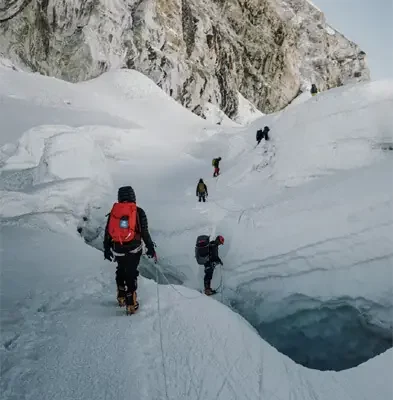
Somewhere above 4,500 metres in Gilgit-Baltistan, a glacier that has fed the Indus for millennia is losing ice faster than at any point since scientists began keeping records.
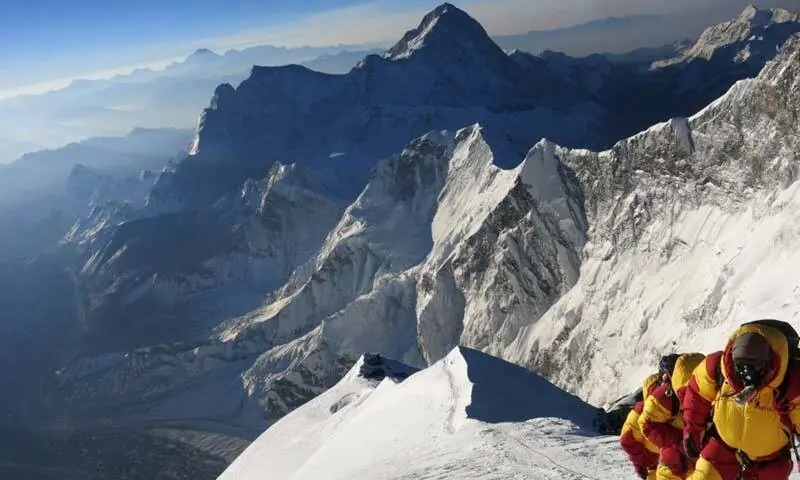
A thousand kilometres to the east, in the Khumbu region of Nepal, the same story is unfolding on the slopes below Everest.
Two countries, separated by India’s landmass and decades of diplomatic distance, are quite literally standing on the same melting ground.
It is time Islamabad and Kathmandu recognised what geography has been telling them all along: their futures are tied together by ice, water and risk, and neither can afford to keep looking at the mountains alone.
The numbers are no longer abstract.
Research from the International Centre for Integrated Mountain Development (ICIMOD), the Kathmandu-based body that has monitored the Hindu Kush Himalaya for half a century, found that glaciers across the region have lost as much as 27 metres of ice thickness since 1975, with the rate of loss having doubled since the turn of the century.
Pakistan alone is home to roughly 13,000 glaciers, and the Indus, the river that irrigates the bulk of Pakistani agriculture and sustains its hydropower, draws an extraordinary 70 per cent of its flow from glacier and snowmelt.
Nepal’s glaciers, including the closely watched Mera and Rikha Samba, serve the same role for South Asia’s eastern river systems.
When ICIMOD’s scientists call this region the “Third Pole” and the “Water Tower of Asia”, they are not being poetic. They are describing the plumbing that keeps nearly 2 billion people alive.
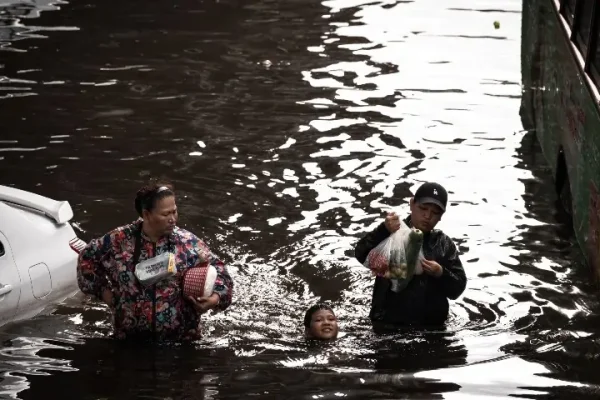
Pakistan has already paid the price of treating this as someone else’s problem. The 2022 floods were not simply an unlucky monsoon.
The country received close to 190pc of its normal July-August rainfall, with Sindh and Balochistan hit by rainfall multiples far beyond historical norms, and the result was catastrophe: over 1,700 dead, 33 million people affected, roughly a third of the country under water, and a UN-backed Post-Disaster Needs Assessment putting total damages and economic losses above $30bn, with reconstruction needs exceeding $16bn.
Pakistan’s government and independent assessments alike have pointed to a common driver behind that disaster, a warming Himalayan and Karakoram system dumping glacial meltwater into rivers already swollen by erratic rain.
This is precisely the “compound risk” that ICIMOD hydrologists have flagged in the region more broadly: rising temperatures, unstable slopes and unpredictable rainfall no longer arrive as isolated events but stack on top of one another, as seen even in this year’s flash flooding in Gilgit-Baltistan’s Thore Valley.
Nepal understands this compounding danger as well as any country on earth. It has spent years building glacial lake outburst flood monitoring systems, evacuation protocols for high-altitude valleys, and community-based early warning networks precisely because its mountain villages have nowhere to run when a lake bursts.
Pakistan, meanwhile, has real operational experience of its own, in flood forecasting for the Indus basin, in cold-climate agricultural adaptation, and in managing glacier-fed irrigation systems that are among the most extensive in the world.
Put simply: Nepal has hard-won expertise in glacial hazard monitoring, and Pakistan has hard-won expertise in managing the downstream consequences at a massive scale.
Neither country has had to build both halves of this puzzle alone before, and neither should have to now.
This is where a bilateral climate framework, modest in ambition but serious in substance, makes sense.
Islamabad and Kathmandu could begin with something achievable: a joint glacier and hydrology monitoring exchange, building on the scientific groundwork ICIMOD has already laid across its eight member states.
Pakistani meteorological and irrigation authorities could share Indus basin flood-forecasting models with Nepal’s disaster management agencies, while Nepal’s glacial lake outburst flood expertise could inform Pakistan’s own early-warning systems for the roughly 3,000 glacial lakes identified in its northern territories, some of which are classified as dangerously unstable.
None of this requires reinventing diplomatic wheels. It requires Pakistan to assert, clearly and confidently, that it is a mountain nation with mountain interests, not merely a downstream victim waiting for the next disaster, but a serious technical partner capable of shaping how South Asia adapts.
There is also a quieter strategic logic here. Pakistan has long been boxed into a regional conversation dominated by its relationship with India, one that leaves little room for the kind of functional, low-politics cooperation that climate diplomacy allows.
Nepal, similarly, has often been treated as a subject of Indian and Chinese strategic competition rather than an actor. A Pakistan–Nepal climate channel sidesteps that framing entirely.
It is not about alliances or rivalries; it is about rivers, ice, and the shared arithmetic of survival. That makes it precisely the kind of cooperation both nations can pursue without inviting the usual regional anxieties and precisely the kind of cooperation that lets Pakistan demonstrate leadership on an issue where it has genuine standing to speak.
The Hindu Kush Himalaya assessment that ICIMOD produced years ago carried a blunt warning: even if the world holds warming to 1.5 degrees Celsius, the region will still lose roughly a third of its glacier volume by century’s end; under weaker climate action, that loss could reach two-thirds.
Pakistan does not have the luxury of waiting to see which scenario unfolds. Every flood season narrows the window for building the kind of resilient, cooperative infrastructure that could soften the next disaster instead of merely responding to it.
Himalayan diplomacy will not solve Pakistan’s water and climate vulnerabilities on its own.
But it offers something rarer than a solution: a genuine, forward-looking partnership built on shared mountains rather than shared grievances. Pakistan should seize it, not as a favour to Nepal, but as an act of enlightened self-interest for a nation that lives, quite literally, downstream of the Third Pole.
Header image: View of the landscape from Langtang, Nepal can be seen in this undated handout file photo. — Tika Gurung via Reuters
The post Himalayan diplomacy: A new frontier for Pakistan–Nepal climate cooperation appeared first on Dawn – Home.