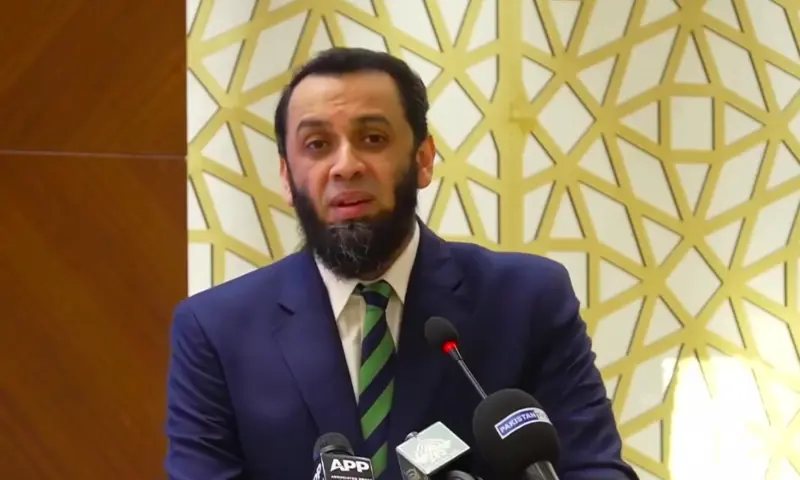
Information Minister Attaullah Tarar on Tuesday said the interim Afghan government needed to “move out of its militant mindset”, declaring it the root of all current problems between Pakistan and Afghanistan.
Ties between the neighbours have been strained in the past few years as Islamabad continues to voice its concern over cross-border terrorism. Meanwhile, September witnessed another bout of conflict between the two.
On Tuesday, addressing a seminar in Islamabad on Afghanistan and the prospects of peace, Tarar described it as the “Afghan predicament or Afghan conundrum”.
He stressed that it was a “very complex” problem which required a long, lasting, and sustainable resolution.
“The interim Afghan government needs to move out of its militant mindset into a mindset of a statesman or state,” the information minister maintained.
“Pakistan and Afghanistan have been, are, and will remain neighbours. We have international borders, linkages, connections. But our past has been turbulent,” he noted.
Tarar reiterated that Pakistan believes in peace and in peaceful coexistence; however, he asked whether peace was given a chance.
“Can peace prevail is the question that confronts us today.”
He asserted: “Can peace be achieved? Yes, but is there a will to achieve peace? The answer unfortunately is no.”
On Islamabad’s part, Tarar highlighted that various attempts to hold negotiations were made, as Pakistan believed that negotiations could resolve outstanding issues.
He recalled that multiple high-level delegations from Pakistan had visited Afghanistan to hold talks with the interim government, and other friendly countries — such as Qatar, Turkiye and China — had also hosted talks between the two neighbours.
The minister stated that Islamabad had been expressing reservations over the use of Afghan soil in carrying out terrorist activities in Pakistan. He added that Pakistan had also “responded to these activities through strikes against the terrorists”.
Tarar maintained that the only problems that persisted were violent extremism and militancy.
“Even now, there are safe havens of terrorists and internationally proscribed organisations in Afghanistan,” he noted, adding that Islamabad had taken up the matter with Kabul.
“Peace has to be achieved through a viable and sustainable model,” the minister stressed.
“For peaceful coexistence, one has to acknowledge and accept that live and let live,” he said, adding, “Only peace can lead to prosperity.”
However, he cautioned that Pakistan’s desire for peace must not be misconstrued as its weakness.
‘Denial of basic rights’
Tarar also criticised the internationally highlighted human rights situation in Afghanistan.
“The fundamental rights are denied to certain segments of society based on a self-created ideology of Islam,” Tarar said, slamming the Afghan Taliban for imposing a certain “brand of Islam” that was not its true ideology.
He explained that there were “two forms of denial” currently prevailing in Afghanistan: the denial of the problem of terrorism and the existence of terrorist havens on Afghan soil, and the denial of the basic human rights to the people of Afghanistan.
“The people of Afghanistan are raising their voices for a change.”
Tarar contended that if the notion of peace leading to prosperity is understood, the disconnect between the people of Afghanistan and the interim government would also be reduced.
“There is great potential in Afghanistan; if peace is achieved, the trade routes can be built from Central Asia, through Afghanistan to Pakistan,” he pointed out.
“No citizen of Pakistan wants disruption of peace and instability. Every citizen wants to prosper and raise his or her standard of living.”
Pak-Afghan conflict
Islamabad has repeatedly urged the Taliban administration in Kabul to dismantle terrorist sanctuaries on Afghan soil, particularly those linked to the banned Tehreek-i-Taliban Pakistan (TTP), that are used for attacks in Pakistan. Officials say those appeals have gone unheeded.
According to a UN Security Council-mandated monitoring report — covering the period from Dec 16, 2025 to June 9, 2026 — Afghan Taliban’s continued support for TTP has contributed to a rise in the frequency and lethality of terrorist attacks in Pakistan, even as Kabul has taken some initial steps to rein in the group.
On Sept 21, in response to recent major terrorist attacks in Khyber Pakhtunkhwa, Pakistan conducted “calibrated” airstrikes against terrorist hideouts in the border region with Afghanistan, with the government saying more than 28 terrorists were killed.
Tarar had described the action as part of Operation Ghazab lil Haq, which was launched on the night of Feb 26 in response to unprovoked cross-border firing by the Afghan Taliban.
Days later, Pakistan shot down eight drones launched from across the border that had entered Pakistani airspace near the Torkham border and Kohat. It was also reported that the Afghan Taliban engaged in unprovoked firing the night before near Kurram as security forces foiled an attempt by terrorists to cross into Pakistan.
In retaliation to the drone incursion, Pakistan last week conducted “precision aerial and drone strikes” in 10 locations across Afghanistan.
A demarche was also delivered to the Afghan side on Saturday on account of the Sept 23 airspace violation by drones.
The post Afghan interim govt needs to move out of its 'militant mindset', says Tarar appeared first on Dawn – Home.