

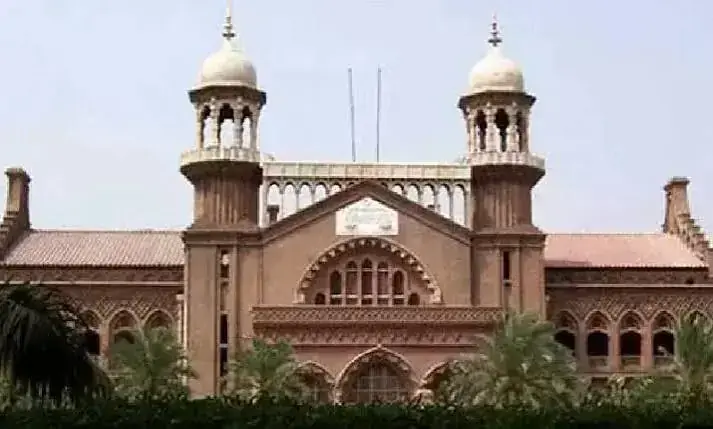
LAHORE: Thirteen Afghan medical students on Thursday filed multiple petitions before the Lahore High Court (LHC), challenging directives from the Pakistan Medical and Dental Council (PMDC) that ordered their return to Afghanistan.
The petitioners, comprising seven women and six men, filed the petitions through Advocate Asad Jamal. They were enrolled at different institutions in Lahore, including King Edward Medical University, Shaikh Khalifa Bin Zayed Al Nahyan Medical & Dental College and the Services Institute of Medical Sciences.
The petitioners said they were removed from their colleges on PMDC’s instructions, with the council acting as the top regulatory body under the Pakistan Medical and Dental Council Act 2023. They argued that PMDC and the medical colleges lacked the legal authority to expel the students.
The petitioners argued that PMDC’s powers must be exercised within the bounds of the Constitution and Pakistan’s international legal obligations, and that neither the 2023 Act nor constitutional or international principles permitted the council to act arbitrarily, particularly against students who had already invested years in their medical education in Lahore and across Punjab.
Many of the petitioners hold scholarships under the Higher Education Commission (HEC)-sponsored Allama Iqbal Scholarship programme. The HEC, in July 2025, held a reception to welcome around 350 Afghan students arriving in Pakistan to pursue their studies.
Nilofar Nikzad, one of the petitioners, said she had completed two years of medical studies in Afghanistan before being forced to abandon her education there because of Taliban restrictions on women’s access to education.
The petitioners said the sudden and disruptive process led to their evictions from hostels by their respective colleges and left them without accommodation as their academic futures hung in the balance.
They said the PMDC’s directives had caused significant distress among Afghan medical students studying across Pakistan, prompting them to seek recourse from the courts as a last resort.
The petitioners requested the LHC to decide on two PMDC directives, issued on July 31 and September 1, and declare them “illegal and unconstitutional”, without lawful authority and void from inception.
“The impugned orders are discriminatory against women and all other Afghan students present in Pakistan,” one of the petitions claimed.
The petitions are yet to be fixed for hearing by the LHC registrar’s office.
PMDC order
On September 1, PMDC issued a notification directing Afghan medical students enrolled in Pakistani colleges “to return to Afghanistan”. The notification also barred medical and dental colleges from granting admission or placement to Afghan students for the current academic session.
Soon after, reports circulated on social media about the alleged expulsion of Afghan nationals who were studying at public sector medical colleges in Lahore.
According to a health ministry official, an “in principle” decision had been made to send Afghan students enrolled in Pakistani medical universities back to their country, due to the ongoing tensions between Islamabad and Kabul.
When asked about the reported expulsion of Afghan students, Foreign Office (FO) spokesperson Sajjad Haider Khan had told Dawn that “any foreign national without a valid visa and passport” was liable to deportation under the Illegal Foreigner Repatriation Plan (IFRP).
Jamal, the petitioners’ counsel, claimed in a post on X that there was “no distinction made between valid visa and invalid stay by PMDC in its directives”.
The Human Rights Commission of Pakistan (HRCP) has condemned the PMDC decision, warning that the move could turn an education policy into a humanitarian crisis. It said around 100 Afghan medical and dental students in Lahore alone could be affected, including an estimated 20 to 40 women.
The post LHC moved against PMDC's directives for repatriation of Afghan students appeared first on Dawn – Home.