
Information Minister Attaullah Tarar on Sunday alleged that the PTI-led government in Khyber Pakhtunkhwa had a “nexus” with terrorist groups, as the Centre explained that the province’s security situation necessitated the imposition of emergency there.
The press conference by government ministers — Tarar, Interior Minister Mohsin Naqvi, Law Minister Azam Nazeer Tarar, and Minister of State for Interior Tallal Chaudhry — came shortly after the Centre imposed emergency in KP, citing the provincial government’s lack of efforts to combat terrorism.
The Centre and the PTI — which was in power in KP — have been at odds over various issues, particularly on the counterterrorism policy, which was one of the main reasons behind the breakdown of their Oct 3 talks.
Addressing the media in Islamabad, the information minister said all cabinet members who attended Sunday’s meeting were of the view that the “PTI government in KP is hand in glove with terrorists and has an unholy alliance with terrorists”.
“Terrorists have a clear say in how each district will be run,” he alleged, citing reports from the Intelligence Bureau and law enforcement agencies (LEAs).
He contended that while other political parties faced terrorist attacks in the region, the PTI got “secure access and passage” thanks to its alleged alliance with such groups.
“What is the reason that even police stations of some districts have been sublet to the Taliban?” Tarar asked, emphasising that the case was not merely of inaction and incompetence but of “empowering” the terrorists.
The minister went on to allege that a “power-sharing formula was gradually taking shape between terrorists and the PTI’s KP government, which was starting from southern districts and was ingressing further into the entire KP”.
He said the “unholy alliance and the nexus between them, as a result of which they had outsourced several districts to terrorists,” enabled the martyrdom of people and attacks on civilian infrastructure.
“I say this publicly that these [Taliban] are foreign-funded people who want to bring our country to destruction,” he said, asserting that a provincial government’s facilitation towards such elements was a “constitutional breakdown”.
Tarar referred to the recent bill regarding police assignments and alleged that the KP government wanted to “hire individuals from terrorist groups in the police”. “They were gradually dragging the entire province towards destruction, irrefutable proof and evidence of which is available.”
KP Advisory Council formed
The minister then questioned the KP cabinet’s performance, hailed “riddance from this group” and provided details of a technocratic KP Advisory Council.
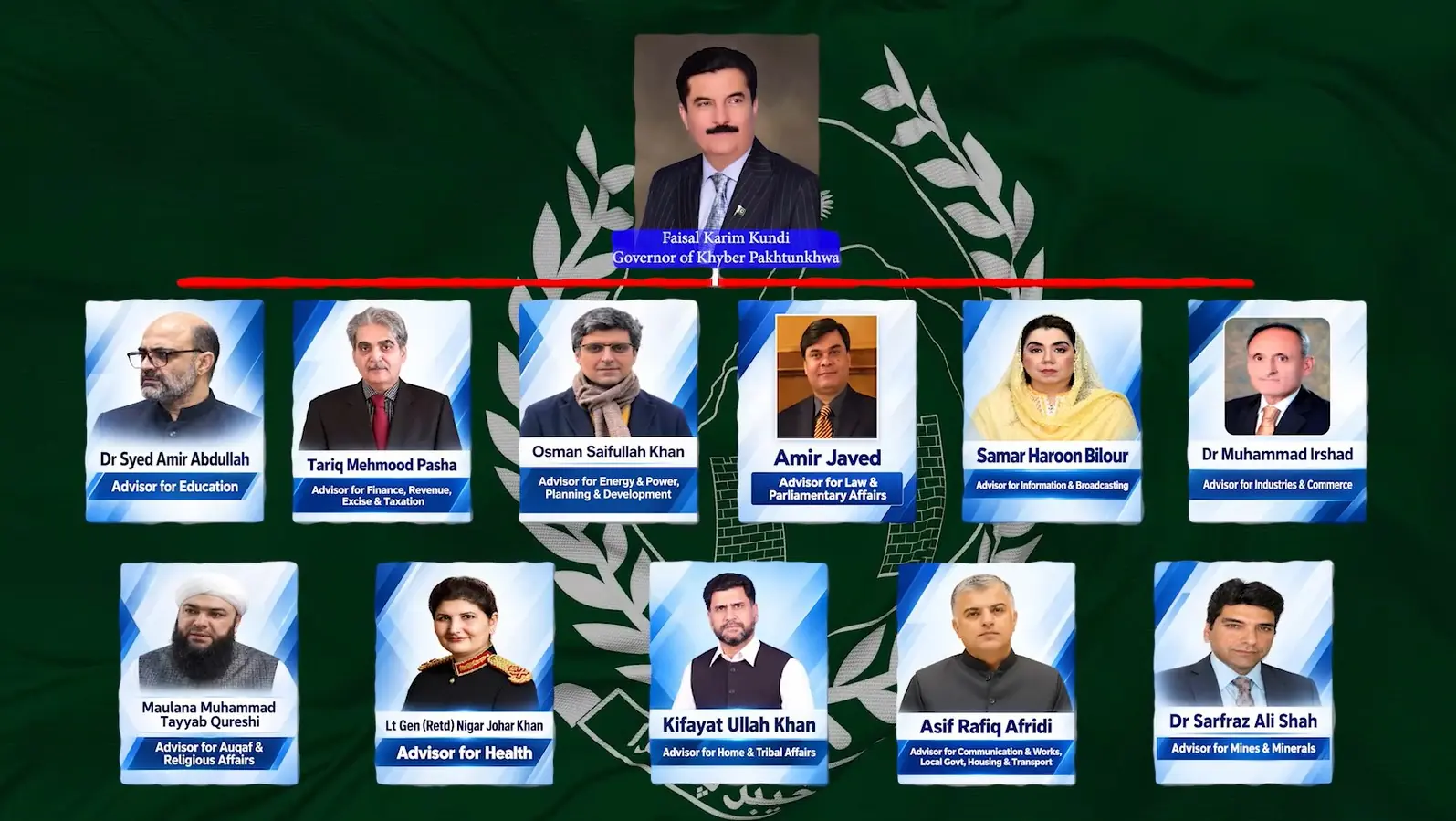
The 11-member council has been formed by the Centre as part of the emergency measures under Article 232 of the Constitution, according to an order seen by Dawn. It will assist the governor in exercising the functions of the KP government on behalf of the federal government.
Through the order, the Centre also appointed Advocate Sanaullah as the KP advocate general.
The province’s home affairs will be overseen by former prisons chief Kifayatullah Khan, described as “very competent” by Tarar.
Tariq Mahmood Pasha, a former FBR chief and an aide to then-finance minister Ishaq Dar, has been assigned as advisor for finance affairs.
MNA Samar Haroon Bilour has been appointed as information adviser, while retired Lt Gen Nigar Johar has been tasked with health affairs.
Former advocate general Amir Javed was assigned the portfolio for law; ex-senator Osman Saifullah Khan will advise the governor on energy and power; Asif Rafiq Afridi was given the portfolio for communication and works; while Maulana Tayyab Qureshi will oversee religious affairs.
Tarar noted that all chosen advisers had either doctorate degrees or extensive experience in public service.
These included Adviser for Industries and Commerce Dr Muhammad Irshad (a former FBR chief with a PhD in finance), Adviser for Mines and Minerals Dr Sarfraz Ali Shah (who had a PhD in economics) and Adviser for Education Dr Syed Amir Abdullah (with a PhD in international relations).
The Cabinet Division has issued an order by the federal government that said that after the proclamation of an emergency, the government of KP “cannot be carried on in accordance with the provisions of the Constitution”.
Exercising its powers under Article 232, the government ordered that an Area Development Secretariat (ADS), under the superintendence of the Area Representative and Development Council (ARDC), be immediately established to “restore law and order, safeguard the security of the citizens of Pakistan and ensure good governance and development” in Dera Ismail Khan, Tank, Lakki Marwat, Bannu, Bajaur, Mohmand, Khyber, Kurram, Orakzai, North Waziristan, South Waziristan (Upper) and South Waziristan (Lower).
It said that the ARDC shall be a representative council comprising the notables from the designated districts and shall be headed by a chairman. The members, the chairman, the vice chairman and the spokesperson of the ARDC shall be appointed in such manner and for such duration, as may be determined.
The order further said that the ADS shall be headed by the additional chief secretary of the designated Districts, who shall be the administrator of these areas.
“Officials of the provincial government and of other bodies or authorities posted in the designated districts shall be placed under the operational and administrative control of ADS. Any further postings/transfers to the designated districts may be ordered by the prime minister on the recommendation of the administrator, from time to time,” it said.
It said that the administrator shall perform all the functions of and exercise all executive, administrative, and law enforcement powers vested in or exercisable by the provincial government in the designated districts.
It said that the administrator may: establish organisational setups for governance, security and development in selected districts with command over district administration, law enforcement and all line departments; issue binding orders to civil, police, and military authorities; issue orders for operational, organisational and administrative functions of ADS; issue orders for allocation and transfer of funds; coordinate with federal agencies, armed forces and provincial bodies for law enforcement and security of the areas; reorganise departments and take necessary actions for public safety, economic stability, relief operations and provision of essential services; and take such other measures as are necessary for the purposes of effective and good governance, maintenance of law and order and provision of services in the designated districts.
“All orders, notifications, directions, or actions taken by the administrator shall have the same legal effect as if issued by the provincial government,” it read.
Naqvi details govt efforts to resolve issues
In his remarks, the interior minister said the Centre tried to take the KP government on board in the counterterrorism fight, but the efforts were in vain due to a lack of response from the latter.
At the outset of Sunday’s briefing, Naqvi said, “Today was not an easy day for us. For over one month, we continuously tried to take the KP government on board. I was personally in touch with them in the background; our only goal was to onboard them so that we could fight together against terrorism.”
The minister went on to reveal that he was in contact with PTI leaders until 11:45pm last night and had been communicating with them “all day about the draft’s para four”. “They did not respond all day.”
“I told them that we can still avoid the situation. Things have gone too far, but we can still do something to delay tomorrow morning’s situation,” he said, referring to the imposition of emergency that the Centre had been mulling.
Naqvi also highlighted efforts by veteran politician Maulana Fazlur Rehman to reduce tensions, but no solution could be found.
He even said the Centre communicated to the PTI repeatedly that it had “no issue” with the party’s long march. “Our issue was entirely terrorism-related, and we want to take you on board on it.”
While acknowledging that there were many issues related to KP’s governance, Naqvi said, “My and the entire interior ministry’s point of view was clear: the situation was not linked to politics even one per cent. We were purely seeing this on the basis of terrorism.”
Referring to the Oct 3 talks between the Centre and PTI, he contended that the situation would have been different if they had reached an agreement back then.” “Even if last night they had said yes, it (emergency) would not have happened.”
He added, “Ask them who their masterminds are. Who were sabotaging them?”
The interior minister then elaborated on the security challenges KP faces, stating that the situation was “really bad” in 12 districts. “In some districts, you cannot even leave your house in the evening.”
“We had multiple meetings with Sohail Afridi, and the only topic was terrorism; no political conversation happened,” he emphasised. The minister said a plan was proposed to strengthen KP Police in five districts initially and eventually hand over security to it in six months, then repeat the process in another five districts.
“They said they had a lack of funds, but it is on the record that we said that we will provide any more funds you need. This was a four-month-old conversation but still no work has happened on it.”
Naqvi further claimed that the PTI team had agreed on imposing emergency in 12 districts, but added that they were “scared of being seen meeting with us”. “We had clarity on one thing that we did not want to involve politics in this.”
He further alleged, “Their connections with the Taliban are no secret. I would not say anything further.”
The minister remarked that the security situation was extremely bad in certain districts, yet the PTI was able to hold rallies and “not even one person was harmed”.
“We only had two options: either we would see the martyrdoms daily, or we end them. So this difficult decision we have made has a background,” he maintained, adding that the federal government tried its best to avoid it.
During the briefing, Naqvi claimed that “demands” the PTI put forward were already being considered last month, before the opposition party announced its long march towards Islamabad. “Some of their own people could not understand why the long march was taking place.”
He recalled that Prime Minister Shehbaz Sharif wanted to hold talks with the National Assembly opposition leader last month and proposed forming a committee, but the government did not get any confirmation.
“We were trying our best to hold the meeting before the prime minister left so that the situation could be diffused,” he said, noting that a committee for the Oct 3 talks was formed later.
According to the interior minister, the consultations took place for two days and credited PTI MNA Asad Qaiser for saying with “clarity that it is not possible that we take even a step back on terrorism”.
“We will not do it for you; we will do it for Pakistan, and we will fight united against terrorism,” Naqvi quoted Qaiser as saying, adding that he requested the ex-NA speaker to take the KP government on board.
The minister then reiterated that an agreement draft was revised four times, after which the government negotiation committee found out a new draft had been presented by the opposition team.
“Although the previous day the chief minister had authorised them to agree on their behalf, the next day it all changed,” Naqvi said.
The post Info minister alleges 'nexus' between PTI-led KP govt, terrorists appeared first on Dawn – Home.
