

By SAREER AHMAD
For a government clerk, the beginning of the month once meant some degree of relief. The salary arrived, household expenses were paid, groceries were purchased and there was at least some hope that the money would last until the next payday.
Today, that calculation has become much harder.
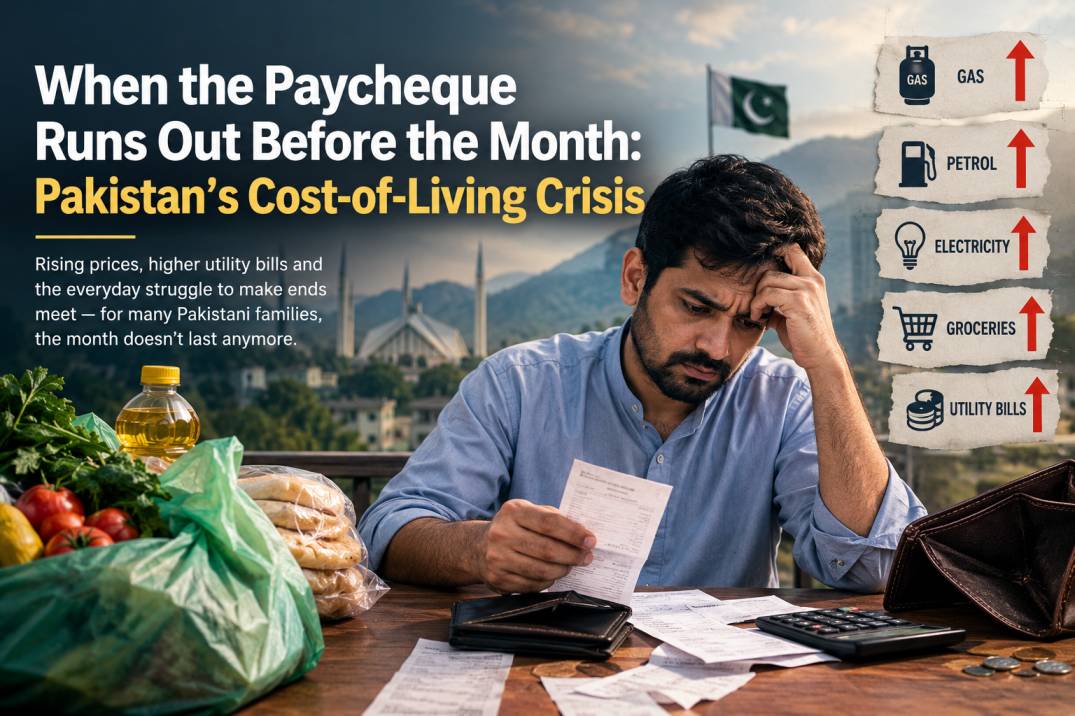
Bilal Khan, a government employee working as a clerk, says his salary was sufficient for his household in the past. But over the last five years, he says, the continuous rise in the prices of essential goods and utilities has changed the way his family manages its monthly budget.
The rising cost of gas and petrol has been particularly painful, he says. Paying utility bills and purchasing groceries have become increasingly difficult, leaving little room for other household needs.
For Khan, the problem is not that his salary has disappeared. It is that the value of his salary has steadily declined as the cost of everyday life has increased.
His experience captures a reality faced by millions of salaried Pakistanis: the paycheque may arrive on time, but it increasingly runs out before the month does.
The figures behind Pakistan’s inflation story help explain why.
Consumer inflation has again become a major concern for households. In August 2026, inflation rose to around 11 per cent year-on-year, with rural inflation reaching 12.2 per cent and urban inflation 10.4 per cent.
For policymakers, these figures are percentages on an economic dashboard.
For families, they have a much more immediate meaning.
They mean another increase in the grocery bill. Another difficult electricity or gas payment. Another trip to the petrol station that costs more than expected.
And when the income of a household does not rise at the same pace, something has to give.
For some families, it is savings. For others, it is healthcare, education, food quality or spending on other necessities. Some borrow from relatives or friends. Others take on additional work.
The pressure is not limited to government employees.
Rabia Ali, a schoolteacher, says her family is also struggling to manage its household expenses. She points specifically to the rising prices of everyday kitchen items.
Cooking oil, sugar and wheat, she says, have become increasingly expensive, making it difficult to manage the family’s monthly budget.
Her observation may sound simple, but it describes the heart of Pakistan’s cost-of-living crisis.
Families do not experience inflation through the Consumer Price Index. They experience it when the same amount of money buys fewer groceries than it did a year earlier.
For a teacher or clerk receiving a fixed monthly salary, there are only so many ways to respond.
The electricity bill cannot simply be ignored. Gas is needed for cooking. Petrol is necessary for commuting. Children need food and education. Rent has to be paid.
The list of necessities keeps growing, while the salary remains largely fixed.
Pakistan’s Labour Force Survey 2024-25 puts the average monthly wage at around Rs39,000. But averages can hide the financial pressure facing individual households, particularly those dependent on fixed salaries.
A household may appear financially stable because it has a regular income. Yet regular income does not necessarily mean financial security.
The real question is purchasing power.
If a family’s salary increases by a few thousand rupees but its food, transport, electricity, gas and education costs rise by more than that, the household is effectively poorer.
This is why the country’s inflation debate needs to move beyond the question of whether the inflation rate is rising or falling.
The more important question for ordinary families is whether their incomes are keeping pace with the cost of living.
In recent years, Pakistan has gone through repeated episodes of economic instability. The country has faced pressure on its foreign-exchange reserves, exchange-rate volatility, high interest rates, fiscal deficits and repeated negotiations with the International Monetary Fund.
Economic stabilisation is necessary.
But stabilisation has a human cost when the burden falls heavily on households that have little financial capacity to absorb it.
Energy prices are a particularly important part of this story.
When electricity, gas and fuel prices rise, the impact does not stop at the monthly utility bill. Higher energy costs affect transport, agriculture, manufacturing, shops and almost every stage of the supply chain.
A rise in petrol prices can eventually appear in the price of food.
Higher electricity costs can increase the expenses of a small shop.
Higher transport costs can make commuting to work more expensive.
For a family already struggling with its monthly budget, these increases accumulate.
That is why Bilal Khan’s experience is important. His concern is not about one particular bill. It is about the cumulative effect of several rising costs.
A household can sometimes absorb one increase.
It becomes much harder when food, fuel, gas, electricity and transport all become more expensive at the same time.
Rabia Ali’s experience tells a similar story from another part of the salaried class.
As a teacher, her income provides a degree of stability, but stability is not enough when the price of basic food continues to rise.
Cooking oil, sugar and wheat are not luxury products.
They are part of everyday household consumption.
When their prices rise, families cannot simply decide to stop buying them.
They may reduce quantities, switch to cheaper alternatives or cut spending elsewhere.
This is how inflation changes household behaviour.
It rarely arrives as one dramatic event.
Instead, it gradually changes what families can afford.
A family that once saved part of its salary may now spend the entire amount. A parent who once paid for private tuition may stop doing so. A household that regularly bought certain foods may replace them with cheaper options.
These decisions may not appear immediately in official economic statistics, but they represent a real decline in living standards.
The pressure is particularly severe for lower- and middle-income households because most of their income goes towards necessities.
A wealthy household can respond to rising prices by reducing discretionary spending.
A low-income household has far fewer choices.
There is little difference between essential and non-essential spending when almost everything in the monthly budget is essential.
This is where inflation becomes a political-economy issue.
The debate is not simply about prices.
It is about who bears the cost when an economy is under pressure.
Pakistan needs fiscal discipline and macroeconomic stability. But the country also needs to consider how economic adjustment affects workers whose incomes do not increase quickly enough to match rising prices.
The burden of taxation, energy prices and economic reforms cannot continue to fall disproportionately on ordinary consumers.
A sustainable recovery must eventually translate into better purchasing power.
That means stronger wage growth, higher productivity, more productive employment and reforms that reduce the structural costs of doing business and providing essential services.
It also means addressing the deeper reasons behind Pakistan’s repeated economic crises rather than asking households to absorb each new round of adjustment.
For workers such as Bilal Khan, economic recovery will not be measured by foreign-exchange reserves or a government announcement.
It will be measured when the monthly salary once again covers the household’s basic needs.
For teachers such as Rabia Ali, recovery will mean being able to buy groceries without constantly worrying about which expense has to be postponed.
This is ultimately the human face of inflation.
A percentage point may rise or fall in an economic report, but behind that number are families making difficult decisions every day.
They are deciding whether to save or spend, whether to buy more or less food, whether to use the car or public transport, whether to pay one bill now and another later.
And perhaps the most worrying part is that many families are no longer asking how they can improve their standard of living.
They are asking how they can simply maintain it.
Pakistan’s economic recovery will remain incomplete as long as a worker can receive his salary on time and still find that it is not enough to reach the end of the month.
The real test of the economy is therefore not only whether inflation falls.
It is whether ordinary people once again feel that their work is enough to provide a decent life.