
Whatever there is to be said about Fakhar Zaman has been said.
And he has usually said it himself – first when he made his debut and steered Pakistan to their greatest triumph of the past decade, then countless times for Lahore Qalandars, then on that one rainy day in Bangalore, climbing a mountain no one had given him a shot at.
Fakhar has had a long few years, with recurring injuries and patches of very lean form, but his penchant of showing up when it matters, in extremely emphatic fashion, hasn’t wavered with time.
In a side that gets frequently noted for crumbling under pressure, faltering in the biggest moments, never being quite able to get over the line for true glory, Fakhar has churned out a reputation for himself that is the opposite.
A ‘big match player’ is the sort of cliche that seems overwrought, but Fakhar has made it entirely his own. When it matters most, it is foolish to count him out.
“The way my last 4 games had gone, a good performance was due,” he said during the post-match ceremony after scoring a match-winning century to lead Pakistan to triumph in the One-day International tri-series final against Sri Lanka on Saturday.
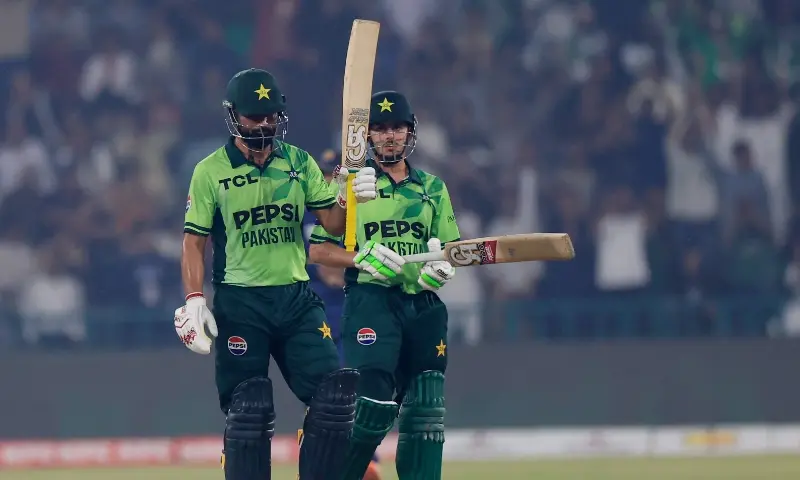
“Cricket is just like this, sometimes you are a good knick and sometimes you don’t score; even today I was struggling in the beginning.”
“But I know that when it is my day, and the ball is coming onto my bat, I will score big.”
And that he did – despite his lean returns in the first four matches Pakistan played in this tri-series, and despite the several scares he survived yesterday – wobbly shots, being dropped and given reprieves, Fakhar showed why giving him a life in a final has been, historically, a bad idea.
Pakistan does not have a lot of time left with Fakhar. He is 36 years old, and will be 37 by the time next year’s World Cup in southern Africa is underway.
It would probably be the most opportune moment for him to sign off on a memorable career, trying to give his team one shot at the ultimate glory in his favourite format.
His century yesterday – 12th in ODIs, a record-breaking fourth in chases of more than 300 – is just one of those things Pakistan fans should learn to cherish when they get.
But if yesterday showed anything, apart from reaffirming what Fakhar means to a Pakistan side, it was that Pakistan don’t have to be starved of time.
In a match where Pakistan’s most trustworthy southpaw wielded his bat once again, it was one other that let him, and yet another that ensured it wouldn’t go to waste.
Saad Baig had big shoes to fill coming into this ODI tri-nation series. With Mohammad Rizwan’s absence, Pakistan was not only missing a cog of the batting line-up that has been so crucial for so long, but also one of the finest pair of wicket-keeping gloves the country has sported.
No one else has seemed good enough in comparison behind the stumps – either too undercooked, or too sloppy.
Saad was Pakistan’s U-19 captain, and made his debut earlier in this tri-series. With a promising performance behind the stumps, and a string of starts with the bat that left one feeling unfulfilled but entirely assured of the pristine talent that shone through, the 19-year-old came out looking like he had a lot to prove.
Ironically, he turns 20 today, following a knock yesterday that can only be described as a coming-of-age.
If Fakhar was Pakistan’s anti-thesis to not showing up when it matters, Saad was the anti-thesis to a star performing batter never having enough support on the other end.
“I have played domestic cricket with Saad, he is a very talented player,” Fakhar said, adding that Saad briskly scoring runs when he came to the crease yesterday allowed Fakhar to settle and take his time, and ultimately go big.
“The credit goes to him for starting the way he did.”
“Obviously there is pressure on you whenever you move to international cricket,” said Saad in a video reflection posted on PCB’s social media handles.
“But the way you have to play through the pressure and back yourself, I was lacking that in the first two or three games, and was getting out in the 30s,” he added, saying that his plan for yesterday’s innings was to score while staying settled at the crease, and Fakhar’s “outstanding” innings made doing that all the more easier.
He rotated strike and got into a good groove with Fakhar, rotating strike and picking out the Sri Lankan bowlers whenever the opportunity came to him. Perhaps the way he got out – an anticlimactic chip back to the bowler on a full Theekshana delivery – reflects where he stands in his career compared to the man across the other end, lacking just the final bit of grit and presence that can only come with time.
And if these two left-handers set Pakistan on for victory, another one entirely made sure he finished it.
Between overs 32.5 and 42.5, Pakistan did not score a single boundary. Fakhar and Salman Ali Agha had been bowled in quick succession.
With Hasan Nawaz and Arafat new on the crease, and most of the toe-end of the innings left to bat through, their game plan seemed simple enough: don’t throw it away.
The scoring during those overs came entirely from rotating strike, which might have felt grinding and underwhelming for an audience who had just witnessed a Fakhar Zaman special.
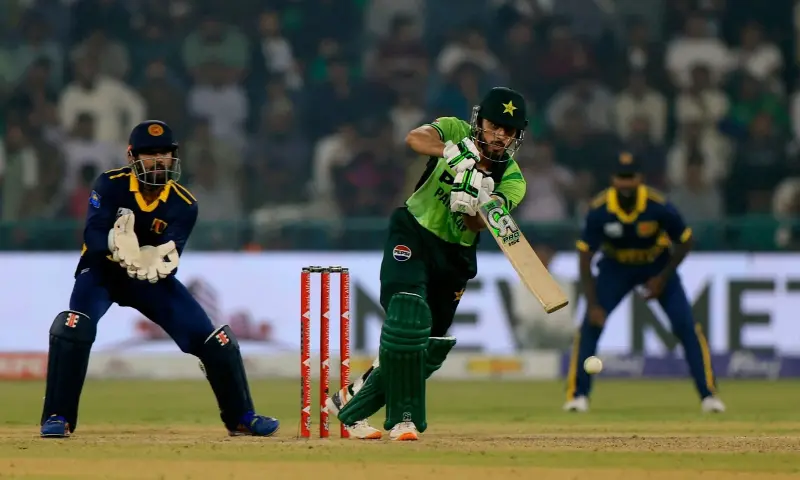
It was a full Asitha Fernando delivery in the 45th over, drilled disdainfully down the ground, that would open the floodgates.
In the bowler’s next over, Arafat hit possibly the cleanest, most sublime sequence of shots he has procured in his short career so far, bludgeoning two sixes and a four before holing out with Pakistan just two short of the win.
“When I went in [to bat], I told Hasan that we have been through this situation before, and so we tried building a partnership,” he said. The two had carried out a deftly executed rescue job in their first tri-series fixture against England as well, ensuring Pakistan posted a total north of 300.
“We backed each other and waited for bad balls to come to us.”
“And I think through communicating with each other we had developed confidence in one another as well,” he said.
Arafat was awarded player of the series as well – the second time he’s been awarded the title in as many ODI series he has participated in.
“I have been saying from the beginning that I am an all-rounder,” he said in the ceremony. He was, after all, the leading architect with both bat and ball in Pakistan’s first win against England.
“There is pressure, but the way you enjoy the pressure, stay calm during it, and execute your skills is important,” he said of the tricky place the team found itself in when he came in to bat with Hasan.
Pakistan’s ODI assignments now all build up to the big shot at the big prize, the World Cup in South Africa next year. Young talents like Saad and Arafat is blooding in, and stalwarts like Fakhar hoping to find one final burst for the nation.
What Pakistan can hope to take to South Africa is a team that sports both, the best of its recent past, and the most promising of its hopefully long future. And three left-handers on Saturday night in Lahore, showed exactly how to do it.
The post Pakistan’s past and future make a bid for the present appeared first on Dawn – Home.
