

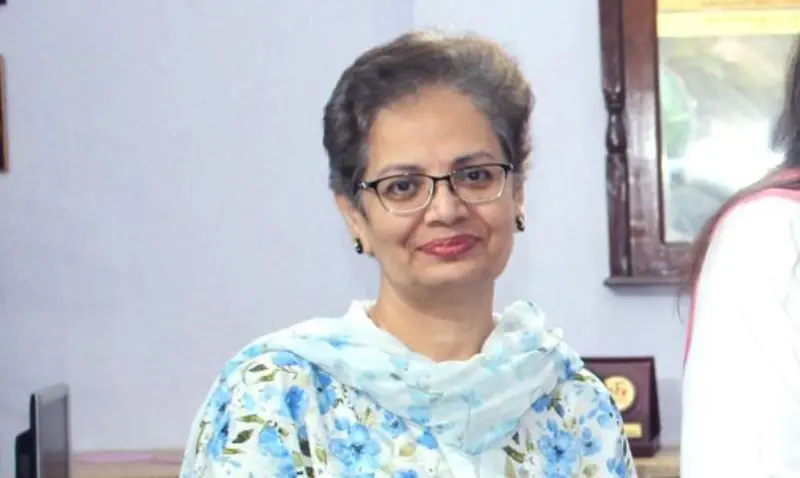
KARACHI: Karachi Police Surgeon Dr Summaiya Syed on Monday said she faced “threats” after disputing the findings of the first post-mortem in the murder case of young businessman Mir Raza Ali.
She made the comments during her testimony before a judicial commission tasked with probing the circumstances of and possible negligence around the murder case. The one-member panel, headed by Sindh High Court’s Justice Omar Sial, has been holding regular hearings.
The 25-year-old victim’s family is convinced that their son was tortured and murdered, and has accused police of trying to bury the facts, as law enforcers initially tried to build the case around the possibility of suicide.
Appearing before the commission on Monday, Dr Syed said she put her career at stake for this case.
“I was followed by a motorcycle for two days. I was also given threats,” she said.
The murder case has been mired in controversy, particularly after Dr Syed pointed out flaws in the findings of Ali’s first autopsy.
The case goes back to July 29, when Ali’s body was found in Karachi’s Gulistan-i-Jauhar with a gunshot wound, a day after he went missing.
In early August, Dr Syed pointed out inconsistencies between the first medico-legal report prepared by MLO Dr Osama Sheikh and the available photographs. Following that, Ali’s body was exhumed on his family’s request and a second post-mortem was conducted.
That examination — conducted by a medical board that Dr Syed was a part of — revealed that Ali sustained multiple injuries before his death and ruled out suicide.
During Monday’s proceedings, Dr Syed said that when she approached a police officer to point out loopholes in the first autopsy report, she was told that the police would be lenient during “interrogation” if she did not oppose the findings hinting at suicide.
However, she was not called for an interrogation, the police surgeon added.
Dr Syed said a “public campaign” was being waged against her and her family members’ information was being shared online, adding that she had filed a complaint before the National Cyber Crime Investigation Agency (NCCIA).
She further said that Ali’s murder case was a “test case” for her.
“I would do the same if I have to in another case,” she declared.
At this, Justice Sial asked the police surgeon whether she wanted Rangers personnel deployed for her security, which she refused.
Justice Sial ordered the chief minister’s focal person to apprise CM Murad Ali Shah of the police surgeon’s statements.
At the outset of today’s hearing, Dr Syed detailed the timeline of her communication in early August with law enforcers, including Senior Superintendent of Police (SSP) Samiullah Soomro, wherein she suggested exhumation of Ali’s body for the second autopsy.
Dr Syed noted that members of a medical board are chosen based on their expertise. She added that 263 photographs were taken during Ali’s second post-mortem examination.
Upon the judge asking whether the Sindh Medicolegal Act 2023 has been implemented, the police surgeon said the legislation was in force, but the rules had not been notified.
Dr Syed then highlighted that the majority of the medical board initially formed for the second postmortem was changed. She added that Ali’s family had voiced their lack of confidence in the new team, which delayed the process until the initial medical team was reinstated.
Asked why the medical board was suddenly reconstituted, Dr Syed said she was not aware of the reasons.
During the hearing, the police surgeon also gave a presentation of pictures when asked about the exhumation process. The commission requested the victim’s family to leave the room, noting that some photographs “could be unbearable for them”.
Dr Syed informed the commission that there was an injury mark on Ali’s head, a mark on the back of his head from being hit by a hard object, and his nose bone was broken. She noted that these injuries occurred before Ali’s death.
She pointed out that samples for checking gunshot residue were not taken in the first postmortem, adding that it also stated the wrong size of the bullet injuries.
The police surgeon observed that the decomposition of the victim’s face was not similar to that of other body parts. She added that the bullet caused fractures to Ali’s ribs, as well as damaged his lungs and heart.
The deceased man’s body also had marks of acid burns, with a chemical examination report confirming the presence of acid, Dr Syed said.
Pointing out issues with the first autopsy, she said Ali’s hands and feet had signs of burns from a chemical, but the initial report had termed them a sign of decomposition.
Stating that four skin specialists had also been consulted, Dr Syed said hydrochloric acid (HCl) turns polyester into carbon and carbonisation was found on Ali’s shirt. She added that HCl was found from the shirt as well.
She further said that the amount of blood where Ali’s body was found was less in comparison to the average four to five litres that a human body contains, especially considering the injury to his heart.
When the proceedings resumed after a short break, Dr Syed informed the commission that the burns present on Ali’s body were likely not from gastric acid, which has a mild effect.
Asked whether the marks on the body could indicate burns from a chemical, the police surgeon said each case was different. She stressed that she carefully reviewed the photographs after the controversy of the first autopsy.
Dr Syed said marks resembling those caused by concentrated hydrochloric acid were seen on the victim’s hands.
She recalled that samples collected by MLO Sheikh, including those from Ali’s stomach and blood in his heart, were sent to Karachi University for testing by Shabbir Leghari.
More to follow
The post Mir Raza murder case: Police surgeon says she received 'threats' after disputing first autopsy findings appeared first on Dawn – Home.