

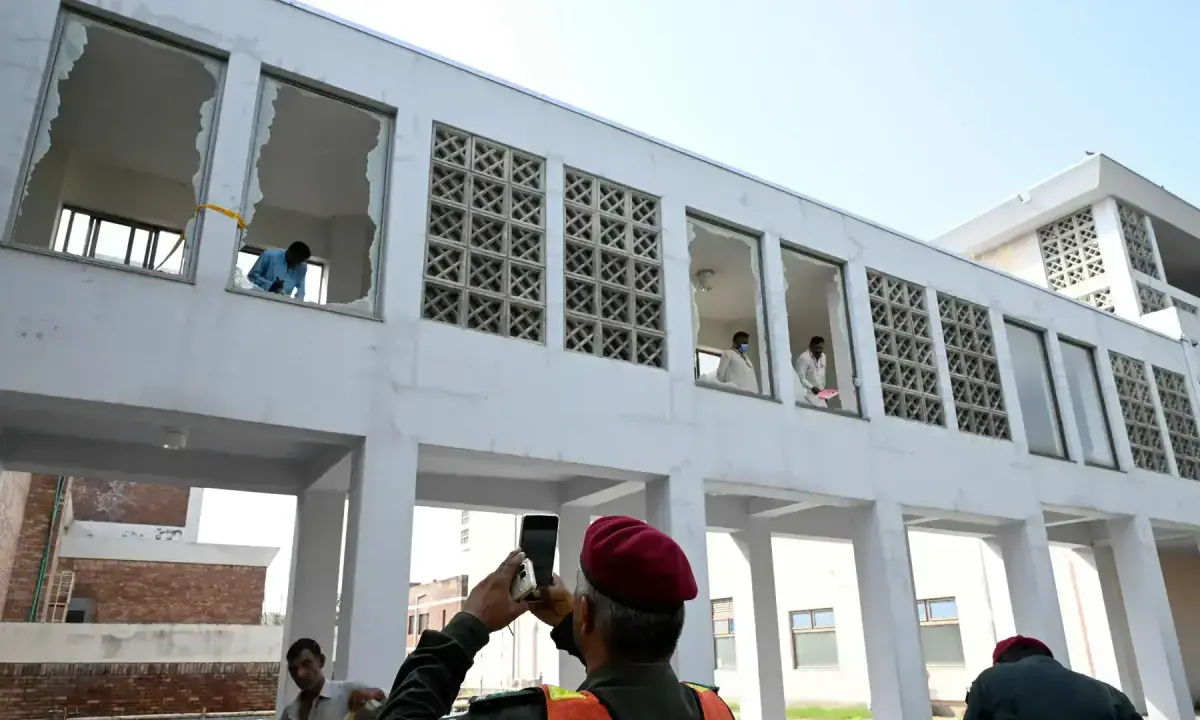
ISLAMABAD: An inquiry committee formed to probe the deadly fire at the Pakistan Institute of Medical Sciences (Pims) has found “systemic and institutional failure” and determined that an electrical failure was the most likely cause of the blaze, it emerged on Tuesday.
The August 26 fire at a nursery in Pims’ Mother and Child Hospital claimed the lives of 14 newborns. The incident raised concerns over fire safety measures and sparked calls for accountability, with criminal action being ordered against eight officials.
Headed by former interior secretary Shahid Khan, the committee was formed on Prime Minister Shehbaz Sharif’s directives on the day the fire occurred. It has presented its findings and recommendations in a 43-page report available with Dawn.
The committee concluded that “systemic and institutional failure is established, while individual responsibility varies with the strength of the evidence”.
It noted that Pims and its “senior management bear the principal institutional responsibility for failing to convert known risks, prior warnings and assigned duties into an effective safety system”.
“The electrical spark explains how the fire began; the institutional system explains why it became a catastrophe.
“Fourteen newborns were lost not because one safeguard failed, but because too many safeguards were absent, weak, delayed or never verified to be working,” the report declared.
It explained: “The causal chain is coherent. A localised electrical failure most probably started the fire; combustible and oxygen-supported conditions accelerated it; inadequate detection and protection failed to contain it; overcrowding, limited evacuation capacity and the absence of a rehearsed neonatal emergency system constrained rescue; delayed institutional activation weakened response; and longstanding governance, maintenance and regulatory failures allowed these vulnerabilities to coexist.”
The committee said its conclusions were based on a structured 52-task investigation drawing upon forensic evidence, CCTV, call records, engineering and maintenance documents, clinical and casualty records, duty and attendance material, witness statements, contracts, regulatory records, and earlier inquiries.
Citing CCTV footage, which established “an exceptionally rapid emergency”, the report said the evidence “rejects any generalised allegation that frontline personnel abandoned the newborns”.
Noting that Charge Nurse Nasreen Akhtar, Security Guard Maria Saleem and Staff Nurse Razia Noreen responded within moments, the report said that “several acted promptly and courageously in circumstances that became untenable within minutes”.
Electrical fault
“The strongest technical evidence, from the National Forensics Agency, identifies the АС Unit No. 2 electrical supply cable near/over AC Unit No. 1 as the most probable point of ignition,” the report said about the cause of the fire.
It explained that abnormal localised electrical heating — possibly from excessive current, a high-resistance connection or another localised defect — most probably caused insulation failure and ignition of nearby combustible material.
The evidence does not establish arson, multiple ignition points, an external fault of the Islamabad Electric Supply Company (IESCO), a pre-fire oxygen leak, or an incubator or warmer as the source, the committee determined.
“The fire was therefore most probably electrical in origin, although the precise defect and the person or entity responsible for preventing it require separate determination,” the report read.
The report stressed that the engineering/electrical/HVAC (heating, ventilation and air conditioning) chain remained the “most significant unresolved technical accountability line”. It added that contractors must be examined only against the duties actually assigned to them.
According to the report, the record “does not presently establish criminal guilt against any named person”.
However, it supported focused investigation into four possible lines: culpable electrical installation or maintenance failure relating to AC 2; culpable obstruction of a mandatory emergency route; culpable failure to act despite specific prior warning; and any proved culpable delay in summoning external assistance.
“Criminal responsibility must rest on the duty owed, knowledge or foreseeability of risk, authority to act, the act or omission, degree of negligence, failed safeguard, causal contribution and applicable offence,” the report said.
It emphasised that frontline responders whose rescue conduct had been “objectively established should not be blamed merely because the outcome was catastrophic”.
More to follow
The post Pims fire: Inquiry committee finds 'systemic, institutional failure' behind tragedy appeared first on Dawn – Home.