

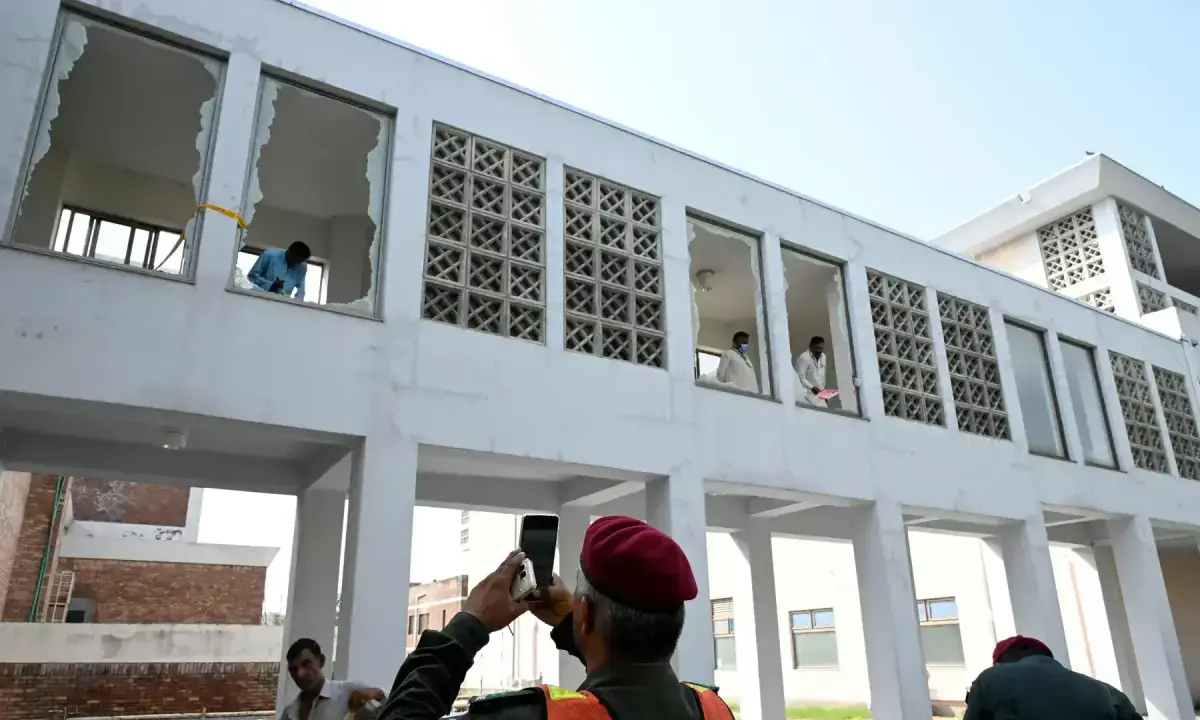
ISLAMABAD: An inquiry committee formed to probe the deadly fire at the Pakistan Institute of Medical Sciences (Pims) has found “systemic and institutional failure” and determined that an electrical failure was the most likely cause of the blaze, it emerged on Tuesday.
The August 26 fire at a nursery in Pims’ Mother and Child Hospital claimed the lives of 14 newborns. The incident raised concerns over fire safety measures and sparked calls for accountability, with criminal action being ordered against eight officials.
Headed by former interior secretary Shahid Khan, the committee was formed on Prime Minister Shehbaz Sharif’s directives on the day the fire occurred. It has presented its findings and recommendations in a 43-page report available with Dawn.
The committee concluded that “systemic and institutional failure is established, while individual responsibility varies with the strength of the evidence”.
It added that Pims and its “senior management bear the principal institutional responsibility for failing to convert known risks, prior warnings and assigned duties into an effective safety system”.
“Administrative, disciplinary, contractual and criminal responsibility must attach only where the relevant duty, omission and causal consequence are proved,” the report said.
“The electrical spark explains how the fire began; the institutional system explains why it became a catastrophe.
“Fourteen newborns were lost not because one safeguard failed, but because too many safeguards were absent, weak, delayed or never verified to be working,” the report declared.
It explained: “The causal chain is coherent. A localised electrical failure most probably started the fire; combustible and oxygen-supported conditions accelerated it; inadequate detection and protection failed to contain it; overcrowding, limited evacuation capacity and the absence of a rehearsed neonatal emergency system constrained rescue; delayed institutional activation weakened response; and longstanding governance, maintenance and regulatory failures allowed these vulnerabilities to coexist.”
The report pointed out a “history of known but incompletely closed risks”, citing prior warnings.
These included earlier correspondence by the Capital Development Authority (CDA), the Federal Ombudsman’s 2015 findings, Pims’ own 2025 acknowledgement of ageing fire safety infrastructure, and especially the July 6, 2026 Nursing Hostel fire, which had already highlighted deficiencies in detection, alarms, electrical inspection, evacuation, firefighting equipment, drills and emergency planning.
“Yet those warnings had not been converted into a comprehensive, time-bound and independently verified corrective programme before the Nursery fire,” the report regretted.
“The specific AC 2 defect may not have been foreseeable; the need for stronger fire preparedness plainly was.”
The record did not establish deliberate locking in of the neonates, conspiracy, sabotage, political protection, manipulation or concealment of casualties, wholesale frontline abandonment, or a prolonged delay by Capital Emergency Services (CES) after confirmed notification.
The committee said its conclusions were based on a structured 52-task investigation drawing upon forensic evidence, CCTV, call records, engineering and maintenance documents, clinical and casualty records, duty and attendance material, witness statements, contracts, regulatory records, and earlier inquiries.
With Khan as its head, the committee comprised Major General (retired) Dr Khurshid Uttra, Establishment Division Secretary Dr Barrister Nabeel Awan, Islamabad Deputy Commissioner Irfan Nawaz Memon, and Dr Rashid A. Chotani (co-opted member).
As a recommendation, the panel said the health ministry, upon acceptance of the report, should prepare a “consolidated corrective action plan assigning every recommendation to a responsible institution and designated officer, with deadlines, resources, interim safeguards, verification authority and closure status”.
Responsibilities
Evidence warranted a focused criminal investigation into possible culpable electrical installation or maintenance failure relating to AC 2, obstruction of a mandatory emergency route, culpable non-action despite specific prior warning, and any proved culpable delay in external emergency notification, the committee determined.
The report said the record disclosed “prima facie grounds for administrative and E&D proceedings against officers where a defined duty, prior knowledge or foreseeability, authority and corresponding act or omission indicate negligence, inefficiency, misconduct, unauthorised absence, failure of supervision or non-performance of assigned safety responsibilities”.
It stressed that final guilt must be determined through due process.
According to the committee, the evidence was “not equally mature against all officers”.
“The security chain has the clearest documented duty basis; senior management responsibility requires confirmation of business allocation, knowledge and authority; clinical responsibility depends upon proof of mandatory physical or supervisory duty.”
It added that engineering/electrical/HVAC (heating, ventilation and air conditioning) responsibility “remains technically central but requires individualisation”.
The report highlighted that the AC 2 installation and maintenance chain remained the “most important unresolved technical accountability line”.
“Responsibility must be traced to the persons who designed, installed, altered, inspected, maintained, supervised or certified the implicated circuit,” it maintained.
Regarding external oversight, the report determined that responsibility of the health ministry, Islamabad Healthcare Regulatory Authority (IHRA), and CDA/CES was “stronger at the institutional, supervisory and regulatory level than as person-specific culpability”.
“The record shows fragmented oversight and insufficient verified closure of critical risks,” it added.
On governance, the report said Pims required “clearer business allocation and professionally qualified management of administrative, engineering, safety and emergency functions”.
“Clinical seniority alone is not a substitute for specialised hospital management competence.”
Frontline response and institutional failure
Citing CCTV footage, which established “an exceptionally rapid emergency”, the report said the evidence “rejects any generalised allegation that frontline personnel abandoned the newborns”.
Noting that Charge Nurse Nasreen Akhtar, Security Guard Maria Saleem and Staff Nurse Razia Noreen responded within moments, the report said that “several acted promptly and courageously in circumstances that became untenable within minutes”.
The report also highlighted the “vulnerability” of the nursery, with 15 “medically fragile, non-self-evacuating neonates were housed in a 10-bed unit, several dependent on oxygen or respiratory support”.
Only two doctors and two nurses were immediately available, and protected evacuation resources were limited.
“No adequately documented, approved, trained and rehearsed nursery-specific fire and neonatal evacuation SOP (standard operating procedure) was demonstrated, nor was a functional automatic smoke detection, alarm or sprinkler system shown to be serving the affected area,” the report read.
It observed that combustible materials and the “oxygen-supported environment further intensified fire and smoke after ignition”.
It emphasised that frontline responders whose rescue conduct had been “objectively established should not be blamed merely because the outcome was catastrophic”.
The committee also called for the response to be distinguished between individual reaction and institutional activation.
It noted that the frontline staff acted within seconds at 6:38am, external notification was at 6:54am, and operational arrival was at 7:01am. Therefore, the principal concern was the interval between visible fire and external activation, rather than the response by CES.
“Pims had not demonstrated a tested incident command system capable of immediately converting detection into alarm, external notification, evacuation, hazard isolation, access management and coordinated rescue.”
Although the particular adjoining door visible in the CCTV footage was not established as causative of the fatalities, “CES separately reported locked or obstructed routes, establishing a serious institutional egress concern”, the report stated.
It further said that Pims’ security SOPs expressly assigned responsibilities concerning fire safety, exits, firefighting equipment, training, access control, keys and emergency reporting, providing “one of the clearest documentary duty chains in the inquiry”.
“The principal institutional failure was the absence of an integrated patient safety system, leaving known risks fragmented across clinical, engineering, security, administrative, contractor and regulatory functions and resulting in incomplete correction, weak preparedness, improvised response and catastrophic consequences,” the report read.
The committee also noted the continued retention of the Nursery in the old MCH despite availability and progressive operationalisation of the new Jica-funded facility.
This, it said, was not “supported by a sufficiently documented risk assessment, justification or time-bound transition plan and constitutes a prima facie management issue”.
While the hospital faced genuine staffing and resource constraints, the record did not establish that any specific Nursery fire safety or AC 2 electrical safety proposal was rejected solely for lack of funds.
“Resource constraint, therefore, does not by itself excuse the identified deficiencies,” the report said.
Electrical fault
“The strongest technical evidence, from the National Forensics Agency, identifies the АС Unit No. 2 electrical supply cable near/over AC Unit No. 1 as the most probable point of ignition,” the report said about the cause of the fire.
It explained that abnormal localised electrical heating — possibly from excessive current, a high-resistance connection or another localised defect — most probably caused insulation failure and ignition of nearby combustible material.
The evidence does not establish arson, multiple ignition points, an external fault of the Islamabad Electric Supply Company (Iesco), a pre-fire oxygen leak, or an incubator or warmer as the source, the committee determined.
“The fire was therefore most probably electrical in origin, although the precise defect and the person or entity responsible for preventing it require separate determination,” the report read.
According to the inquiry panel, the maintenance record showed that the nursery ACs had been serviced, but it did not “demonstrate a sufficiently systematic and traceable electrical safety regime covering cables, terminations, insulation, earthing, breaker protection and thermal hotspots”.
“The critical distinction is that equipment being operational is not the same as its electrical installation being demonstrably fire safe. The evidence reveals a wider institutional gap between keeping equipment running and ensuring that it was safe,” the committee pointed out.
According to the report, the record “does not presently establish criminal guilt against any named person”.
However, it supported focused investigation into four possible lines: culpable electrical installation or maintenance failure relating to AC 2; culpable obstruction of a mandatory emergency route; culpable failure to act despite specific prior warning; and any proved culpable delay in summoning external assistance.
“Criminal responsibility must rest on the duty owed, knowledge or foreseeability of risk, authority to act, the act or omission, degree of negligence, failed safeguard, causal contribution and applicable offence,” the report said.
Recommendations
The panel recommended immediate fire, life safety and electrical audits, as well as ensuring functioning detection, alarm, suppression and egress (exit) systems.
It also called for a dedicated neonatal evacuation SOP with realistic drills; direct emergency notification and incident command; preventive electrical safety and asset management systems; professional and merit-based hospital governance; stronger regulatory oversight.
It further recommended a “closed-loop compliance system in which every deficiency has a responsible owner, deadline, resources, interim safeguard, independent verification and formal closure”.
“A measure is not implemented because it is approved or under process; it is implemented only when the risk has been physically removed and independently verified.”
The committee called for establishing a Family Support and Liaison Cell, providing psychological and bereavement support to the families of those affected, ensuring long-term clinical follow-up of the surviving neonate and processing any lawful compensation or relief transparently and expeditiously.
It also suggested that Pims establish a “senior fire/life safety and facilities function and a permanent multidisciplinary Hospital Safety and Vigilance Committee with authority to track deficiencies to verified closure”.
The panel further recommended considering a time-bound independent Safety and Governance Oversight Board to monitor implementation, conduct independent or unannounced audits and report to the competent federal authority.
It urged the hospital to continue “high-risk services such as nursery/NICU, PICU, ICU, HDU and operating theatres only where minimum life safety safeguards are physically functional and independently verified”.
The panel further said that all critical services remaining in legacy buildings should be transferred to appropriate purpose-built facilities where feasible.
It recommended that PIMS be “restructured around professional hospital administration, with administrative, engineering, biomedical, safety, finance, HR, procurement and emergency management functions assigned to suitably qualified and experienced professionals”.
The post Pims fire: Inquiry committee finds 'systemic, institutional failure' behind tragedy appeared first on Dawn – Home.