
Democrats have made significant gains in the final days of the 2026 midterm campaign, with new polls showing them leading in several states that President Donald Trump carried in 2024. The findings point to a changing political landscape, although the outcome of the Senate contests remains uncertain.
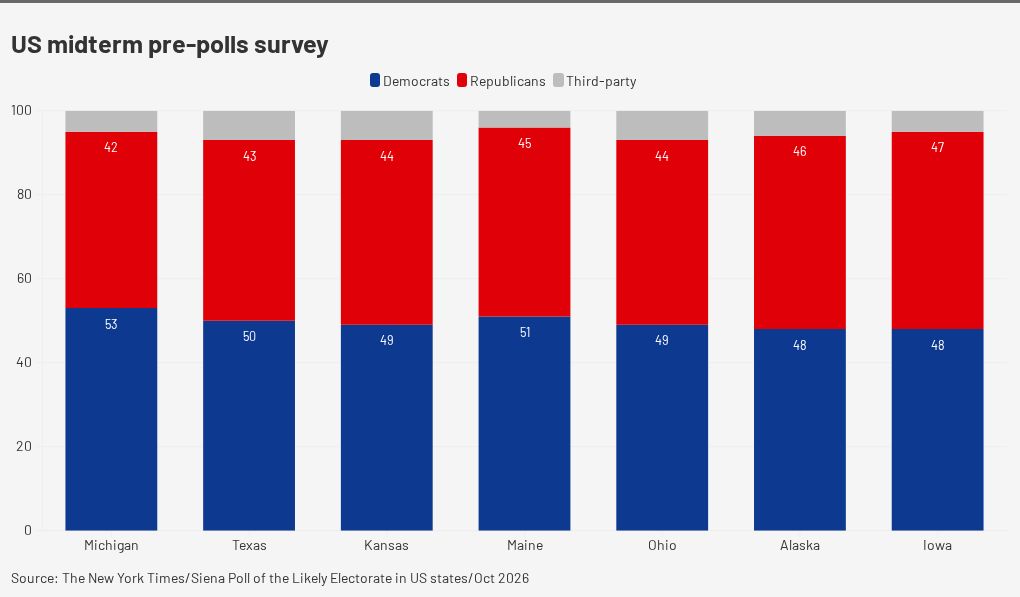
The final New York Times/Siena College surveys of seven key Senate battlegrounds show Democratic candidates ahead in Michigan, Texas, Kansas, Maine and Ohio. They also hold narrower leads in Alaska and Iowa, where the contests remain highly competitive.
The results have attracted particular attention because several of these states have traditionally favoured Republicans. Democratic leads in Texas and Kansas, in particular, would have appeared unlikely only a few months ago.
The surveys, released on November 1, covered 5,708 likely voters across the seven states. The individual state surveys had margins of sampling error ranging from approximately 3.3 to 4.8 percentage points.
(function () {
var me = document.currentScript || document.scripts[document.scripts.length – 1];
var wrapper = me && me.closest(‘.raw-html-embed-wrapper’);
var source = wrapper && wrapper.querySelector(‘script.raw-html-source’);
if (!source || wrapper._rawHtmlMounted) return;
wrapper._rawHtmlMounted = true;
// position:sticky breaks under any overflow:hidden ancestor. “clip” hides the same overflow
// without creating a scroll container.
for (var a = wrapper.parentElement; a; a = a.parentElement) {
var cs = getComputedStyle(a);
if (cs.overflowX === ‘hidden’) a.style.overflowX = ‘clip’;
if (cs.overflowY === ‘hidden’) a.style.overflowY = ‘clip’;
}
// Undo the server-side escaping of closing script tags / comment openers.
var html = source.textContent.replace(/<(\+)(/script|!–)/gi, function (m, slashes, token) {
return '<' + slashes.slice(1) + token;
});
source.remove();
// iOS Safari kills tabs that hold many large base64 images: turn them into blob: URLs.
// blob: URLs work inside the srcdoc frame because it inherits our origin.
html = html.replace(/data:(image/[w.+-]+);base64,([A-Za-z0-9+/=]+)/g, function (m, type, b64) {
if (b64.length < 4096) return m;
try {
var bin = atob(b64), bytes = new Uint8Array(bin.length);
for (var i = 0; i frame.clientHeight ? scroller.scrollHeight : root.getBoundingClientRect().height);
pinned = h > window.innerHeight;
if (pinned) {
stage.style.position = ‘sticky’;
stage.style.top = ‘0’;
fillScreen(stage);
track.style.height = h + ‘px’;
max = Math.max(0, h – frame.clientHeight);
} else {
// Grow only: vh-based content would otherwise shrink with its own frame, forever.
fitH = Math.max(fitH, h);
stage.style.position = ‘static’;
stage.style.height = fitH + ‘px’;
track.style.height = ‘auto’;
max = 0;
}
sync(true);
}
frame.addEventListener(‘load’, function () {
try {
win = frame.contentWindow;
doc = win.document;
var ro = new win.ResizeObserver(measure); // created in the frame’s realm
ro.observe(doc.documentElement);
if (doc.body) ro.observe(doc.body);
doc.addEventListener(‘click’, onAnchorClick);
measure();
} catch (e) {
// No script access to the frame: fall back to a plain scrollable frame.
win = null;
frame.removeAttribute(‘scrolling’);
stage.style.position = ‘static’;
fillScreen(stage);
track.style.height = ‘auto’;
}
});
fillScreen(stage);
fillScreen(track); // placeholder until the frame has loaded and been measured
window.addEventListener(‘scroll’, function () { sync(false); }, { passive: true });
window.addEventListener(‘resize’, measure);
stage.appendChild(frame);
track.appendChild(stage);
wrapper.appendChild(track);
})();
In Michigan, Democratic candidate Abdul El-Sayed leads Republican Mike Rogers by 53 to 42 per cent. In Texas, James Talarico is ahead of Republican Ken Paxton, 50 to 43pc.
Kansas Democrat Adam Hamilton leads incumbent Republican Senator Roger Marshall, 49 to 44pc, while in Maine, Democrat Troy Jackson leads Republican Senator Susan Collins, 51 to 45pc.
Ohio presents another potentially significant contest. Former Democratic senator Sherrod Brown leads Republican Jon Husted, 49 to 44pc.
The margins are narrower in Alaska and Iowa. Mary Peltola leads Republican Senator Dan Sullivan, 48 to 46pc, while Democrat Josh Turek is ahead of Republican Ashley Hinson, 48 to 47pc.
Although Democrats lead numerically in all seven surveys, the differences in Alaska and Iowa are too small to establish a statistically reliable advantage. Even the larger leads elsewhere remain subject to polling error.
The findings nevertheless show how competitive the Senate map has become as both parties seek control of Congress.
A Republican warning: The Senate remains competitive
The prospect of Democratic gains is no longer being acknowledged only by Democratic strategists or traditionally liberal media outlets. Fox News, which generally offers a more favourable perspective on Republican electoral prospects, has also revised its assessments.
In its November 1 Power Rankings, Fox moved Kansas from “Lean Republican” to “Toss-up”, acknowledging that the Republican incumbent was facing a serious challenge in a traditionally conservative state.
Of the 100 seats in the Senate, Fox considers Democrats favoured in 48 Senate seats and Republicans in 45, with seven competitive states likely to determine control of the chamber. It nevertheless describes the overall Senate contest as a toss-up.
Its reasoning is based largely on electoral geography.
Trump carried seven of the 11 battleground states in 2024, several by double-digit margins. Republicans believe that voters who supported him in those states could return to the polls and support Republican Senate candidates, even if the national political environment has shifted.
Fox also points to the number of undecided voters in Alaska, Iowa and Kansas. A late movement towards Republican candidates, combined with strong Election Day participation, could change the outcome.
The network’s analysis presents two possible scenarios: a Democratic gain that could give the party as many as 55 Senate seats, or a Republican performance strong enough to preserve a majority of up to 52. Either party needs to secure 51 seats in the Senate for a majority win.
The House picture is different. Fox’s final Power Rankings project that Democrats are likely to win at least 223 seats, with the possibility of reaching 240 in a strong performance. In the lower House of Representatives, the winner needs to gain at least 218 out of the 435 voting seats.
Other forecasts examine the changing political map.
The Wall Street Journal, reporting on the latest assessment by the Cook Political Report, said Democrats had become slight favourites to capture the Senate.
Cook identifies seven Senate races — Alaska, Iowa, Kansas, Maine, Michigan, Ohio and Texas — as sufficiently competitive to remain within the margin of error.
For the House, Cook projects Democratic gains of between 12 and 25 seats, potentially giving the party a majority of as many as 240 members.
CBS News has also reported a sustained Democratic advantage in its House modelling. Its October 25 analysis, however, offered an important qualification: the Democratic lead had remained relatively stable rather than expanding, and voters who were still uncertain about participating tended to lean more Republican.
That distinction matters. A favourable polling environment does not necessarily mean that all voters expressing dissatisfaction with the administration will turn out on Election Day.
The Harvard model assigns probabilities to a possible Democratic takeover.
A forecast from the Harvard ElectIt project offers another way of assessing the congressional contests. The project provides three versions of its 2026 forecast: one based on its statistical election model, a second incorporating national generic-ballot polling and a third incorporating available state and district polls.
The underlying LogisTiCC model uses historical congressional election results and accounts for factors including incumbency, candidate-specific effects, strategic departures from office and the historical tendency of the president’s party to lose ground in midterm elections. The poll-based versions adjust the model using additional polling information.
Under the forecast configuration displayed in the Harvard link used for this report, Democrats have a 96pc probability of taking the House and a 79pc probability of gaining control of the Senate.
The model projects approximately 241 Democratic House seats, a net gain of 26, and 53 Democratic Senate seats, an increase of six.
The reported 95pc ranges are wide: 214 to 282 seats in the House and 47 to 57 in the Senate. These ranges underline that the figures are statistical estimates, not guaranteed outcomes.
The Senate projection is particularly significant because it illustrates how the model evaluates the possibility of Democrats overcoming the geographical disadvantages that have traditionally made the chamber difficult for them to capture.
The Harvard project cautions against treating a single projected seat count as a certain result. Its different forecast versions can produce different estimates as polling information changes.
Progressive politics and the changing Democratic coalition
The emerging political picture also reflects a longer evolution within the Democratic Party, particularly the growth of progressive politics and dissatisfaction with established political institutions.
Commentator Zeeshan Shah, a physician in Northern Virginia, believes Senator Bernie Sanders helped inject new energy into the progressive movement, creating political space for candidates challenging the Republican establishment.
After Sanders came New York Mayor Zohran Mamdani, who is believed to have taken that energy into the mainstream by directly challenging Trump and the politics associated with his administration, according to Mohsin Masood, a Virginia educationist.
Political science professor Farhat Haq believes Democrats could benefit from another pendulum swing in American politics, driven largely by dissatisfaction with Trump.

She points to rising living costs, the war involving Iran and the Gaza conflict as factors contributing to public discontent. Haq links the economic consequences of the Iran war to inflation and the pressure on household budgets.
She also argues that Trump has lost support among some of the groups that helped him politically, including Latino voters. Haq notes that PTI supporters in the United States, despite remaining politically active, are no longer supporting Trump as they did previously.
Together, these assessments suggest that the political shift may reflect more than the immediate circumstances of the campaign. Economic anxiety, foreign-policy disagreements and disappointment with established political leadership have all entered the debate over the direction of the country.
The final test comes on Tuesday
Republicans currently hold a 53-47 Senate majority, including two independents who caucus with Democrats. Democrats need a net gain of four seats to secure an outright 51-seat majority.
The House is a more straightforward target. Republicans hold a narrow majority, and the latest polling and election ratings point to a highly competitive contest for control.
A change in either chamber would significantly affect Trump’s ability to advance his legislative programme. Democratic control would also give the opposition party greater authority to investigate the administration and scrutinise its policies.
The final polls and forecasts show Democrats entering Election Day with opportunities in several states and congressional districts that were not widely expected to be competitive earlier in the campaign.
Yet polling error cannot be dismissed. Undecided voters, differences in turnout and the difficulty of predicting who will actually vote can all produce results that diverge from final surveys.
For Democrats, the election offers an opportunity to regain the House and potentially the Senate as well. For Republicans, the task is to persuade their supporters that the contests remain open and to ensure that voters who have not participated early turn out on Tuesday.
The final results will show whether the patterns identified by the polls and forecasting models were temporary expressions of dissatisfaction or evidence of a broader change in American electoral politics.
The post On eve of midterms, final polls point to Democratic gains, but can Republicans hold the Senate? appeared first on Dawn – Home.