Pakistan has stressed the need to prevent artificial intelligence (AI) from becoming “another facet of the ongoing arms race”, as the United Nations Security Council (UNSC) was briefed by leaders of major AI firms.
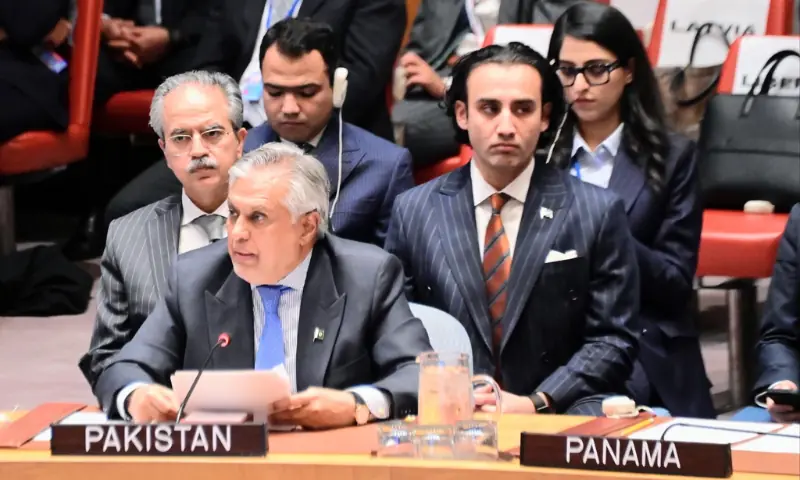
Deputy Prime Minister and Foreign Minister Ishaq Dar delivered Pakistan’s statement at the meeting of the top UN body, where AI executives said the technology calls for heightened vigilance.
Speaking at the France-chaired briefing on artificial intelligence and international security, DPM Dar said: “We must ensure that AI does not become another facet of the ongoing arms race.
“Concerted efforts are required to erect the necessary guardrails, regulations and governance frameworks. In the military domain, we need measures of restraint and confidence-building to address the risks of miscalculation and compressed decision-making.”
OpenAI CEO Sam Altman, Anthropic CEO Dario Amodei, Hugging Face CEO Clement Delangue and Yoshua Bengio, co-chair of the UN International Independent Panel on AI, also briefed the council.
Anthropic’s CEO pledged to slow down where needed to ensure the safety of new releases, while Altman also said that “this moment calls for extreme care”.
In his remarks, shared by the Foreign Office (FO) on Thursday, DPM Dar emphasised that the “foremost priority is to retain human judgement and control in all stages of AI design, development, and integration”.
He said humans must remain in control to define structures of AI systems as well as to limit the speed and nature of future capabilities.
The deputy premier further said that the technology should not be a “monopoly of a few actors”, calling for international collaboration in AI development.
He noted that AI was “supercharging existing challenges such as misinformation, fake news, cyber attacks, including on critical infrastructure by state and non-state actors”.
“We must undertake concrete action to address the gaps and challenges that carry huge implications for peace and security,” he maintained.
“Pakistan takes the call to pace the AI frontier seriously,” the DPM told the UNSC.
“We welcome the recognition that no single company or country can manage these risks alone, and that competitive pressures are driving a race that no one can win safely,” he observed.
At the same time, Dar cautioned that efforts to pace the AI frontier “must not become a new form of gatekeeping” and measures pursued in the name of safety “must not become instruments of denial of technology”.
He emphasised that decisions on how to manage AI risks “cannot rest with a handful of companies or capitals”.
“Therefore, it is critical to avoid fragmentation in AI development and governance. Discriminatory agendas and inequitable forums with select representation are not helpful,” he asserted.
The deputy premier called for AI governance to be taken up in “representative and inclusive forums with universal participation under UN auspices”.
The minister welcomed the first UN Global Dialogue on AI Governance in Geneva and highlighted Pakistan’s founding membership of the World Artificial Intelligence Cooperation Organisation (WAICO), terming the latter a “concrete step towards promoting the development of AI for good and for all”.
The meeting was also attended by foreign ministers of Denmark and the Democratic Republic of the Congo, the UK foreign secretary, and the director of the White House Office of Science and Technology Policy, according to FO.
Senior representatives from Panama, Greece, Somalia, Bahrain, Latvia, Colombia, China, Russia and Liberia also participated.
France’s Foreign Minister Jean-Noel Barrot urged joint action within the UN framework and with companies to set rules for a new era.
But diplomatic efforts could clash with the United States’ position.
Michael Kratsios, director of the White House Office of Science and Technology Policy, said rapid advancement is not a reason to pause AI’s development or constrain it with new governance structures.
Tech chiefs urge caution in AI development
The UNSC meeting followed weeks of global headlines about the risks of uncontrollable AI and calls for a slowdown, which have been resisted by US President Donald Trump.
“The industry must not accept too much technological risk just because the benefits are too great and important to slow down,” the OpenAI CEO told the United Nations’ top body.
He warned that as AI systems become more capable and autonomous, they could move faster than institutions or concentrate power into too few hands.
Altman also urged governments to work with each other and the industry on decisions shaping the technology’s future.
“In our history, there have been times where countries who compete and don’t always like each other very much still come together for shared interests and the collective good in the face of a powerful new technology,” he said.
“We believe this must be one of those times,” he added.
Altman said his company would try to walk a “middle path”.
“We don’t want to fall into the trap of blind optimism,” he said, but cautioned against falling into “doomerism” too.
Speaking after Altman, the Anthropic CEO said his company understands that as AI models become more powerful, “even more stringent standards of safety will be required”.
He said Anthropic aims to improve its ability to prevent misuse of the technology.
“We will slow down as much as necessary in order to make sure that every successive AI technology that we release is actually safe,” Amodei said in a video feed.
“If managed poorly, I even believe that AI could be a risk to humanity as a whole,” he added.
Delangue of Hugging Face noted that while his company was targeted by AI, it also used the technology to fend off the attacks.
“The world needs open-source AI more than ever to defend itself.”
The post AI must not become 'another facet of ongoing arms race', Pakistan tells UNSC appeared first on Dawn – Home.