Deputy Prime Minister and Foreign Minister Ishaq Dar closed out the 30th meeting of the Economic Cooperation Organisation (ECO) Council of Ministers (COM) in Islamabad on Monday with a call for countries to translate their commitments into action.
Pakistan, which holds the ECO chairmanship for 2026-27, hosted the meeting under the theme “Reviving Regionalism for a Resilient ECO”.
The deputy premier, who chaired the meeting, expressed his “sincere appreciation to all delegations” for their constructive engagement during the meeting.
“The deliberations today have reaffirmed our shared commitment to regional economic cooperation and integration,” Dar said.
He termed the adoption of the Strategic Goals of Economic Cooperation 2035 an “important milestone in charting the future course of our organisation over the next decade”, saying that it provided a shared framework to advance regional priorities alongside the Islamabad Communiqué.
“Our task now is to translate our collective commitments into concrete action,” he added. “This will require clear priorities, realistic timelines, and effective follow-up mechanisms.”
He highlighted regional cooperation as a central pillar of Pakistan’s foreign policy and noted that the country had consistently advocated a “stronger, more effective and responsive” ECO that harnessed “geographical proximity, historical bonds and economic complementarities”.
Dar underscored Pakistan’s commitment to advancing the ECO agenda as the chair of the organisation and to working with all institutions and member states to strengthen regional connectivity, facilitate intra-regional trade and promote mutually beneficial economic cooperation.
He looked forward to welcoming the countries back for the 31st COM meeting in 2027, saying, “Let us build on the momentum generated here so that our next meeting can take stock of tangible progress in advancing our shared priorities.”
In addition, he wished Iran success in hosting the upcoming 18th ECO summit on Dec 3-4.
The deputy premier thanked all member states, as well as the secretary general and his team, ECO permanent representatives, and senior officials for their support.
Later in the day, Dar held a media briefing on the meeting alongside ECO Secretary General Asad Majeed Khan and Information Minister Attaullah Tarar.
Araghchi calls for sustainable energy mechanism
At the ECO meeting, Iranian Foreign Minister Abbas Araghchi stressed the need for a reliable and sustainable regional energy mechanism during his address.
The Iranian FM spoke about the US-Israeli war on Iran, which has also resulted in the choking of key fuel supply routes — the Strait of Hormuz and Bab al-Mandab.
“Our region needs not only an independent security framework but also a reliable and sustainable regional energy mechanism to safeguard energy flows, ensure stable supplies, reduce external vulnerabilities and enhance collective resilience against geopolitical shocks and disruptions,” Araghchi said, according to a transcript of his speech provided by the Iranian embassy in Pakistan.
Araghchi said ECO was moving “beyond its traditional role towards becoming an effective platform for collective action, strengthened cooperation and joint efforts”. He said the shift would enable member states “to address emerging challenges and contribute to an inclusive and equitable global economic order”.
He stressed the need for a “modern, new-generation, more inclusive, effective and operational trade agreement” that would benefit the region.
Referring to the US war on Iran, Araghchi said, “Iran has remained committed to diplomatic engagement and peaceful solutions.”
He added, however, that the US had opted for a different course of action, which was “marked by aggression, threats, targeted assassinations, economic coercion, and blockades, in flagrant violation of international law and the UN Charter”.
He underscored that Iran had “no inherent dispute” with countries in the region, adding that “the territories, airspace and facilities of the regional countries must not be used as platforms for launching attacks against each other”.
“Iran’s legitimate defensive measures are directed exclusively at the targets and military bases of the aggressors and should in no way be construed as actions against the peoples or governments of the neighbouring countries,” Araghchi said.
He also called attention to Palestine, describing the genocide in Gaza as “the most pressing international crisis”.
Condemning the destruction and killings at the hands of Israeli forces in Palestine, he said, “We are witnessing the intensification of expansionist policies by the Israeli regime in the West Bank and occupied Al-Quds.”
“This is a moment that calls for concrete action, collective responsibility, and an end to silence and indifference.”
He concluded his speech by reiterating that Iran’s stability and prosperity were “intrinsically linked” to those of other ECO members.
Pakistan calls on Afghanistan to address terror concerns
Araghchi’s remarks followed the opening speech by DPM Dar.
In those remarks, Dar said Pakistan desired a peaceful, prosperous and stable Afghanistan, but meaningful progress towards regional cooperation required the Afghan authorities to address the legitimate security concerns of neighbouring countries, particularly the threat of terrorism.
He added that a stable Afghanistan, at peace with itself and all its neighbours and fully integrated into the ECO framework, would benefit the Afghan people as well as the wider region by opening up avenues for trade, transit and economic cooperation.
“At the same time, meaningful progress requires the Afghan authorities to address the legitimate security concerns of the neighbouring countries, particularly the threat of terrorism,” Dar said.
He stressed that a secure and stable environment was essential for sustained regional economic partnerships, adding that these considerations remained central to Pakistan’s broader connectivity agenda.
“Regional connectivity rests on more than the routes that link us. It depends upon trust between states and confidence that international commitments will be honoured. Unresolved disputes and the non-fulfilment of international obligations can erode that trust and impede economic progress,” said Dar.
The foreign minister emphasised that respect for international law and treaties is essential to enduring economic partnerships between countries.
Outlining Pakistan’s priorities during its chairmanship of the ECO, Dar identified five key areas of focus, including expanding trade and investment, strengthening regional connectivity, advancing the ECO Trade Agreement, building regional resilience and promoting human development.
The foreign minister said the region’s natural resources, energy reserves, agricultural potential and strategic location offered considerable opportunities for economic cooperation, but realising that potential required functioning transport corridors, efficient border procedures and predictable transit arrangements.
He said Pakistan would work towards wider market access, stronger regional value chains and greater private sector participation, particularly by small and medium-sized enterprises, to boost trade and investment among member states.
“Closer interaction among our business communities can help translate commercial potential into greater trade and investment.”
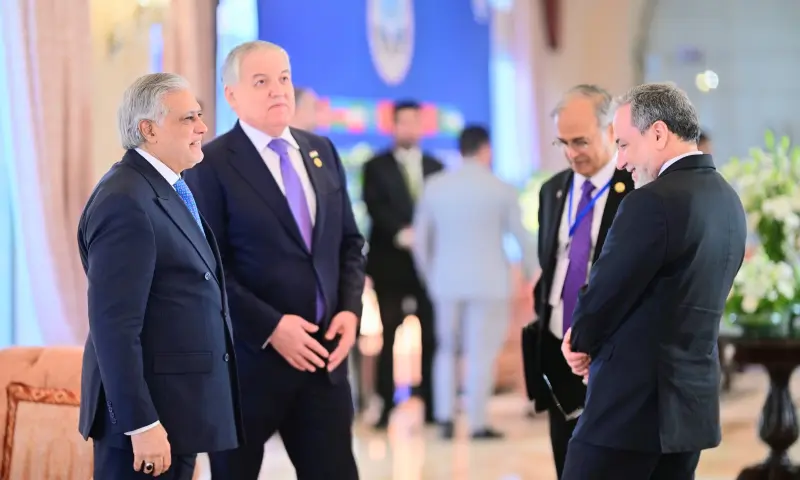
On connectivity, Dar said Pakistan would seek to improve transport and transit links between Central Asia, South Asia and Pakistani ports on the Arabian Sea. Harmonised customs procedures, efficient border management and predictable transit arrangements were essential to making regional trade routes commercially viable, he added.
The foreign minister also highlighted the need to advance the ECO Trade Agreement, saying the negotiating strategy and roadmap approved by ECO trade ministers in November 2025 provided a basis for modernising the agreement. Pakistan would support efforts to develop a more effective, inclusive and digitally enabled regional trade framework, he said.
On regional resilience, Dar called for closer cooperation in disaster preparedness, early warning systems, sustainable water management and climate-resilient infrastructure, noting that climate change and growing pressure on water and energy resources posed serious challenges to regional economies.
He also underscored the importance of human development, particularly in education, research, innovation and vocational training, saying greater opportunities in these areas could equip young people with skills needed by changing economies. Promoting entrepreneurship and professional exchanges would further strengthen regional integration, he added.
The foreign minister maintained that the five priorities were interconnected and their success would depend on collective efforts by member states. He expressed Pakistan’s readiness to work with ECO members and the organisation’s secretariat on initiatives relating to trade facilitation, transit connectivity and disaster preparedness.
Regional peace and diplomatic efforts
Dar cautioned that peace and stability were essential for economic development, warning that conflict and insecurity in the region could disrupt trade routes, energy supplies, investment and economic projects.
“Peace and development reinforce each other,” he said.
He added that Pakistan remained “deeply concerned about conflict and instability” in the region.
“Their consequences extend beyond national boundaries, disrupting trade routes, energy supplies, investment, and the economic projects of our peoples.”
He said that Pakistan has consistently advocated for “the peaceful resolution of disputes through dialogue and diplomacy in accordance with international law and the United Nations Charter”.
Referring to Pakistan’s diplomatic efforts in the US-Israeli war on Iran, Dar said, “Pakistan will continue these diplomatic efforts in support of dialogue, de-escalation, and lasting regional stability.”
He said that Prime Minister Shehbaz Sharif and Chief of Defence Forces and Chief of the Army Staff Field Marshal Asim Munir “remained closely engaged with brotherly countries and international partners to facilitate peaceful outcomes”.
ECO delegation heads call on PM Shehbaz
Separately, the foreign ministers and delegation heads of ECO member states paid a joint call on Prime Minister Shehbaz Sharif, according to a handout issued by the PM’s Office.
The premier thanked them for their participation in the meeting and reaffirmed Pakistan’s “strong commitment” to ECO objectives. He reiterated his government’s resolve to promote regional cooperation, connectivity and economic integration within the ECO member states.
The premier appreciated the meeting’s successful conclusion and welcomed the adoption of the Islamabad Communique and the Strategic Goals of Economic Cooperation 2035, describing them as “important steps” towards strengthening the organisation and advancing shared regional priorities.
The premier highlighted Pakistan’s ECO chairmanship and emphasised the need to translate the organisation’s collective vision into concrete, result-oriented initiatives that deliver “tangible benefits” to the region’s people.
Furthermore, the handout said that the premier called for enhanced cooperation in trade and investment, transport and transit connectivity, energy, information and communication technology, and sustainable development.
“He stressed the importance of effective implementation of existing ECO agreements and strengthening institutional mechanisms to accelerate regional economic integration,” the statement said.
PM Shehbaz highlighted the country’s strategic geographical location. He reiterated Pakistan’s commitment to enhancing regional connectivity through road, rail and multimodal transport corridors, including linkages with the ports of Karachi, Port Qasim and Gwadar, to facilitate access to regional and international markets, particularly for landlocked ECO member states.
“Underlining Pakistan’s commitment to dialogue and diplomacy for the peaceful resolution of disputes, the premier stressed the importance of collective efforts to address threats to regional security,” the statement added.
He also expressed Pakistan’s resolve to work closely with all member states and the ECO secretariat to further strengthen the organisation during its chairmanship.
“The prime minister reaffirmed that Pakistan looked forward to welcoming ECO member states again in 2027 for the next Council of Ministers Meeting and the ECO summit,” the handout concluded.
Senior officials meet to finalise agenda
Senior officials of the ECO finalised the agenda and draft Islamabad Communiqué on Sunday, ahead of the organisation’s COM meeting.
According to a statement issued by the Ministry of Foreign Affairs (MoFA), the Senior Officials Meeting (SOM) was held on Nov 15 under the chairmanship of Foreign Secretary Ambassador Asim Iftikhar Ahmad.
The meeting was attended by senior officials from ECO member states, representatives of the ECO Secretariat, and delegates from the organisation’s specialised agencies and regional institutions.
The officials reviewed preparations for the ministerial meeting and finalised its agenda and the draft Islamabad Communiqué for consideration by the foreign ministers.
They also reviewed the activities undertaken by the ECO Secretariat during the year, including ongoing programmes and initiatives, outcomes of sectoral ministerial meetings, and the work of subsidiary bodies and specialised institutions, the ministry said.
Administrative and financial matters of the organisation also came under discussion, with participants exchanging views on measures to improve its effectiveness.
The SOM serves as a preparatory forum for the ECO COM, enabling member states to assess progress, discuss issues of mutual interest and build consensus on proposals and draft documents ahead of ministerial-level deliberations.
The post At ECO moot, Dar calls for translating 'collective commitments into concrete action' appeared first on Dawn – Home.
