

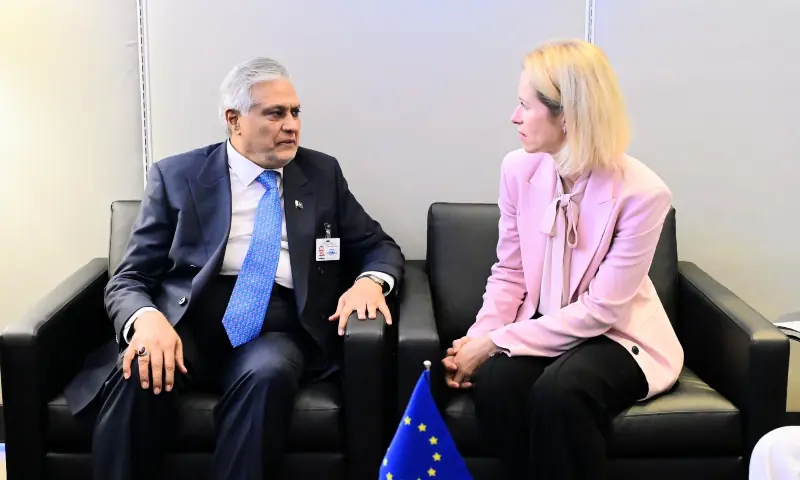
Deputy Prime Minister and Foreign Minister Ishaq Dar stressed the significance of GSP+ for Pakistan’s trade relations with the European Union in a meeting with EU High Representative for Foreign Affairs and Security Policy Kaja Kallas on Monday, according to a statement by the Foreign Office (FO).
The meeting took place on the sidelines of the 81st session of the United Nations General Assembly (UNGA) in New York, which will be held from Sep 21-25.
The deputy premier highlighted “the importance Pakistan attaches to its partnership with the European Union, particularly in trade and economic cooperation”. He stressed the significance of GSP+ for Pakistan’s trade relations with the EU, the FO said.
The two sides also exchanged views on regional and global developments, with DPM Dar appreciating the EU’s constructive engagement with Pakistan during recent regional developments, as well as its recognition of Pakistan’s efforts towards de-escalation and dialogue.
He called for a return to “the path of dialogue and diplomacy” and full implementation “by all parties” of the Islamabad Memorandum of Understanding signed between the US and Iran earlier this year, according to the statement.
“Both sides agreed to maintain close engagement on matters of mutual interest,” the FO added.
The meeting took place against the backdrop of an intense engagement between Islamabad and Brussels over a trading scheme and its future.
The current EU Generalised Scheme of Preferences framework is set to expire at the end of this year, and Pakistan is required to seek inclusion in the successor regime, which would carry more stringent requirements.
Though the new trading framework will take effect with the turn of the year, Pakistan and other existing beneficiaries will continue to receive preferences during a two-year transition period ending on Dec 31, 2028.
But the transition does not amount to an automatic continuation of the facility for the two-year period, or a roll over into the new scheme.
A European Commission assessment covering the years 2023-25, released in July this year, concluded that Pakistan had faced compliance issues with its obligations, regressed in a number of areas and made limited positive change.
Moreover, while acknowledging legislative and administrative measures, it noted that much of the progress had yet to translate into improvements on the ground.
The report had identified significant concerns relating to enforced disappearances and extrajudicial killings, freedom of expression, journalists’ and minority rights, judicial independence, access to justice and forced labour.
Diplomatic discussions between Pakistan and the EU suggest that Islamabad is aware of the gravity of the situation, though questions remain over whether it has yet moved decisively towards addressing the concerns that Brussels has repeatedly raised.
Earlier this month, the European Union’s ambassador to Pakistan had cautioned that GSP+ benefits could not be taken for granted.
EU imports from Pakistan reached €9.4 billion in 2022 before declining to €7.9bn in 2023 because of weaker European demand and recovering to €8.3bn in 2024.
The EU has remained Pakistan’s largest export destination, accounting for 28 per cent of its total exports, while textiles and clothing constituted around 70 to 76pc of Pakistani exports to the European market.
About 90pc of Pakistan’s exports to the EU remained eligible for GSP+ preferences during 2022-2024, with utilisation averaging 93pc and recovering to 95pc in 2024. According to the European Commission, Pakistan benefitted from approximately €732 million in tariff exemptions last year alone, equivalent to around 9pc of its exports to the European Union.
The post Dar meets EU foreign policy chief, stresses importance of GSP+ for Pakistan's trade ties with the bloc appeared first on Dawn – Home.