
ISLAMABAD: A joint sitting of Parliament on Thursday gave its approval to the Centre’s imposition of emergency and governor’s rule in Khyber Pakhtunkhwa amid a strong protest from the opposition.
The joint session had been summoned to discuss separate resolutions on the imposition of emergency and governor’s rule in KP, where the opposition’s PTI was in power.
During the session, which was addressed by both members of the treasury and opposition benches, the government justified its decision while the PTI lambasted the Centre and the allegations levelled against the party.
The Centre took the measures on Oct 11, citing the provincial government’s “deliberate disengagement” from the fight against terrorism. The move followed weeks of political tensions between the Centre and the PTI — as well as negotiations to bridge their differences — after the latter announced a long march to Islamabad to demand the release of its jailed founder, Imran Khan.
During Thursday’s joint sitting, opposition members turned up carrying placards inscribed with slogans, such as “emergency na manzoor (emergency is unacceptable)”.
PM Shehbaz, who attended part of the session, shook hands with opposition leaders of both the Senate and the NA, pictures and footage showed.
Parliamentary Affairs Minister Tariq Fazal Chaudhry tabled the two proclamations and separate resolutions regarding the emergency and governor’s rule.
After hours-long debate, NA Speaker Ayaz Sadiq put the two resolutions to a vote, while opposition members chanted “emergency unacceptable”.
The resolutions approving emergency and governor’s rule were then passed.
At the outset of the proceedings, Chaudhry also presented a motion under Rule 232 of the Parliament (Joint Sitting) Rules 1973 to suspend certain sub-rules so he could move the resolutions.
As loud noes echoed and opposition members chanted “emergency na manzoor”, the speaker again put the motion to a vote by asking the members to stand up, which was then adopted with 214-56 votes.
Subsequently, Chaudhry moved two resolutions before the joint sitting — one for approving the Proclamation of Emergency under Article 232 and the second for the proclamation of governor’s rule under Article 234.
Law Minister Azam Nazeer Tarar then opened the discussion on the two resolutions and said members of the treasury benches were ready to reply to any query raised by the opposition.
Explaining the constitutional process to approve the resolution for emergency, he said the joint sitting could reject it by a total majority, ie 51 per cent. Similarly, the resolution for governor’s rule also required a total majority of votes for approval.
The joint sitting also offered prayers for the lives lost, mostly of children, in a roof collapse in Peshawar.
The joint session took place a day after both Houses of Parliament, in separate sittings, passed resolutions endorsing the imposition of emergency in KP.
According to Article 232, if the “president acts on his own, the Proclamation of Emergency shall be placed” before both Houses of the Parliament for approval by each House within 10 days.
Meanwhile, a proclamation for governor’s rule issued under Article 234 “shall be laid before a joint sitting and shall cease to be in force at the expiration of two months”, unless a joint sitting approves its extension. However, such a measure shall not remain in force for more than six months.
Naqvi notes ‘clear stance’ of PTI lawmakers
Speaking during Thursday’s joint sitting, Interior Minister Mohsin Naqvi urged the opposition to stick to facts when recounting the dialogue held with the government, asserting that the Centre had “no option left” but to impose emergency and governor’s rule in KP.
“By God, our hearts did not want to do this,” Naqvi remarked, adding that the treasury members were trying their best so that the measures were not taken in KP.
“I will request only that you let facts remain facts. […] We had no option left, after which we did this and you will definitely oppose it, but we should consider the facts,” the minister said as he sought to provide a “clarification” on the allegations levelled by the opposition.
“Please do not say that we misused terrorism.”
He also refuted what he said was the opposition’s stance that the government delegation left the talks. “We did not get up and leave […] we did not even urge you to hurry up.”
Naqvi, who was part of the government’s delegation during the Oct 3 talks, emphasised: “We tried until the last minute […] It was our effort until the last hour that this (emergency/governor’s rule) is not imposed.”
The minister said the federal government offered its KP counterpart to declare emergency in “12 districts, on which you said fine, let’s do it”. He claimed that PTI’s Asad Qaiser, who was present during the talks, was willing to sign an agreement, but he advised the latter to consult the KP government first.
Pointing towards the opposition benches, Naqvi affirmed that the government was not levelling allegations against them. “I vouch for those sitting here that you were not even a single step behind on [countering] terrorism,” he added.
The minister referred to a video clip — later sharing it on his X account — in which KP Information Minister Shafi Jan was asked to declare that the banned Tehreek-i-Taliban Pakistan (TTP) was a terrorist group.
“Those individuals in the TTP who are against the state are terrorists,” Jan responded.
Addressing the opposition members, Naqvi further said: “I believe that you, and those we spoke to, particularly Asad Qaiser sahib, as he responded on [the issue] of terrorism that day, I guarantee that even we were not thinking of the things they were speaking on.”
He went on to acknowledge that all those present in the meeting “had an absolutely clear stance [on terrorism] that we will do this for Pakistan”.
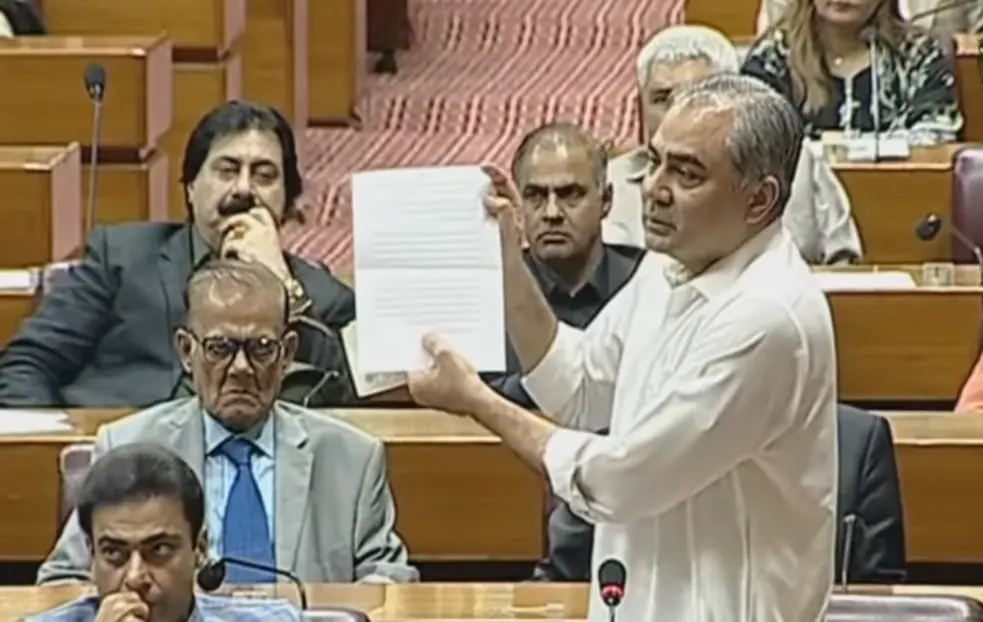
The interior minister, holding a paper, said he suggested to even exclude a term about the PTI calling off its long march, but PPP Vice President Sherry Rehman insisted on keeping it.
Naqvi noted that Sohail Afridi, the KP chief minister whose role is now non-functional, had not gone to the site of “even a single operation with the army and only used to say ‘I cannot afford this politically’”.
The minister recalled his efforts to sort out differences between the Centre and KP, such as meetings between Afridi and Prime Minister Shehbaz Sharif on the issue of provincial funds.
While saying he did not deem it appropriate to speak about Afridi in his absence, Naqvi claimed he and the PTI leader had discussed a plan to strengthen police forces in five KP districts.
He said the federal government wanted a meeting of the provincial apex committee to be held.
“A press release had to be issued, which would state that we will fight against terrorism together. You can ask for that press release, what was written in it and what happened; everything is before you.”
He recalled that some personnel were martyred in an attack “the same day”, adding that it took place in February.
“We requested the CM sahib and took him to the funerals with us. That was the last day when CM KP attended the funeral of any army officer or jawaan (soldier),” he added.
The minister concluded his speech by reaffirming the Centre’s determination to fight the wave of terrorism. He said the fight could not be waged on “under two [different] policies” of the federation and the province.
He urged the PTI to hold discussions with the KP government on what matters were wrong, adding: “No political party should be accused of terrorism. This is a major thing. But if something has happened, it should be fixed.”
Gohar objects to allegations of ‘backing terrorists’
Speaking on the Parliament’s floor, PTI interim chairman Barrister Gohar Ali Khan said the country was going through a “very fragile situation”.
He lamented that the KP government was accused of “backing terrorists”.
“The prime minister has alleged that we are supporting terrorists. We are disappointed to hear that. You have to apologise to the entire population of KP and us,” he said.
“Prime minister, you have given a message to the entire world that one of the federating units of the country was backing terrorists,“ Gohar added.
He highlighted that the opposition stood with the government during a war with India. “But today we are called supporters of terrorists,” he regretted.
Barrister Gohar rejected the proclamation of emergency and declared that the PTI will make the country stronger and eradicate terrorism when it comes into power again.
He also rejected the government’s claims that PTI leaders did not attend funerals of martyrs, recalling that he himself had attended multiple funerals in KP.
Gohar said the PTI was willing to engage in dialogue with the government provided that its demands were met.
He lamented that speeches of opposition members were not shown in the media.
Speaking to the media at Parliament after the session, Gohar again condemned the move to impose the emergency and governor’s rule in KP.
He noted that the production orders for two detained opposition MNAs — Sanaullah Khan Masti Khel and Dawar Khan Kundi — were issued on Wednesday, yet they were not brought to Parliament during the joint session.
Gohar said by removing the PTI from power in KP would not affect the party’s popularity as “its strength is the public”. But, he continued, “we condemn the illegal and unconstitutional dismissal of a provincial government. We will raise our voice against it at every forum”.
He then condemned terrorism, responding the federal government’s allegations that the PTI supported terrorism. He warned that accusing a provincial government of supporting terrorism would have “serious implications for Pakistan” internationally.
The PTI chairperson added that the prime minister had made a “mistake by making a political statement in a federal cabinet that a provincial government was supporting terrorism”.
“Don’t politicise the issue of terrorism,” Barrister Gohar urged.
“Do not put the nation and the federation at stake for the sake of your narrative. This (terrorism) is not just an issue for a province or the federation. Rather, it was a state-level issue. Time will prove that your decision was political,” he added.
He also rejected the allegations that the PTI was the reason behind the breakdown of talks with the government ahead of the imposition of governor’s rule in KP.
Dar defends ‘difficult decision’
During the joint session, speaking towards the end of the debate, Deputy PM and Foreign Minister Ishaq Dar defended the federal government’s “difficult decision” to impose emergency and governor’s rule in KP.
Dar said that the decision was “categorically” in accordance with the Constitution and appealed to the opposition “not to misinterpret or misquote facts” to save personal politics.
“Let me remind you of the history,” he said, saying that the menace of terrorism emerged after the 2014 Army Public School attack in Peshawar.
The PML-N leader recalled that a multi-party moot was held following the attack, with PTI in attendance and on board with the counterterrorism decisions, including the National Action Plan (NAP).
The deputy premier recalled that Operation Zarb-i-Azb and Operation Raddul Fasaad were launched against terrorists, adding that data showed their activities had “ended after the operations”.
“We all are Pakistanis […], but we all have the clarity in our minds regarding the facts,” Dar emphasised. Referring to the opposition, Dar said he could see the PTI was against terrorism, but asked who those “few” were who he alleged opened the borders and let the terrorists enter Pakistan.
“There are a few individuals in the party (PTI) who are responsible for the terrorism reaching its peak,” he claimed. “For how long will we keep repeating the same mistakes due to our petty politics and some individuals?” he asked.
On political reconciliation, Dar said that the menace of terrorism should be dealt with before any other matter. “If not now, then when?”
He also criticised Afridi for holding mobilisation campaigns across Pakistan while his province reeled from the threat of terrorism. Dar contended that the province had “collapsed in terms of governance”.
Referring to the federal cabinet’s Oct 11 meeting in which the decision was made to impose emergency and governor’s rule in KP, Dar said that PM Shehbaz left the meeting by saying “it’s now or never” to deal with the deteriorating security situation.
Achakzai blames ‘faulty decisions’
Speaking in the Parliament, NA Opposition Leader Mehmood Khan Achakzai blamed “faulty decisions” of the country’s rulers for the current situation.
He enquired about the whereabouts of Afridi, who was reported to be in preventative custody.
Achakzai, who leads the opposition alliance Tehreek-i-Tahafuz-i-Ayin-i-Pakistan (TTAP), accused PML-N’s Sadiq of not running the house judiciously as the speaker.
He said the opposition was ready for dialogue on issues such as empowerment of Parliament and eradicating terrorism of all kinds.
“If you hold dialogue on these issues, we will give unconditional support,” he added.
The opposition leader compared the KP imbroglio to the 1971 separation of East Pakistan, noting that Afridi was called a “terrorist”.
“Were multiple attacks on the heads of different political parties in the past in KP committed by Sohail Afridi?” he asked.
Achakzai said terrorism was introduced by those who had brought fighters for the Soviet-Afghan war. “When the Afghan war was over, these terrorists were left free in the tribal areas of the country and they started killing Pakistanis,” he added.
The opposition leader then mentioned the reported deaths during the July unrest in Azad Jammu and Kashmir (AJK).
The TTAP chief sought meetings of incarcerated PTI founder Imran Khan with his family, friends and party workers. He questioned who had “sent” ex-premier Nawaz Sharif to exile in Saudi Arabia and who “murdered” ex-PM Benazir Bhutto.
The NA speaker took exception to Achakzai’s remarks on his chairing of the session.
“You are saying to me that I am not running the House correctly. You have not read Rule 30. Someone takes their mobile phone; someone disrupts [the proceedings].”
Sadiq further said recordings of members’ speeches that were “anti-state” would not be uploaded on the NA’s social media accounts.
Meanwhile, Senate Opposition Leader Allama Raja Nasir Abbas accused the government’s delegation of derailing the dialogue with the opposition, including the Oct 3 talks.
The Majlis Wahdat-i-Muslimeen (MWM) chief said some more time should have been allowed to make the talks successful and called for resolving the public’s issues instead of blaming each other.
The senator contended that people voted for the PTI in large numbers during the February 2024 general elections in reaction to Imran’s imprisonment.
Noting that this was his first tenure as a parliament member, Abbas said he realised that the Constitution was a safeguard of the rights of people. He further claimed he did not receive a salary or any perks and privileges from the Senate.
‘We kept waiting’: PPP’s Rehman recounts Oct 3 talks
In her remarks, PPP’s Rehman asked the PTI to define its agenda and reasons for its long march, which the party had announced to stage towards Islamabad but remained within KP.
The senator added that President Asif Ali Zardari and PPP Chairman Bilawal Bhutto-Zardari had insisted on resolving issues through dialogue because terrorism was a red line for them.
She called on the opposition not to dictate to the government and to avoid giving lectures on patriotism.
Rehman emphasised that everyone was trying to find common ground and “a path of action”.
The PPP leader objected to the opposition’s claims that the government delegation left the Oct 3 talks.
“We kept waiting for you. The speaker and I ordered food for you as leaving was not being considered. We could have sat till 5am or 6am,” she said.
Rehman asserted, “We had said we would wait further […] This is not fair to say that we said ‘we are leaving’. Definitely not. Opposite.”
Speaking on the topic, the NA speaker — who chaired the talks — also remarked, “What was the hurry in launching the long march?”
Sadiq referred to a post on X made by Afridi about going ahead with the long march even as the negotiations were underway.
“You said to ignore it, so we kept ignoring it till 3am, so I think, if you want to sit again [at the table] then do not go into further details. Those things took place in confidence; bury them here.”
The PPP vice president remarked that the country faced several emergencies, including those regarding education and poverty, that needed to be seen holistically.
“If you think PPP is going to support any sort of emergency which is against the Constitution, you are wrong,” she declared.
“This Constitution has bound the country together through difficult times. We remember the lessons from the fall of Dhaka,” she said.
“PPP has seen many phases of the path towards democracy. It (martial law) was a dark chapter in history; we do not want the country to go through such an experience again,” Rehman said, recalling “sacrifices” made by her party.
JUI-F says no ‘evidence’ presented
Senator Kamran Murtaza of the Jamiat Ulema-i-Islam-Fazl (JUI-F), who had earlier submitted a resolution opposing the imposition of governor’s rule in KP, contended that no documentary evidence was presented before the Parliament for the decision.
He argued that the proclamation under Article 234 required a report from the KP governor, but in this case, Governor Faisal Karim Kundi had not presented a report explaining why governor’s rule was necessary.
The JUI-F senator said the security situation in Balochistan was also grave and pointed out that a provincial government now had its writ in the Katcha areas without an emergency being imposed there.
Murtaza stressed that free and transparent elections under a fair election commission were the only solution to the existing problems.
The post Joint sitting of Parliament endorses emergency, governor's rule in KP amid opposition outcry appeared first on Dawn – Home.
