
Lahore topped the list of the world’s most polluted major cities once again on Sunday morning with an hourly air quality index (AQI) reading of over 500, according to real-time air quality data.
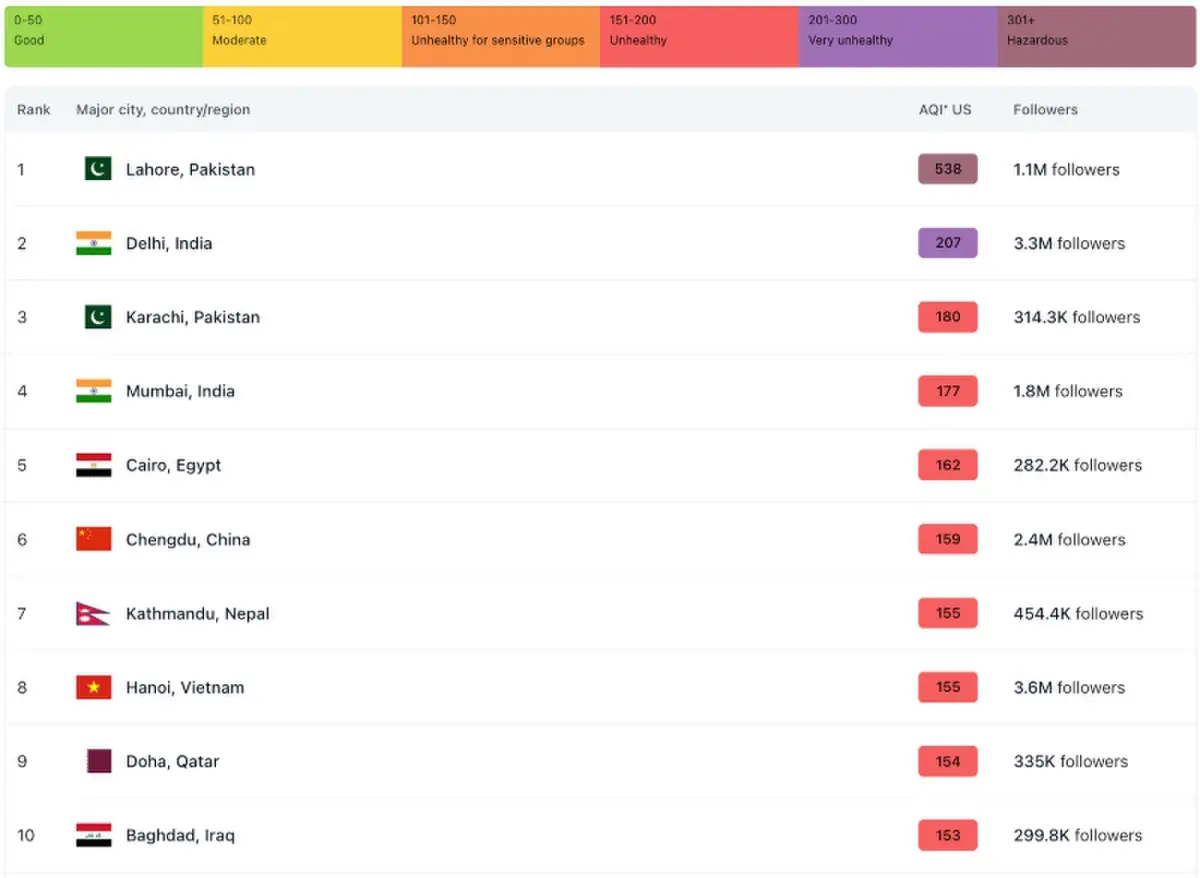
Swiss air quality monitoring platform IQAir’s live global major city ranking placed Lahore first with 538 between 9am and 10am, classifying the quality as ‘hazardous’, indicating extremely polluted conditions and serious health risks for residents.
It was followed by Delhi with an AQI of 207, Karachi with 180, Mumbai with 177 and Cairo at 162. The ranking showed Lahore’s pollution level to be more than twice that of the second-ranked city, Delhi.
The deterioration was not confined to the provincial capital.
IQAir’s live ranking of Pakistani cities on Sunday morning placed eight Punjab cities among the country’s 10 most polluted urban centres.
Kahna Nau in Lahore district topped the list with an AQI of 606, followed by Lahore at 538, Bahawalpur at 536, Sargodha at 392 and Gujranwala at 347.
Other cities in the top 10 included Multan, Dera Ghazi Khan, Skardu, Faisalabad and Peshawar.
According to global health statistics, air pollution, both outdoor and indoor, is the second-leading risk factor for deaths worldwide, claiming an estimated 8.1 million lives annually. Outdoor particulate matter alone accounts for 4.7m deaths.
Lahore has consistently ranked as the world’s most polluted major city in the past few weeks. On Saturday evening, it recorded an AQI of 266, showing Lahore’s air quality in the hazardous category.
On Friday, heavy smog pushed air quality in several Punjab cities into the hazardous category, with Lahore recording an hourly AQI reading of 465 between 7am and 8am.
Punjab govt intensifies crackdown against smog violations
Amid the worsening air quality, Punjab’s Environment Protection and Climate Change Department (EPCCD) has intensified its province-wide crackdown against environmental violations, imposing fines amounting to Rs449.5 million, sealing 6,476 premises and carrying out 1,808 demolitions during the first 11 months of 2026.
According to the latest enforcement figures compiled by the Environment Protection Agency (EPA) Punjab, enforcement teams conducted 187,588 field visits across the province between January 1 and November 21, targeting industrial pollution, non-compliant brick kilns, illegal plastic businesses, commercial establishments and fugitive dust.
The enforcement drive has also yielded a 60 per cent increase in fines compared with the corresponding period last year, reflecting intensified regulatory action against major sources of pollution.
Industrial units accounted for the largest share of penalties, with fines reaching Rs231.6 million against Rs108.8m during the same period in 2025.
Brick kilns attracted Rs183.3m in fines, while penalties against plastic-related violations increased 4.5 times to Rs34.5 million.
Brick kiln inspections remained a major component of the campaign, with 85,768 visits recorded during the reporting period. Enforcement teams demolished 1,431 units and sealed another 1,018 premises. Industrial enforcement operations involved 50,555 inspections, resulting in 1,525 premises being sealed and 377 demolitions.
The department has also stepped up enforcement against restaurants and commercial establishments operating without the required suction hoods. A total of 10,766 inspections were conducted, leading to the installation of 4,385 suction hoods and the sealing of 1,287 premises. Significantly, 1,130 suction hoods were installed during November alone.
The daily enforcement figures for November 21 further illustrated the scale of operations, with teams conducting 1,022 inspections across Punjab and imposing fines of Rs1.87 million.
The operation resulted in 20 premises being sealed, seven FIRs registered and one brick kiln demolished. Officials also confiscated 390 kilogrammes of plastic bags and oversaw the installation of 72 suction hoods.
Brick kilns accounted for 499 of the day’s inspections, followed by 275 industrial units, 153 plastic-related inspections and 95 suction-hood inspections. All seven FIRs and the demolition recorded on the day were related to brick kilns.
Director General Environment Abdullah Nayyar Sheikh said the department was maintaining strict enforcement against all major sources of pollution through continuous monitoring, field inspections and action against non-compliant units. He emphasised that the strategy was aimed at ensuring compliance with environmental laws and preventing pollution at its source.
EPCCD Secretary Silwat Saeed also stressed the importance of sustained institutional monitoring and effective implementation of environmental regulations to address pollution through a coordinated enforcement approach.
A day earlier, the Lahore Traffic Police claimed to have intensified enforcement operations against vehicles contributing to air pollution.
Chief Traffic Officer Syed Abdul Rahim Shirazi on Saturday claimed that the traffic police have issued challan tickets to 14,653 smoke-emitting vehicles.
Action has also been taken against 10,306 vehicles transporting sand, soil and other materials without covering their loads with tarpaulins. The police have also proceeded against 31,618 unfit and dilapidated vehicles and taken action against 272,760 vehicles for overloading, he said.
Pakistan’s average PM2.5 concentration stood at 67.3 micrograms per cubic metre in 2025, nearly 14 times the World Health Organisation’s annual guideline of 5 micrograms per cubic metre, according to the 2025 World Air Quality Report.
This concentration corresponded to an average AQI of 156, placing Pakistan among the world’s most polluted countries.
The post Lahore once again ranks as world's most polluted major city as AQI crosses 500 appeared first on Dawn – Home.
