

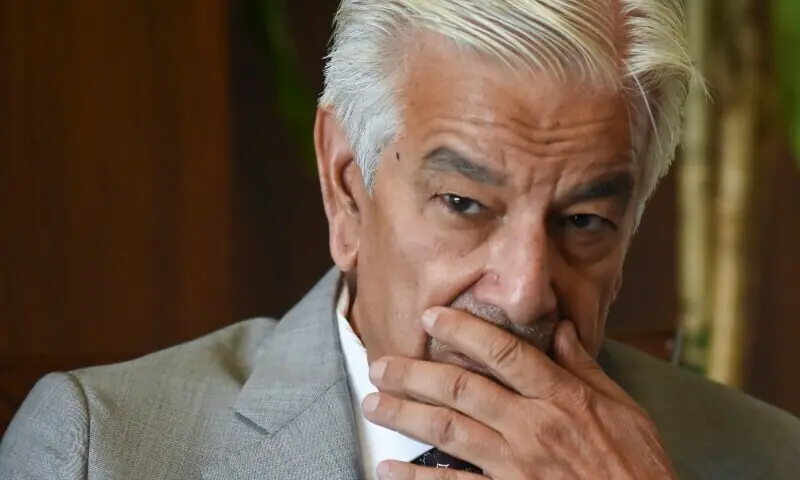
Defence Minister Khawaja Asif on Wednesday said Pakistan would “practically and diplomatically” stand by Saudi Arabia against Yemen’s Houthi rebels if the situation escalated.
Earlier in the day, the Saudi-led coalition battling Yemen’s Houthis accused the rebels of targeting the holy city of Makkah, sparking outrage across the Muslim world and deepening the conflict roiling the region.
However, the Houthis swiftly rejected Riyadh’s report as a “lie” that it shot down a drone from the rebels heading towards Makkah.
“If the situation escalates, we will stand with Saudi Arabia, both practically and diplomatically,” he said while speaking on Geo News programme ‘Aaj Shehzaib Khanzada Ke Saath’.
Commenting on the Pakistan-Turkiye-Saudi Arabia trilateral agreement — the Makkah Defence Alliance — he affirmed that an agreement was in place.
However, he said that even if there had been no such agreement, Pakistan was bound by an “eternal agreement to respond if the holy sites come under attack”.
“There are some worldly agreements, too, and they have their own sanctity and obligations, but protecting the holy sites is our religious duty,” he said.
Asif maintained that Muslims around the world did not need an agreement to act if the holy sites in Makkah or Medina came under attack. “There is no need to activate any agreement,” he said.
The defence minister maintained that Pakistan would fulfil all its obligations under the Makkah Defence Alliance in accordance with the terms of the agreement between the three countries.
“There is absolutely no ambiguity,” he asserted.
Asked about any military or political engagement with the Houthis, Asif said he could not disclose details, adding that strategies at this level were not meant to be made public.
However, he reiterated that Pakistan was bound by the agreement.
“Under the trilateral agreement, if the territorial integrity of a country comes under threat, the agreement will be activated and the other two countries will proceed to protect it in fulfilment of their obligations,” he said. “The situation has arrived.”
On the US-Israeli war on Iran, Asif said it had become clear, a month into the conflict, that Israel’s calculations had not produced the expected results.
“Israel sucked America into this war as a combatant party, but under the present circumstances, the world and the region need to realise that Israel is the real culprit,” he said.
“Until Israel is confronted by a joint alliance, it will remain a threat to the region. The Zionist lobby also forces the US to join Israel’s wars.”
Sharing his personal view on possible Iranian support for the Houthis, he said Iran, as a state, might not be backing the group as it was already embroiled in another conflict in the Middle East.
“This would be a diplomatic error if Iran were to take the side of the Houthis, but the chances are minimal. Escalating the conflict into another theatre is not a wise decision and could turn it into a wider conflict,” Asif said.
Fresh fighting between the Houthis and the Yemeni government has dragged in Riyadh, with the Houthis declaring a maritime blockade on the kingdom and targeting its ships in the Red Sea.
Last week’s lightning offensive saw the group seize control of the entirety of Yemen’s Red Sea coast and the Bab al-Mandab Strait, a vital artery for Saudi oil exports as the wider Middle East war chokes off the Strait of Hormuz strategic shipping route.
Pakistan’s stance
Earlier today, Inter-Services Public Relations (ISPR) Director General Lieutenant General Ahmed Sharif Chaudhry said that the defence alliance has no “regional aspirations”, adding that it is intended for collective deterrence.
The military spokesperson made the remarks during an interview on Al Arabiya English’s programme ‘Global News Today’, during a conversation with the host, Tom Burges Watson.
“It formalises Pakistan’s decades-old relationship with the kingdom of Saudi Arabia and the brotherly country of Turkiye in the domains of collective deterrence and defence,” he said.
Watson asked whether the pact was primarily a defensive cooperation or the beginning of a broader strategic alliance. To that, Lt Gen Chaudhry asserted that the pact was defensive, as its name implied.
“It is defensive. There’s nothing aggressive. There are no regional aspirations. It is collective deterrence,” he said, adding that the agreement was also “complementary”.
During the interview, Lt Gen Chaudhry was also asked whether he saw the defence agreement becoming a part of the wider, Muslim-world security architecture.
He replied that there was nothing in the pact that stated that it was a Muslim alliance, adding that it was an alliance for regional stability.
“It is not a club that is being made for only Muslim countries,” he said, adding that decisions on its expansion were to be taken by the leadership of Pakistan, Saudi Arabia and Turkiye.
“This agreement, this alliance can always encompass new, willing partners who also believe in regional peace, stability and security, [and] who have a shared vision of non-aggression, non-interference and collective deterrence.
“But that’s for the leadership of these three countries to decide; the how and when part,” he elaborated.
The joint defence pact was signed on Aug 7 and provides that an attack on one member state would be treated as an attack on all. Its inaugural meeting was held in Istanbul on Aug 31, where it was decided that Pakistan would initially head the alliance’s secretariat for three years.
Since its signing, there has been conversation about the possibility of its expansion, with Turkiye initially suggesting the possibility of Egypt’s inclusion. Though there has been no confirmation from Cairo.
From Pakistan, Prime Minister Shehbaz Sharif and Deputy Prime Minister and Foreign Minister Ishaq Dar clarified soon after the signing that the pact was defensive in nature, with the latter saying that it was also “open to any country in the region” willing to uphold its fundamental principles.
However, when Foreign Office spokesperson Sajjah Haider Khan was asked about possibility of the pact’s expansion during a weekly media briefing last week, he said an expansion was not on the cards at that point.
The three countries first needed to solidify the new organisation before considering opening it to other states with similar threat perceptions and requirements, he explained.
The post Pakistan to stand by Saudi Arabia 'practically and diplomatically' if Yemen conflict escalates: Asif appeared first on Dawn – Home.