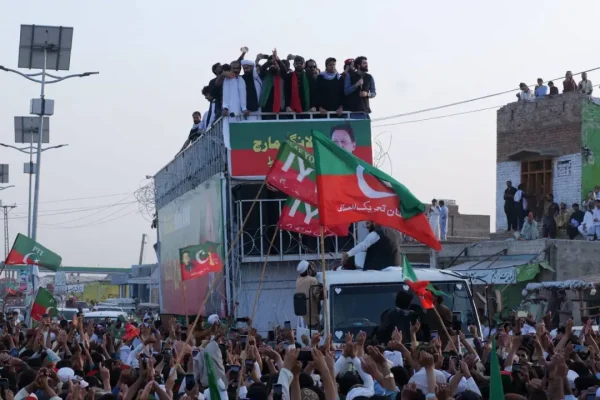
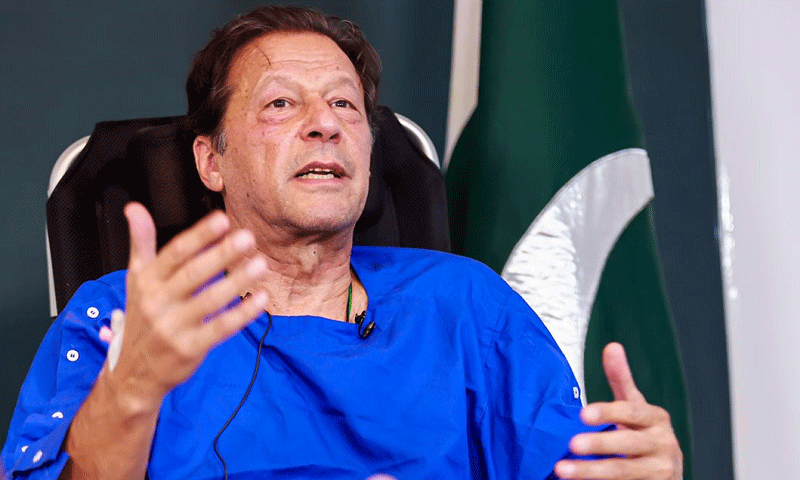
The PTI on Sunday asserted that the main reason for the breakdown of its talks with the Centre was that the latter refused to incorporate terms regarding access to incarcerated party founder Imran Khan into a proposed agreement.
Hours-long negotiations yesterday between an opposition delegation comprising the PTI and Tehreek-i-Tahafuz-i-Ayin-i-Pakistan (TTAP), and a joint team of the government and PPP, ended in a deadlock.
While the federal government blamed the PTI for the failure of negotiations, the main opposition party denied the allegations and claimed that the federal government was responsible for all that happened on Saturday night.
In a press release posted on social media, the PTI expressed regret that the negotiations concluded without substantive progress, despite “serious efforts” to address concerns including political instability, access to the PTI founder as well as his medical treatment, and the worsening security situation in the country, particularly Khyber Pakhtunkhwa.
The statement said that the “principal point of the deadlock” was the party’s demand for immediate access to Imran, so that its leadership could consult him on matters of “national and political importance”.
According to the statement, the government agreed to restore meetings between Imran and his family members and lawyers from Tuesday, but did not agree to the additional measures concerning his medical assessment and treatment.
“In an effort to facilitate progress, the negotiating team conveyed that other demands could be set aside if the government agreed to this single request. However, according to PTI, the government declined to make access to Imran Khan part of the proposed agreement,” the PTI said.
“PTI welcomed the resumption of family and legal meetings but stressed that such access cannot substitute for proper medical examination and necessary treatment,” the statement read, adding that the party called for Imran’s health to be addressed with “seriousness, transparency and humanitarian consideration”.
The party stressed that just as leaders of other political parties remained central to decision-making and policy, the PTI must also be allowed to consult its chairman; restricting such consultation limited the scope for meaningful political engagement, it added.
Imran — imprisoned since Aug 5, 2023, for concealing details of Toshakhana gifts — is serving a 14-year sentence at Rawalpindi’s Adiala jail in a £190 million corruption case, also known as the Al-Qadir Trust case.
Despite an order by the Islamabad High Court (IHC) allowing him twice-a-week meetings on Tuesdays and Thursdays with his family, lawyers and other associates, Imran has been restricted from meeting visitors for several months.
His health has deteriorated over the course of his prison sentence, prompting outcry from members of the party.
According to the PTI, Imran’s health and medical treatment were also raised as a matter of fundamental importance in the talks, with the negotiating team seeking immediate access to him, his transfer to Shifa International Hospital in Islamabad for treatment, and the constitution of an “appropriate” medical board — including his personal physician — to ensure his proper examination, diagnosis and treatment.
After his eye ailment — right central retinal vein occlusion (CRVO) — came to light in late January, Imran has been provided with treatment at the government-run Pakistan Institute of Medical Sciences (Pims).
In mid-August, the Supreme Court ordered the government to shift Imran to Shifa International Hospital within two days for examination and treatment. However, the government later revealed that Imran was instead taken to Pims, prompting a strong reaction from his family and party.
Security situation in KP
The security situation in KP also featured prominently in the discussions, with the PTI saying it stressed that the concerns of the public must remain central to counterterrorism policies.
According to the statement, the Centre sought the provincial government’s “unconditional support” for its counterterrorism measures and operations as well as support for imposing emergency measures within 72 hours in the merged districts and adjoining areas.
“The PTI reiterated its unequivocal condemnation of terrorism and stressed that eliminating terrorism, protecting citizens and restoring lasting peace must remain a national priority,” it said, adding that the party paid tribute to the officers and personnel of the authorities that have sacrificed their lives in the fight against terrorism and expressed solidarity with civilians and families who had suffered from terrorist violence.
“Terrorism cannot be defeated through force alone or through unilateral measures that could expose innocent civilians to further loss of life, property or displacement,” the party maintained, calling for a strategy that combined “firm action against terrorism with protection of civilian populations and sensitivity to local realities”.
Accordingly, it proposed a meeting within 72 hours of authorised representatives of the federal and provincial governments to develop a mutually agreed strategy for peace and counterterrorism. It also proposed consultation with political parties represented in the KP Assembly, elected representatives, tribal elders and other relevant stakeholders in order for the policy to enjoy public confidence and be implemented effectively.
PTI also rejected attempts to characterise the position of KP Chief Minister Sohail Afridi as political obstinacy, arguing that “had access to Imran Khan been facilitated, the chief minister could have consulted the PTI chairman directly on security and counterterrorism policy, potentially helping to bridge differences and create greater consensus”.
Responding to the press conference held by federal ministers after the talks ended without result, PTI said the government should address the substantive issues that prevented progress instead of seeking to place the responsibility on the opposition.
It called for an explanation as to why immediate access to Imran was considered unacceptable, why requests regarding his medical care were not accommodated, and why the proposed broader consultative approach was not accepted for developing a sustainable security strategy in KP.
The party reiterated that it remains “prepared to engage in political dialogue, constitutional processes, meaningful consultation and national consensus to address Imran Khan’s health and treatment, restoration of democracy, supremacy of the Constitution and law, political stability, terrorism and the wider challenges confronting Pakistan”.
The party stressed, however, that “meaningful negotiations” could not succeed through predetermined positions or demands for unconditional endorsement.
“Serious dialogue requires flexibility, mutual confidence, consultation and a genuine willingness to translate discussions into practical progress,” the statement added.
‘Three fundamental red lines’
Separately, Opposition Chief Whip Malik Aamir Dogar stated that the talks had fallen through on “three fundamental red lines”: meetings with Imran, his medical treatment, and KP’s terrorism policy.
“We made it clear that the authority to call off the long march rests solely with Imran Khan sahib, so a meeting with him is essential,” he said in a post on X.
The MNA added that, when the government was unwilling to do this, an alternative demand for Senate Opposition Leader Allama Raja Nasir Abbas’s meeting with Imran was also put forward, but similarly rejected.
On the PTI founder’s health, Dogar said that the opposition’s minimum demand had been the inclusion of his personal physicians in his treatment to dispel “doubts and suspicions” about his health. This, too, was not agreed to, which heightened the opposition’s concerns.
The third “red line”, he said, was that the opposition demanded that “no decision be made unilaterally” regarding KP’s security and terrorism policy, but rather that all relevant stakeholders be taken into confidence.
“Instead of broad consultations on this matter, the government sought hasty decisions within 72 hours,” he said.
As a result of the government’s refusal of these demands and the party’s refusal to back down from them, he added, the negotiations ended in a deadlock.
Salman Akram notes Centre’s ‘insistence on unilateral’ CT measures
Earlier, PTI Secretary General Salman Akram Raja asserted that the main reason for the breakdown of talks with the Centre was the latter’s insistence on “unilateral” counter-terrorism measures in KP.
In a post on X, Raja wrote that the “primary reason for the failure of the talks around 3am this morning” was that the “PTI-TTAP team stood firm on its principled position that anti-terrorism actions in KPK would be based on agreement between the federal government and the KPK government”.
He said the opposition wanted those actions to be “framed on the basis of consultation with, and the buy-in of, the different political parties represented” in the KP Assembly.
“This was not acceptable to the government team, that insisted that all actions unilaterally initiated by it would have to be owned by the provincial government,” Raja asserted.
“The PTI-TTAP team was clear that we have zero tolerance for terrorism and are committed to rooting it out. We also have a clear position against so-called collateral damage in the form of innocent lives and internal displacement of the local population.”
Raja noted that counterterrorism policies require support from the local population and ground intelligence.
“The wisdom provided by the jirga held in the KP assembly of all the political and tribal notables of the province, including the merged districts, must be heeded.
“This was not acceptable to the federal government,” he wrote.
In November last year, a peace jirga held at the KP Assembly, also attended by the governor, demanded that the Centre consult the KP government over Afghan policy.
Tarar accuses KP govt of ‘supporting’ terrorism
On the other hand, Information Minister Attaullah Tarar responded to Raja in a lengthy post on X, questioning why the KP government has not taken action against terrorism.
“It is only now, when your KP government is politically weak, [that] you have started responding to the federal government’s calls for [a] joint mechanism to fight terrorism, that too only as a strategy to save your political capital in KP,” the minister alleged.
“This is an old strategy of PTI, that when under pressure, they start talking of consultations and joint actions, but on [the] ground they do the exact opposite.”
Accusing the KP government of “double standards and hypocrisy”, Tarar contended that while it said it was taking steps to fight terrorism, its “narrative on terrorism is in favour of terrorists”.
“KPK government’s policy only encourages and supports [the] spread of terrorism in the province,” the PML-N leader alleged.
Tarar questioned why the KP government had not taken steps against terrorism or convened the provincial apex committee for meetings and why it had not condemned the “TTA regime for sponsoring terrorism inside Pakistan and conduct of cross-border attacks on the posts and drone attacks by them”.
“Why hasn’t the KPK Government not implemented NAP as per which clear action is required against illegal spectrum, illegal Afghan immigrants, measures for capacity enhancement of Police and [Counter-Terrorism Department]?” he added.
He asked why PTI leaders did not visit checkposts of security forces and police to express their support, and whether they had taken interest in the governance and development of esrtwhile Fata.
The minister urged the PTI to “stop selling this false narrative of collective consultations, jirgas or any other method, as this means nothing on [the] ground other than delaying tactics”.
Tarar reiterated his comments in a televised video statement, slamming the PTI for failing to abandon “double standards and hypocrisy”, which he said resulted in deadly terrorist attacks in KP.
“We were considering that they may go back on their word, and I had been saying it for the past two and a half weeks: if we are going to talk, then who should we talk to? And if we talk, what guarantee do we have that they will honour their word?” the minister asked.
He accused the PTI of taking U-turns and “expressing pride in them”, as well as failing to maintain a steady stance on the issue of protecting the lives and property of KP’s residents.
“Now different statements are emerging: Salman Akram Raja is saying one thing; [Adviser to KP Chief Minister on Information] Shafi Jan is saying that they want to change the policy on terrorism,” he added. “What is your policy? Does it even exist?”
Tarar alleged: “The only policy you have is deliberately supporting terrorism. Your policy is how you can elevate terrorists, how you can build a political terror-crime nexus and how you can spread terrorism across the province.
“I said earlier that you have to decide whether you stand with Pakistan or Afghanistan. You take the benefits of Pakistan, but are in favour of Afghanistan.”
“The policy change they are talking about is to give terrorists cover and protection,” Tarar further claimed.
He said people of KP were being killed in terrorist incidents because KP Chief Minister Sohail Afridi “wants to free one prisoner”.
“Lives have been wasted and people have been martyred because the province’s CM prioritises the release of one convicted prisoner,” he insisted. “This is why I say they (PTI) are TTP’s (Tehreek-i-Taliban Pakistan) B-team and TTA’s (Afghan Taliban) C-team,” the PML-N leader alleged.
The minister further accused the KP government of having a “pro-terrorism mindset”, which he contended had contributed to a failure to prevent terrorist attacks and cross-border firing from Afghanistan.
“Because their mindset is pro-terrorism, then they don’t care that security forces, armed forces, police, and thousands of officers and troops have been martyred,” Tarar claimed.
“They cannot even honour their martyrs … They burned the Chagai monument in Peshawar. This is a terrorist mindset; can they stop terrorism with this mindset in govt? No, they never will,” the minister asserted.
The minister continued denouncing the PTI, accusing it of not building a forensic lab or creating a Counter-Terrorism Department, failing to install Safe City cameras and being unable to fortify police check posts.
“You’ll be surprised to know that since they took power, they have received over Rs700 billion for counter-terrorism under the NFC Award,” Tarar claimed, adding that it is “extra”.
“This year, if you look at the figures, they have earmarked Rs45bn for police capacity building and counter-terrorism, but only released Rs1.5bn. The rest is for salaries and expenses. Is this how the war on terrorism will be fought?” he asked.
Earlier on Sunday, Interior Minister Mohsin Naqvi said that the weekend talks collapsed as the PTI had initiated its long march, accusing KP Chief Minister Sohail Afridi of “sabotaging” the negotiations.
“Their team was reasonable. I am repeating that I will not blame anyone else for all of this collapsing. There is only one person responsible for the entire collapse, and that is the KP chief minister,” the interior minister declared.
He further said that Afridi was to be responsible “if there is any loss of life”. He said those supporting the PTI leader should “realise that they will be committing contempt of court, and we will take legal action against them to every possible extent”.
The post PTI terms access to Imran 'principal point of deadlock', claims Centre refused to include it in agreement appeared first on Dawn – Home.