

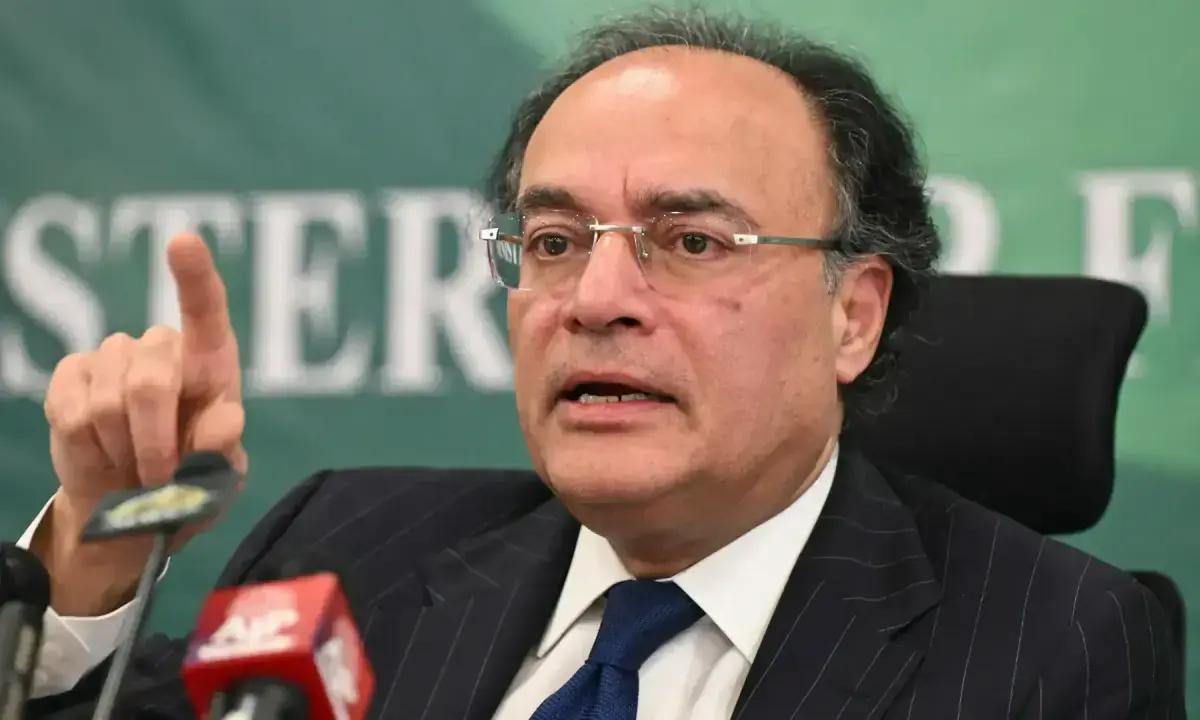
Finance Minister Muhammad Aurangzeb warned on Sunday that protests and sit-ins would result in a daily loss of around Rs120 billion, citing research findings.
His warning in a televised recorded message came ahead of the PTI planned protest march to Islamabad on Sept 27, which the government has vowed to stop.
The PTI has announced a nationwide protest on Sept 27 to demand release of party founder Imran Khan and mobilise people for the supremacy of the Constitution, with the plan to march towards Islamabad.
The Jamaat-i-Islami also launched its march towards Islamabad today in a bid to press the government to end the fuel levy.
In his message, Aurangzeb said the protests and sit-ins, when seen against the backdrop of the economic hardships resulting from the Middle East conflict, would be a “self-inflicted pain”.
The finance czar said that supply chain disruptions and increased freight and insurance costs were arising from Middle East tensions. He also recalled the recent Kohat bombing, noting a fresh wave of terrorism in the country.
Within this context, he said, “In the past few days, along with the economic wing of our planning commission, we have held consultations on the results of protests and sit-ins on the economic progress we have sustained through difficult decisions”.
Taking previous instances and the present situation into account, he said the planning commission had estimated that the proposed protests will cause “a loss of Rs120bn daily, and this is based on very good research”.
He noted that the services sector — including financial services, communication, retail, transportation, wholesale and hospitality — was estimated to take the biggest hit, with a loss of Rs86bn.
In the industrial sector, the loss was estimated to be Rs25bn, the finance minister said, adding, “this includes construction, finished goods, raw material and supply chain”.
Meanwhile, the agriculture sector will suffer a loss of Rs9bn, he said.
Aurangzeb estimated an additional Rs17bn revenue loss if the proposed protests were to go ahead.
He also noted the “burden of a high cost on the national treasury” within the context of logistics, transport, fuel, and security deployment used in response to the previous protests and sit-ins.
Aurganzeb noted that an emphasis was often placed on promoting export-led growth, noting that the target for the current fiscal year stood at $35.9bn “and there is a six per cent increase expected”.
“We have been on trajectory for the first two months,” he said.
Within this context, the finance minister recalled a strike in December 2025 and said, “It took us 1.5 months to recover” from the resulting economic losses.
He recalled a similar instance in August, noting that “such disruptions could severely harm our growth trajectory, and this is on top of the situation in the Middle East in Hormuz and Bab al-Mandeb”.
Aurangzeb also spoke of the economic impact on Information Technology (IT) exports resulting from civil disobedience.
“In July and August, our IT exports have been $811 million, with $13m daily,” he said. Aurangezeb expressed concern that internet connectivity issues from acts of civil disobedience previously “impacted IT exports by 80pc”.
“So, as you can see, aside from goods and services, this will be a big setback if we go towards these long marches and sit-ins,” he said.
More to follow
The post 'Self-inflicted pain': Finance minister says protests, sit-ins to cause daily loss of around Rs120bn appeared first on Dawn – Home.