Last week, I came across a social media video showing a truck smashing into a traffic police car in Karachi. The officer in the car had been trying to pull the truck over for a traffic violation. What stood out most, however, were the comments underneath the video.
The majority of commenters sided with the runaway truck driver. Some argued that the police shouldn’t have tried to stop a truck in the fast lane, while others questioned the officer’s “real motives.”
Predictably, the discussion soon derailed into politics, spiralling into tirades against the government and the city administration. Rather than focusing on the reckless hit-and-run itself, many commenters simply used the incident as a springboard for their own political grievances.
The personalisation of politics was once mostly associated with radicals, while turning tragedies into political points was strictly the job of politicians. Today, however, everyday people have picked up both habits. It has become a global phenomenon. A corporate executive is assassinated in broad daylight in New York and some anti-Trump liberals praise the murder as “justified”.
A far-right extremist in Charlottesville drives his car into a crowd of protesters and certain Trump supporters applaud the act. These are just two examples among countless similar incidents. Personal politics has crept far beyond simply casting a vote or debating an opponent and moving on with one’s life.
Political disagreements were once confined to dinner table arguments. Today, they are increasingly breaking friendships, dividing families and turning relatives into ideological enemies
The most troubling part of this is playing out in public across several countries, where political disagreements have started breaking up not just friendships, but families too. Friends and colleagues insulting and demonising each other on social media over differing political views is now a common sight online.
More alarming, though, is a recent trend, especially in the United States: people filming and uploading YouTube videos to publicly disown their own blood relatives. Some Democratic Party supporters have announced online that they will skip Thanksgiving dinner at their parents’ homes because their parents are ‘toxic’ Trump supporters.
Earlier, similar videos circulated of people scolding their liberal siblings and cousins as “un-American and unpatriotic” for backing progressive causes. This was largely unheard of in olden days.
At least not on this scale. I grew up in a deeply conservative joint family, where I almost always disagreed politically with most of my relatives. Yet, the thought of publicly calling them out and cutting them off never crossed my mind and nor did it ever enter theirs. After heated political arguments, it was business as usual. To understand why ordinary people are suddenly breaking lifelong family ties over politics, political scientists, psychologists and sociologists point to a major shift in how modern societies view identity and morality.
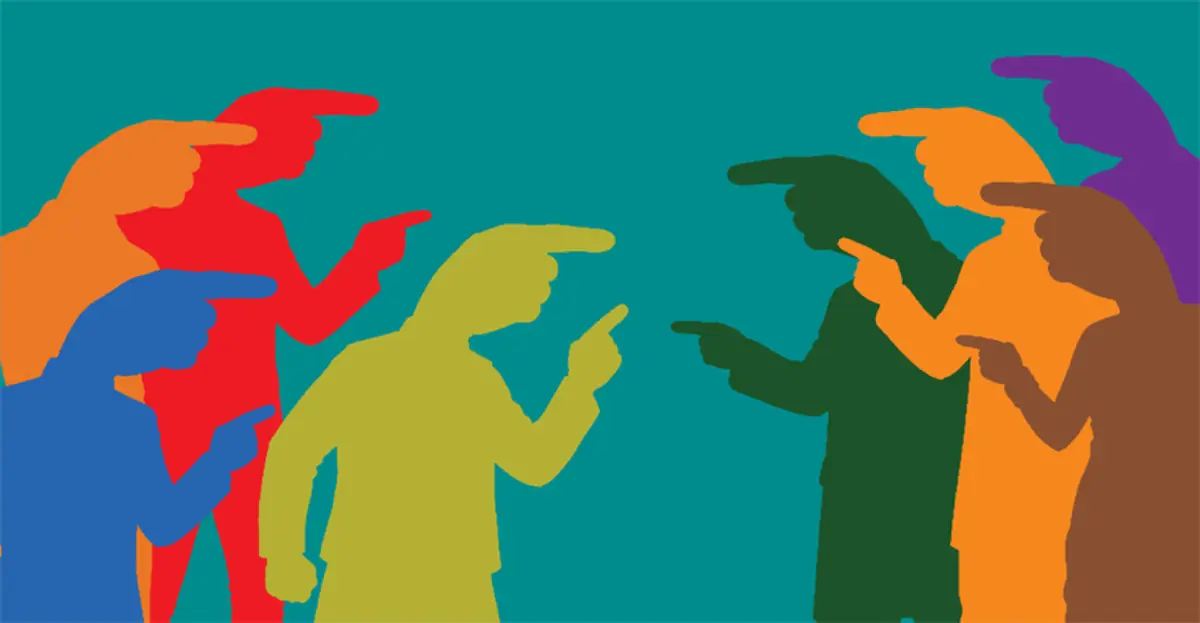
Research by groups such as the American Psychiatric Association and the non-partisan organisation More in Common shows that roughly one in five Americans now experience family break-ups directly caused by political arguments. What used to be a dinner table debate over taxes, foreign policy or governance has turned into a bitter clash over morals.
At the heart of this shift is what American political scientist Shanto Iyengar calls “affective polarisation.” In his research on group identity and party loyalty, Iyengar shows that political loyalty has largely replaced religion, social class and neighbourhood as the main way people define their ‘tribe’ and/or community.
Building on Polish social psychologist Henri Tajfel’s social identity theory, multiple researchers posit that when a political party becomes tied to peoples’ core identity, they stop seeing political opponents as fellow citizens who simply hold different opinions. Instead, opponents are treated like a hostile enemy group, whose very existence threatens one’s way of life. When a relative votes for an opposing leader, it is no longer seen as a simple political choice, but as a betrayal.
In 2024, when my brother and I voted for a party that most of our relatives opposed, we faced plenty of passive-aggressive hostility from them. But thank heavens, none of them boycotted us, even though sometimes we felt they were about to. It was baffling, really. Turning politics into a test of personal morality has slowly changed how we view family duty. American psychologist Joshua Coleman notes that a person’s political views today are treated as a direct reflection of their character.
For many anti-Trump individuals, a relative’s support for a populist movement is not seen as a standard conservative or economic choice but as an act of supporting policies that harm vulnerable people or weaken democracy. On the flip side, conservatives associated with populist movements often see opposing views as a direct attack on decency and morality and as support for undemocratic policies. In both cases, staying close to a relative who disagrees starts to feel like accepting bad behaviour or betraying one’s principles.
Making matters worse is the way modern media and social platforms work. Researchers have long pointed out that social media algorithms trap users inside information bubbles, where relatives living under the same roof may end up seeing completely different sets of ‘facts’. When family members cannot even agree on basic reality, whether it is a viral traffic crash in Karachi or an election result in Washington, having a sensible conversation becomes nearly impossible.
The internet offers a quick, easy replacement for a real-life family. Research by American psychologist Molly Crockett shows that social media algorithms actively reward expressions of moral outrage with likes, shares and social approval. Filming and posting a public attack on a “toxic” parent or an “unpatriotic” cousin, lowers the personal cost of family conflict and gets instant applause, online attention, and validation from a chosen family on the internet made up of likeminded strangers.
To paraphrase Coleman, politics now acts like fuel poured on to older, hidden family tensions. When families already lack mutual respect or healthy ways to handle disagreement, harsh political language gives them a socially acceptable excuse to vent years of built-up anger.
What we are seeing online, from bitter comment sections in Pakistan to viral Thanksgiving boycotts in the US, is what political sociologists describe as the slow breakdown of the wall between public politics and private family life. When politics stops being something we simply do and becomes everything we are, even blood ties are no longer strong enough anymore to survive the results of an election.
Published in Dawn, EOS, November 29th, 2026
The post SMOKERS’ CORNER: WHEN THE POLITICAL IS PERSONAL appeared first on Dawn – Home.
