
• From $1.3 billion in FY24-25, bilateral trade has fallen to a little over $350 million in FY25-26
• Traders call for balancing security and commerce needs
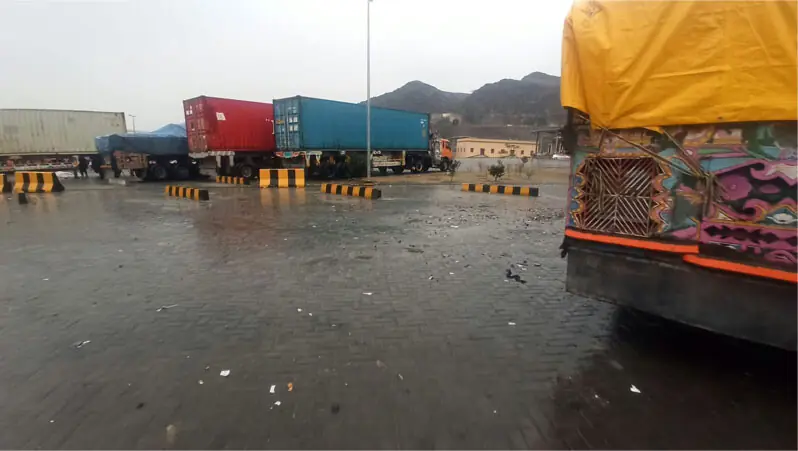
PESHAWAR: The sprawling terminal at Torkham, built at the cost of several billion rupees, wears a deserted look as a protracted conflict continues to overshadow trade ties between Pakistan and Afghanistan.
Islamabad remains adamant that there can be no engagement with Kabul without tangible action against terrorists operating from its soil, but the relationship remains in suspended animation due to the intransigence of the Taliban regime.
Industries in Pakistan, especially transport and pharmaceuticals, have been facing heavy losses since the border closed on Oct 12, 2025, following deadly clashes between the two countries.
Besides Torkham, other border crossings, including Kharlachi, Ghulam Khan and Angoor Adda in Khyber Pakhtunkhwa and Chaman in Balochistan, have also remained closed for all kinds of trade.
Figures released in July showed that Afghan Transit Trade, which stood at nearly 89,000 containers valued at $5 billion before the return of the Taliban, had plunged to just 11,592 containers worth $367 million in the outgoing fiscal year.
According to data on bilateral trade, released by the Trade Development Authority of Pakistan (TDAP) earlier this year, Pak-Afghan trade witnessed a drop of 74pc in the last fiscal, from one year prior. Figures show that bilateral trade fell from $1.3bn in 2024-25 to $358m in 2025-26.
A 95pc decline was recorded in bilateral trade in 2026-27 compared with the previous year, according to the TDAP figures released in August.
Pakistani exports to Afghanistan include pharmaceutical products, cement, plastics, rice, fruits and vegetables among others, while major imports include onions, tomatoes, seeds, grapes, dried apricots, apples, coal, and unwrought lead.
Junaid Altaf, a former president of the Sarhad Chamber of Commerce and Industry (SCCI), said the business community of Khyber Pakhtunkhwa endured increasingly difficult economic challenges due to the prolonged closure of the Pak-Afghan border.
“For a province already facing structural economic disadvantages, the closure has not merely disrupted a trade route, it has further weakened the economic opportunities on which its businesses, workers and border communities depend,” he deplored.
Mr Altaf said that unlike Karachi and Lahore, Peshawar and the rest of KP faced higher logistics costs for many manufacturing and trading activities.
“Being far from seaports and major international shipping gateways adds to the cost of importing raw materials, transporting them to factories, manufacturing finished products and subsequently distributing those products across Pakistan or exporting them to international markets.”
Against this backdrop, the Pakistan-Afghanistan trade corridor has historically represented a major economic opportunity for KP, he said, highlighting the potential of KP to become a stronger pharmaceutical production and export centre.
The pharmaceutical sector accounted for approximately $130m in exports to Afghanistan in FY23-24, according to the Pakistan Bureau of Statistics. This figure illustrates that the loss of access to the Afghan market is a significant commercial setback with implications for production, investment and employment.
Saying that the KP business community deserved a clear and sustainable way forward, Mr Altaf suggested that the objective should not be trade at any cost, nor should it be indefinite economic isolation.
“It should be secure borders, regulated trade, competitive industry and shared prosperity,” he opined.
Malik Sohni, president of the All Pakistan Agricultural Produce Traders Federation, said that Afghanistan was a huge market for Pakistani potatoes. Up to 50 trucks carrying potatoes used to cross into Afghanistan daily, while 25 trucks of green vegetables also passed daily, he said, adding that the border closure badly hit the potato market, reducing crop cultivation by almost half.
“Potato prices will go up in the coming months as demand will rise against limited supply,” Mr Sohni feared.
He claimed that he faced a loss of Rs180m when potato prices crashed after the sudden flare in hostilities. He added that the border closure also affected Pakistani exports to Central Asia.
Besides exports and imports, a large number of people from across KP, particularly in Khyber, have been associated with the transport business and they have fallen on hard times as well. Azeemullah, a transporter, said that due to the prolonged border closure, he had to sell three of his five trucks.
“The transport sector of KP is nearly ruined,” he lamented, adding that diverting these trucks to other parts of the country was not economically viable.
However, Fuad Ishaq, a Peshawar-based businessman and former president of the SCCI, held different views.
“I am of the view that we cannot compromise our security for just $800m in trade a year.”
He said Afghanistan had a 45m population, roughly the same as KP, and the items normally exported there could be directed somewhere else. He claimed that cutting off ties with Afghanistan also reduced the burden on hospitals and schools in Pakistan, which he described as a positive development.
“We should have trade, but security comes first,” Mr Ishaq stressed.
Published in Dawn, October 19th, 2026
The post The commercial cost of Afghan intransigence appeared first on Dawn – Home.
