Perhaps the most successful political trick that’s been played in Pakistan has been to make people believe that survival is a personal responsibility.
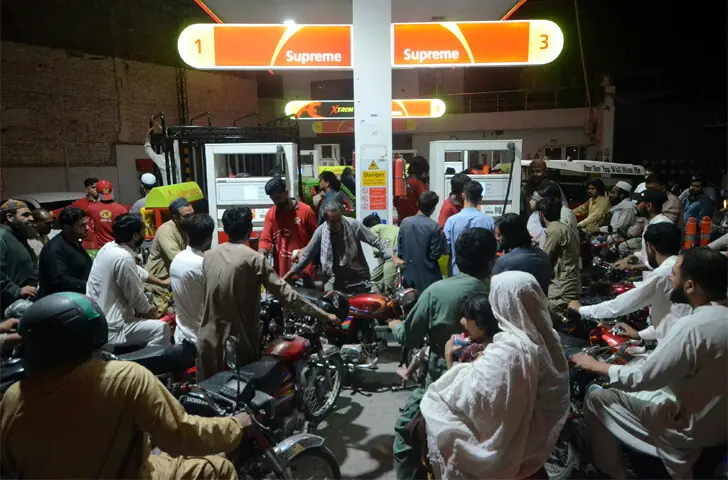
When electricity becomes too expensive, a household is told to consume less. When the petrol rate rises, people are advised to travel carefully. When food prices climb, families are expected to adjust their kitchens. When water does not arrive, those who can afford it arrange a tanker. When public hospitals fail, people find a private doctor. When public schools fail, they pay for a private one.
The citizen is continually asked to become more economical, more patient, more resilient, as though the country’s economic problems begin and end inside the household. This is how a political failure becomes a private inconvenience.
And perhaps this is why the Pakistani middle class is so difficult to see. It is not poor enough to be counted among those who require immediate relief, nor wealthy enough to escape the consequences of a failing public system. It works, pays taxes, sends children to school, pays its bills and keeps going. Its hardship rarely arrives as a dramatic collapse.
Pakistan’s middle class is being squeezed, not just by inflation, but by the growing cost of privately securing the essentials for an ‘ordinary’, everyday life. As electricity, water, education, healthcare and transport become increasingly expensive or unreliable, households are repeatedly told to adjust and become more resilient, turning what should be political questions into private calculations
It appears instead as a gradual narrowing of life: the savings that do not accumulate, the treatment that is postponed, the house that remains rented, the child whose education becomes a financial calculation, the young graduate who begins to regard departure from the country as an economic necessity rather than a choice.
There is something politically disturbing about this quietness.
We have become accustomed to discussing the cost of living as though it were the weather: unpleasant, unavoidable and beyond anyone’s control. Yet, prices are not weather. Tariffs are not weather. Taxes are not weather. Public expenditure is not weather. They are decisions made by governments, negotiated with institutions, shaped by powerful interests and ultimately paid for by citizens.
Pakistan’s latest household data makes the contradiction difficult to ignore. The Pakistan Bureau of Statistics reports that average monthly household income from 2024-25 was Rs82,179, against an average monthly consumption expenditure of Rs79,150. The margin is scarcely Rs3,000.
That is not a measure of poverty in itself, and national averages conceal enormous differences between households, but it tells us something about the fragility of ordinary life.
Once the month’s necessities have been paid for, there is very little room left for the future. A medical emergency, a period of unemployment, a rise in school fees or a major household repair can turn a seemingly stable family into a borrowing family with remarkable speed.
Yet, we continue to call this class ‘secure’. But ‘secure’ against what?
The Pakistan Bureau of Statistics reports that average monthly household income from 2024-25 was Rs82,179, against an average monthly consumption expenditure of Rs79,150. The margin is scarcely Rs3,000. That is not a measure of poverty in itself, and national averages conceal enormous differences between households, but it tells us something about the fragility of ordinary life. Once the month’s necessities have been paid for, there is very little room left for the future.
WHEN PUBLIC FAILURE BECOMES PRIVATE COST
The question becomes more serious when the costs of the things a household cannot reasonably live without are considered.
Electricity, for example, has become one of the most politically revealing household expenses in the country. Pakistan’s power sector remains burdened by circular debt, inefficient distribution and costly generation, while consumers are repeatedly asked to absorb the consequences through tariffs and surcharges.
In February 2026, Reuters reported that proposed changes to the tariff structure under Pakistan’s International Monetary Fund (IMF) programme could place a substantially greater burden on middle-income electricity consumers, with analysts warning of sharp increases for some households, even as industrial users were considered for lower rates.
The significance of this is larger than the bill itself. Electricity is now woven into the ordinary conditions of life: cooling a room through an increasingly severe summer, preserving food, pumping water, working from home or studying after dark. To tell a household simply to consume less is to overlook the fact that the modern household has been built around electricity.
Therefore, the question is not only how much electricity people use, but why the cost of using an essential public service has become a recurring source of economic insecurity.
Water carries the same contradiction in a different form. Karachi, a city whose relationship with water has been shaped by shortage, unequal distribution and a large tanker economy, offers perhaps the clearest example of what happens when a public necessity becomes a private purchase.
Research by the International Growth Centre found that Karachi households spent an average of roughly Rs2,500 a month on domestic water and another Rs736 on drinking water, with the burden falling proportionately more heavily on lower-income households.
The city has effectively developed parallel systems of provision: one for those connected to reliable infrastructure and another for those who can purchase their way around its absence.
The political absurdity is easy to miss because it has become ordinary. A citizen can pay for a public service through taxes and charges and then pay again when that service does not reach the household.
The wealthy can absorb the second payment. The poor may not be able to make it at all. The middle class occupies the uncomfortable space between the two, able to purchase some private substitutes but increasingly unable to do so without sacrificing something else.
THE MIDDLE CLASS VS THE STATE
This is where the question of the middle class stops being a question about comfort and becomes a question about the state. If a family must privately secure its water, education, healthcare, transport and electricity, what exactly remains of the public contract for which it continues to pay taxes?
And if the state responds to these failures by asking households to become more resilient, more careful and more self-reliant, at what point does self-reliance become another name for abandonment?
The poor, of course, have even less room to escape. This is the part of the conversation that must not be lost. The middle class may complain about the electricity bill, but a poor household may be deciding whether it can pay it at all. A salaried family may move its children to a cheaper school, while another family may have no school to move them to.
The World Bank estimates that around 22.5 percent of Pakistan’s population remained below the national poverty line in fiscal year 2025, while millions more remain vulnerable to falling back into poverty when faced with inflation, illness, unemployment or another economic shock.
So, the question is not whether the middle class is suffering more than the poor. It is whether the suffering of the middle class is a warning about what is happening further down the economic ladder. If a person with a regular salary is struggling to maintain what was once considered an ‘ordinary’ standard of living, what does that tell us about the person without a regular salary?
And if the answer is that the poor will be protected through welfare programmes, then another question follows: why must the state first make basic life unaffordable and then offer assistance to help people survive the unaffordability it has helped create?

THE POLITICS OF MAKING THINGS ‘NORMAL’
This is where our politics deserves much more scrutiny than it receives.
For generations, Pakistani governments have spoken to citizens in the language of necessity. “Roti, kaprra aur makaan [food, clothing and shelter]” remains one of the country’s most enduring political phrases because it promises the minimum conditions of dignity. But perhaps the country has reached the point where even the meaning of that promise needs to be questioned.
What does roti mean when the electricity required to refrigerate food becomes expensive? What does makaan mean when a house without reliable water, sanitation, transport and electricity is hardly a secure home? What does education mean when a family can afford the degree but not the economic future that was supposed to follow it?
The slogans have remained remarkably durable. The conditions they describe have not.
And maybe this is why the conversation so often remains behind closed doors. People know the system is failing them in small, expensive ways, but they have been taught to experience each failure individually. The electricity bill is a household problem. The water shortage is a neighbourhood problem. The petrol price is a transport problem. The school fee is a family problem. The hospital bill is a personal problem. Once everything has been divided into private problems, the political question disappears.
The German political theorist Karl Marx, writing in a very different century and a very different society, understood the importance of that disappearance. In The German Ideology, he and Friedrich Engels wrote that the ideas of the ruling class tend to become the ruling ideas of an age.
Marx was not writing about Pakistan and his 19th century categories cannot simply be placed over contemporary Pakistani society. But his larger question remains useful: who has the power to decide what becomes normal? Perhaps we should ask that every time we are told that another increase is ‘unavoidable’.
Who decided that electricity must cost this much? Who decided which sectors could be protected and which households could absorb the burden? Who decided what should be taxed and what should remain difficult to tax?
Who decides whether development spending is sufficient, whether public transport deserves investment, whether water infrastructure can remain inadequate, whether healthcare should be largely privatised through necessity?
These are not acts of nature. They are choices. And choices can be questioned.
POLITICS, PRICES, POWER
That is what makes the present condition more troubling than inflation alone. We have not merely become accustomed to expensive life — we have become accustomed to the idea that there is nothing political about its expense.
We discuss bills but not the decisions behind them. We debate prices but rarely the distribution of power that produces them. We complain about governments, yet allow the same fundamental questions to disappear beneath the familiar language of crisis management, economic adjustment and national sacrifice. The question Pakistan needs to ask is not simply how much more the middle class can bear. It is why it is being asked to bear it at all.
The answer is uncomfortable because it takes us beyond the familiar language of economic crises and towards the question of power. Pakistan is not simply a country where there is too little money. It is a country where money, opportunity and protection are distributed unevenly, and where the ability to avoid a crisis often depends on the ability to pay for an alternative.
The wealthy household does not experience a power outage in quite the same way as a salaried household, because it can invest in solar energy, generators and battery storage. It does not experience a water shortage in quite the same way because it can buy water tankers, install filtration systems and maintain underground storage. It does not experience the collapse of public healthcare or education in quite the same way because it can move into private systems.
This is not an argument against private wealth. People naturally use their resources to protect themselves. The political problem begins when private protection becomes the only reliable protection available. A state can tolerate inequality in income, but it cannot afford to allow inequality in access to the basic conditions of citizenship to become permanent.
A SECOND TAX
The tax system makes this division even more visible. Pakistan needs taxation and it needs much more of it if it is to finance development without repeatedly returning to external lenders. The problem is not that citizens should not pay. The problem is that the ease with which different citizens can be taxed is itself unequal.
The salaried worker has little room to disappear from the tax system. Income is documented, deductions can be made at source and the state knows where to find him. A formal business faces similar visibility.
Large areas of economic activity, however, remain difficult to document and tax effectively. This has created a peculiar bargain, in which those who are easiest to identify can find themselves carrying a disproportionate share of the formal burden.
The result is not simply resentment about taxation. It is the feeling that the state has become very efficient at finding the people who are already inside its system while remaining much less capable of bringing everyone else into it.
This matters because taxation is ultimately a question of trust. People are more willing to pay when they can see the relationship between what they contribute and what the state provides. In Pakistan, that relationship has weakened.
A salaried household may pay income tax and still send its children to private schools because it does not trust the public alternative. It may pay for private healthcare because a public hospital cannot provide timely treatment. It may purchase bottled water because the line supply is unreliable. It may spend on private transport because the public system cannot connect home to work in a reasonable amount of time. It may install solar panels because electricity prices have become difficult to manage.
None of these expenditures is technically another tax. Together, however, they resemble a second tax: the cost of purchasing privately what citizens expect a functioning public system to provide.
This is also why the debate about the middle class should not be reduced to whether people are living beyond their means. There is certainly unnecessary consumption and there are households that spend beyond what they can afford. But it is too convenient to explain a structural problem through individual financial discipline.
A family cannot budget its way out of an electricity tariff. It cannot save its way out of a shortage of public transport. It cannot become sufficiently frugal to make an unreliable water system reliable. The idea that every household can solve these problems privately is attractive because it places responsibility exactly where it is easiest to place it: on the individual. But a society built around private solutions eventually becomes a society in which citizenship itself is measured by purchasing power.

THE FUTURE IS BECOMING A CALCULATION
This becomes particularly serious for younger Pakistanis. The middle class once carried an expectation that each generation would move forward: parents would educate their children, children would obtain better employment, and the next generation would live with greater security than the one before it.
That expectation is becoming harder to sustain. Young people are entering a labour market in which education does not necessarily guarantee economic independence, while housing costs and everyday expenses make it increasingly difficult to establish an independent household.
For many, migration is no longer simply an aspiration. It becomes a calculation. The question is not whether life abroad will be easier in every respect, but whether the relationship between income and possibility makes more sense somewhere else. When an educated young population begins to imagine its future primarily outside the country, the loss is not only personal. It is an economic and political loss for the country that educated it.
The irony is that the state continues to speak about the demographic strength of Pakistan. A large, young population is repeatedly described as an opportunity, a potential workforce and a source of future growth. But a young population becomes an economic asset only when the economy can give it productive work, useful education and a reasonable prospect of building a life.
Otherwise, population becomes another pressure on households already struggling to maintain themselves. The question is not simply how many young people Pakistan has. It is what kind of future Pakistan is capable of offering them.
The same contradiction can be seen in the language of development. Economic growth is necessary, but growth measured through aggregate numbers does not automatically tell us whether ordinary people are becoming more secure.
A country can record higher exports, improved foreign reserves or a declining inflation rate while households continue to feel that their lives are becoming more difficult. Macroeconomic stability matters enormously — without it, the consequences can be even worse.
But stability cannot become the final definition of economic success. A stable economy in which the ordinary citizen remains unable to afford decent housing, reliable transport, healthcare, education and energy is stable only in the narrowest technical sense.
This is perhaps where the political argument needs to become more demanding. Governments should not only be asked whether inflation has fallen, whether the deficit has narrowed or whether foreign exchange reserves have improved. They should also be asked what these improvements have meant inside households.
And this returns us to the poor. If the middle class is increasingly spending its income simply to maintain a basic standard of living, then the question of redistribution becomes unavoidable. Pakistan cannot address poverty only by giving money to poor households while leaving the underlying cost of living untouched.
Social protection is essential and programmes such as the Benazir Income Support Programme (BISP) provide an important safety net to millions of families.
But a cash transfer can help a household buy food; it cannot by itself create a functioning water system, a reliable electricity network, a good public school or a productive labour market. Welfare can protect people from the worst consequences of poverty, but it cannot substitute for an economy and public institutions that allow people to escape poverty.
This is where the old political promise of roti, kaprra aur makaan begins to look inadequate for the present. The promise was never merely about three objects. It was about dignity and security. But dignity now depends upon systems that did not occupy the same place in political language decades ago.
A home without water and electricity is not secure shelter. Food becomes more expensive when transport and energy become expensive. Education cannot fulfil its promise if the economy cannot provide employment to the people who obtain it. Healthcare is not meaningful as a right if illness can push a family into debt. The minimum conditions of a decent life have expanded, even if our political vocabulary has not.
There is a political danger in this. A society can survive poverty for a long time because poverty is often experienced as a condition that has always existed. It is much harder to sustain a society in which people who believed themselves secure begin to lose faith in the possibility of remaining secure.
The middle class has traditionally been one of the strongest believers in institutions. It believes in education, employment, law, property, taxation and the promise that effort should produce some degree of stability. If that belief weakens, the consequences extend beyond household budgets. People begin to look elsewhere for security: in private networks, family wealth, migration, patronage or political identity. The public system becomes something to navigate rather than something to trust.
THE LIMITS OF ‘RESILIENCE’
This may explain why so many economic conversations in Pakistan take place behind closed doors.
It is not that people do not know what is happening. They know very well. They know when their bills rise, when their children’s school fees increase, when the price of food changes and when their salary no longer carries the same value. What is missing is the transformation of that private knowledge into a public demand.
We have normalised the idea that every household must solve its own version of the national crisis. The wealthy solve it with money. The middle class solves it with adjustment. The poor solve it with sacrifice. But none of these is a substitute for political accountability.
A country cannot ask its citizens to be endlessly adaptable while its institutions remain unchanged. At some point, resilience becomes an excuse for the absence of reform.
The ability of Pakistanis to endure difficult conditions has often been celebrated as a national virtue, but there is something dangerous about celebrating endurance without asking what people are being forced to endure and who has the power to change it. A citizen should not have to become extraordinarily resilient simply to live an ordinary life.
That is perhaps the question that should sit behind every budget, every tariff notification and every political speech: what kind of life are we asking people to finance?
If the answer is a life in which the middle class works primarily to pay for necessities, the poor remain dependent on assistance and the wealthy can increasingly purchase their way around public failure, then economic growth alone cannot be the measure of progress. The country may continue to move forward on paper while its people feel that they are standing still.
And this is where the political argument finally becomes unavoidable. The issue is not whether one government is responsible for every problem, nor whether one political party can repair decades of structural weakness. It is whether citizens have become so accustomed to adjusting themselves to the failures of the system that they have stopped asking the system to change. The electricity bill is then no longer a political document; it is simply something to be paid.
Perhaps this is the real political problem of the Pakistani middle class. It is not merely that it is being squeezed, it is that it is being taught to experience the squeeze privately.
Until these private calculations become public questions, the burden will continue to move quietly from one household to another, from the middle class to the poor and from one generation to the next. The country will continue to debate which government is better at managing the crisis, while far fewer people ask why ordinary citizens have been made responsible for managing it at all.
The writer is a researcher whose work centres on cultural critique and social realities.
She can be contacted at hamnasyed66@gmail.com
Instagram: @hamnsyed
Published in Dawn, EOS, September 20th, 2026
The post THE QUIET DESPERATION OF PAKISTAN’S MIDDLE CLASS appeared first on Dawn – Home.