

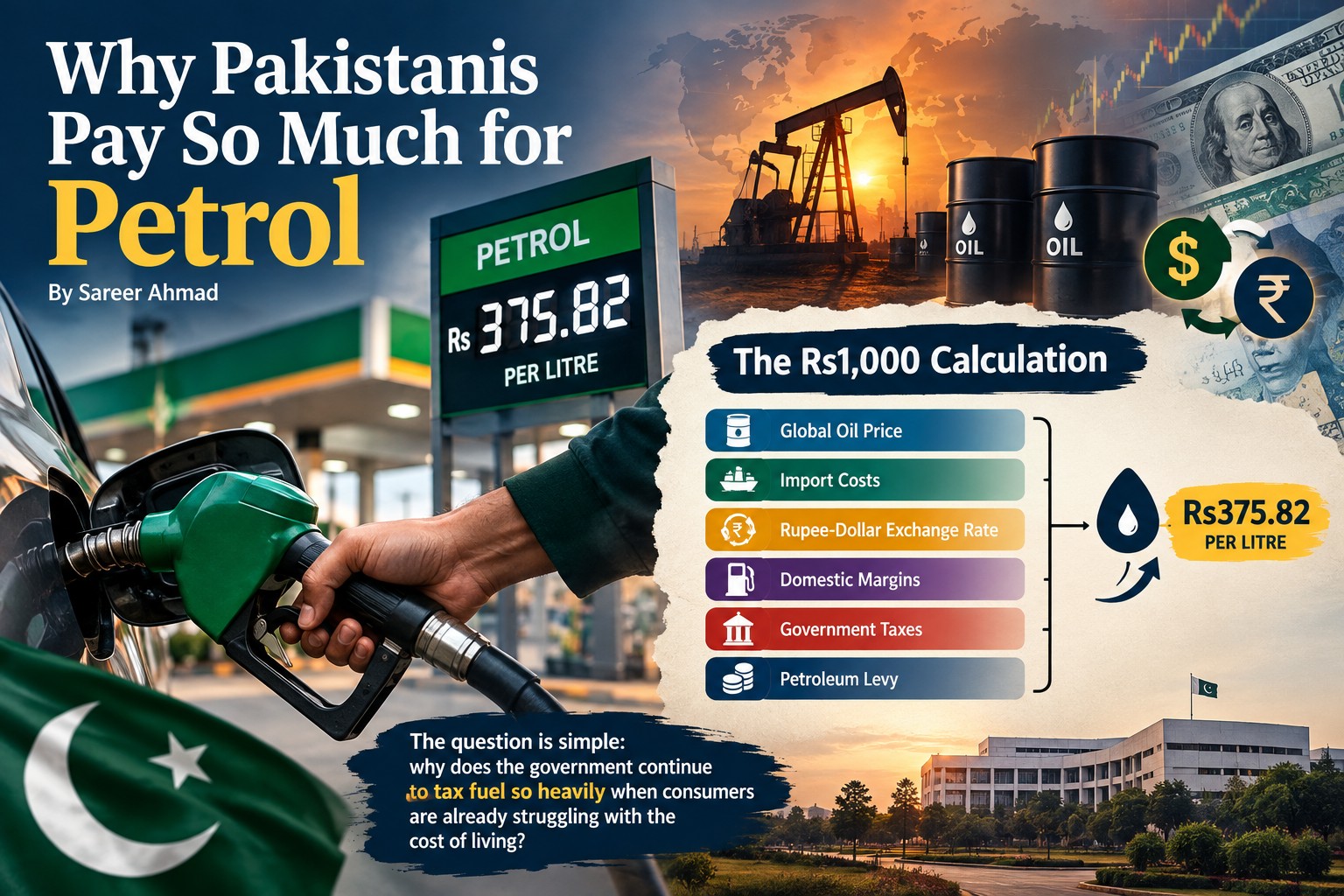
By Sareer Ahmad
Pakistanis are paying Rs375.82 for a litre of petrol, but the international price of oil is only part of the story.
The global oil market, the rupee-dollar exchange rate, import costs and domestic margins all influence the price. But so do government taxes and the petroleum levy — a major source of federal revenue.
The question is simple: why does the government continue to tax fuel so heavily when consumers are already struggling with the cost of living?
The Rs1,000 calculation
At the current price of Rs375.82 per litre, a consumer spending Rs1,000 buys:
Rs1,000 ÷ Rs375.82 = 2.66 litres
The government has stated that taxes and duties on petrol are around Rs114 per litre.
Therefore, on 2.66 litres:
2.66 × Rs114 = approximately Rs303
So, using the government’s Rs114-per-litre figure, roughly Rs303 of a Rs1,000 petrol purchase represents taxes and duties.
The remaining approximately Rs697 covers the fuel itself and other components such as import and freight costs, margins and related charges.
This is an illustrative calculation, not a claim that Rs303 is all petroleum levy. The Rs114 figure refers to government taxes and duties collectively; the precise composition changes according to the official pricing notification.
That distinction matters.
Why does the government need the levy?
The answer is straightforward: revenue.
Pakistan’s government needs money to finance debt servicing, defence, salaries, pensions, development and other expenditures. But the country’s tax base remains relatively narrow, making petroleum products an attractive source of revenue.
Fuel is particularly easy to tax. The government does not need to chase millions of individual consumers. The charge is collected through the petroleum supply chain and ultimately paid by consumers at the pump.
According to figures reported by the Pakistan Business Forum, the government collected around Rs1.567 trillion in petroleum levy during the last fiscal year — an average of approximately Rs130.6 billion a month.
For the current fiscal year, the petroleum-levy target is reported at around Rs1.638 trillion.
That makes the levy far more than a temporary charge.
It has become an important pillar of government revenue.
But consumers pay the price
The problem is that petroleum taxation is a consumption tax.
A wealthy car owner and a low-income motorcycle rider pay the same levy per litre.
If the government charge is Rs114 per litre, buying 10 litres means approximately Rs1,140 in taxes and duties, regardless of whether the consumer earns Rs40,000 a month or Rs400,000.
The burden, however, is obviously much greater for the lower-income household.
And the impact does not stop at the petrol station.
Higher fuel prices mean higher transport costs. Higher diesel prices increase the cost of moving food and goods, operating agricultural machinery and running construction equipment.
The result can be another round of price increases across the economy.
Pakistan cannot blame everything on oil
International oil prices matter enormously.
Pakistan imports much of its petroleum requirement and pays for it in US dollars. Therefore, when global oil prices rise, Pakistan’s import bill rises. When the rupee weakens, the same dollar-priced fuel costs even more in rupees.
But international prices do not determine the entire retail price.
The government also decides how much tax and levy consumers will pay.
That is why two countries facing the same global oil market can have very different petrol prices.
Why not abolish the levy?
This is where the government’s argument deserves consideration.
If Islamabad suddenly removed the petroleum levy, consumers would benefit immediately — but the government would lose hundreds of billions of rupees in revenue.
That money would then have to be recovered through higher income taxes, sales taxes, other levies, spending cuts or additional borrowing.
Borrowing to make petrol cheaper may provide short-term relief, but it does not eliminate the cost. It.